Gen Z and the search for faith: What new data reveals
A September 2024 article in the New York Times brought to light research and experience that indicated a renewed interest in religious affiliation by Gen Z men, roughly aged 13-28. While the article focused on the draw of evangelical Christianity for these young men and a subsequent move toward conservative political ideals, this data point falls in line with a larger trend: Gen Z’s increased interest in faith after years of decline.
This narrative is supported by writings from the conservative-leaning American Enterprise Institute and conclusions based on the Barna Group’s “State of the Church 2025” study, which cites an increase of 12 percentage points, from 54% to 66%, in Americans saying they’ve made a personal commitment to follow Jesus since 2021. Gen Z and Millennial men are driving this trend, reporting increases of 15% and 19% since 2019, with 67% of Gen Z men and 71% of Millennial men now saying they’ve committed to following Jesus. Most surprising to Barna researchers and other commentators is that, for the first time in recent history, Gen Z and Millennial men now outpace women in their stated commitment to Jesus – by 6% and 7% respectively – reversing a long-standing pattern in which women have consistently reported higher levels of church involvement and personal faith commitment.
Barna and Pew offer conflicting pictures of religious trends
A more granular and long-term study by the Pew Research Center provides better insight into gender and age trends, which shows a gender shift, but not a drastic increase in religious affiliation as Barna suggests. Pew’s data indicates the rate of those claiming no religious affiliation, known as “Nones,” is increasing faster for women than for men. At the same time, men claiming affiliation with mainline Protestantism have dropped nine percentage points over 17 years, while the same drop among women has been 6%. Among male and female evangelical Christians, participation has decreased by 2% across the same period. (Note: No data is provided in these reports for non-binary persons.)
Presbyterian membership: A closer look at the numbers
As for the ages of Presbyterian Church (U.S.A.) members, a detailed breakdown of membership along gender and age lines isn’t reported or available. However, the denomination’s most recent comparative summary of statistics shows church membership for those aged 25 and under holding steady at 11.2 percent since 2021.
The PC(USA) statistics are more in line with what Pew’s research shows. While there is a slight percentage increase in men affiliating with religious institutions in the recent past, there’s no significant numerical increase in this trend. In fact, the number of young people aged 18-29 who identify as Christian in the U.S. – including mainline and evangelical protestant, Black Protestant, Catholic and others – continues to decline: from 68% in 2007, to 55% in 2014, to 45% in 2024-25.
Ryan Burge, a political science professor at Washington University in St. Louis and curator of the popular substack newsletter Graphs About Religion, concluded in a June 26, 2025, posting, “[T]here’s just not nearly enough evidence in the data to point towards a revival [among Gen Z]. At least not right now.” At the same time, another of his postings shows younger men are attending church more regularly than younger women.
Beyond the data: How Gen Z is finding belonging in churches
That’s not to say there isn’t renewed interest by young people in many corners of the church, including the PC(USA). Although it may not yet be reflected in the denomination’s comparative summaries, some in the PC(USA) are seeing a renewed interest and church participation from Gen Z.
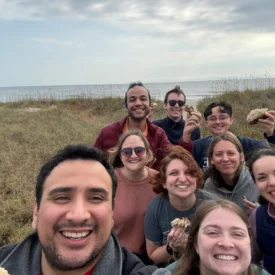
At First Presbyterian Church in Durham, North Carolina, a group known as the “somethings” (20-somethings, 30-somethings) has gained momentum over the last several years with the leadership of associate pastor Esther Hethcox. Through regular spiritual formation, personal outreach, book clubs, after-hours gatherings and seasonal studies, the group has grown to more than 50 people.
“It’s a beautiful community where all these people are finding joy and fellowship together,” she says. “It’s more about spiritual gatherings. That’s the gist I’ve been getting from a lot of young adults.”
“It’s a beautiful community where all these people are finding joy and fellowship together,” she says. “It’s more about spiritual gatherings. That’s the gist I’ve been getting from a lot of young adults.” — Esther Hethcox


Community, music and justice: What draws young Presbyterians back
Andy Skipper is part of the group and a resident in the Department of Radiology and Oncology at Duke University Hospital. A lifelong Presbyterian, he moved to Durham from Knoxville, Tennessee, but had stopped attending church during his college years. However, the demands of medical school and residency made him realize he was seeking something more.

“The real reason why I came back is I really just noticed I was missing the community,” he says. “And just talking with people my age about going through life and thinking about different perspectives on faith mixed with different careers.”
Emma Hayes found First Presbyterian of Durham through the church’s support of the non-profit that employs her. She grew up in the Church of Christ before leaving that setting and found the progressive message and broader acceptance in the somethings group refreshing.
“I moved here, and I got connected with Esther and really liked what they had going on,” she says. “I wouldn’t categorize myself as religious, but I like what this Presbyterian church is doing. And similar to what Andy said, looking for community is kind of what brings me back for sure. A lot of my friends would probably say the same thing.”
“The real reason why I came back is I really just noticed I was missing the community.” — Andy Skipper
Connection and community are recurring themes among both the research and those interviewed for this article. While the isolation of the pandemic may have played a role, with searching for meaningful community as a reaction, it doesn’t seem to be the driving factor in the return to church.
“For a lot of young adults, it is mainly community that really brings them, and they’re really yearning for something,” says Hethcox. “I think technology makes things hard. I think dating apps can make you feel like you’re an isolated person in society and the world, and it’s harder to connect with people.”
“I think technology makes things hard. I think dating apps can make you feel like you’re an isolated person in society and the world, and it’s harder to connect with people.” — Esther Hethcox
Tradition plays a role for some as well. Spencer Reeves is a 25-year-old lifelong Presbyterian who says he attends First Presbyterian of Durham not only for community but “for the organ music.”
Reeves regularly checks in on his peers, with Hethcox saying his pastoral presence is a blessing for the group. And Reeves also attends to be encouraged to act in the world. “Sometimes religion is at its heart political,” he says. “Christianity is founded on protests, and so in some ways I think certain things get said [at First Durham] that challenge the viewpoints being offered by the political party in office.”
Following college, Max Miller returned to his childhood church – First Presbyterian Church of Baldwin, New York. At 24, he says he’s the youngest person in the church by roughly 12 years. But as an active member and ruling elder, he feels he’s contributing to something bigger.
A hunger for meaning: How the PC(USA) can engage Gen Z
“No one has ever said, ‘He can’t say this or that,’” he said. “They know that I’m obviously younger, but I’ve been a part of the church for a long time, so I’ve seen all the changes. So I think there’s more of an aspect of respect. I never felt like, ‘Oh, I feel small,’ like my voice isn’t heard.”

As much as finding community and being part of something significant were factors in Miller’s return to church, he says worship and hearing messages of encouragement help him to prepare for times when “life can be difficult.”
“Obviously, things come up. You have stressful weeks,” he says. “It’s a great way to get prepared for an upcoming week. Being with people. It’s pretty simple. Worshipping Christ is an aspect of it for me, but I really enjoy the structure of it, being able to go and help out.”
Hethcox echoes the sense that there is a yearning for something bigger in the young people she has encountered. And she believes the church plays a role in meeting this need as it helps them relate to the world and to others around them.
“Some people really don’t know how the church has truly lined up with the teachings and views of Christ. And so, they want to learn about this Christ that we always talk about and how can I be a Christian and be queer; how can I be a Christian and be an ally; how can I be a Christian and advocate for justice?
“These values bring them to seek community,” says Hethcox. “And I think that’s all wrapped up in their spiritual hunger, why they might resonate with church, and it gets at how we can serve God together.”