In my childhood church, Reverend Dunkelberger’s booming voice commanded the pulpit. From our family’s usual pew, if I stared at him without blinking, a halo appeared around his head. Now, I know it was an optical illusion. At the time, however, it deepened my belief that he was saintly — a genuine man of God.
As a shy college sophomore, I began to sense the first stirrings of a call to ministry. But I was convinced I didn’t have what it took. I was too quiet, too awkward, not nearly holy enough. One weekend at home, I finally told my parents. My dad paused, set down his coffee mug, and said, “Maybe you should talk to Reverend Dunkelberger.” The idea terrified me. I barely spoke to him at church, and now I was supposed to confess my deepest insecurities?
Dad made the appointment anyway.
I sat nervously on the couch in my pastor’s office. “Your dad says you’re feeling called to ministry,” he began. I nodded and mumbled, “But I don’t think I’m a good enough person.”
He smiled and leaned back in his chair, and the stories began — about partying too hard in college, about the time he showed up to his Bible exam still hungover from his 21st birthday. All he managed to do was sign his name and walk out. “That C was generous,” he admitted with a grin. Story by story, he dismantled the pious pedestal I’d placed him on.
I left his office with something unexpected: confidence. If Reverend Dunkelberger, with his flaws and hangovers, could be a pastor, maybe there was room for someone like me, too.
Ministry takes many forms. Maybe it’s preaching. Perhaps it’s volunteering, teaching, organizing, editing, cleaning or caregiving. Whatever your calling, most of us face the same gremlins: self-doubt, inadequacy and the sinking suspicion that none of it matters.
After 27 years of ordained ministry – sermons preached, hospital visits made, youth retreats planned, worship and classes led – I still wonder: Was it enough? And then, every so often, something unexpected arrives. A note from a student thanking me for encouraging her faith. A word from a pastor who used the Outlook liturgy I wrestled to write. A young woman who found the courage to pursue ministry because I’d been the first female pastor at her church. Even a church member who once sent me an angry note about a sermon wrote back – 15 years later – to apologize and say that my sermon had been what she needed to hear.
Every time, I’m stunned. And I am reminded that God works through us — not because we’re perfect, but because God is faithful.
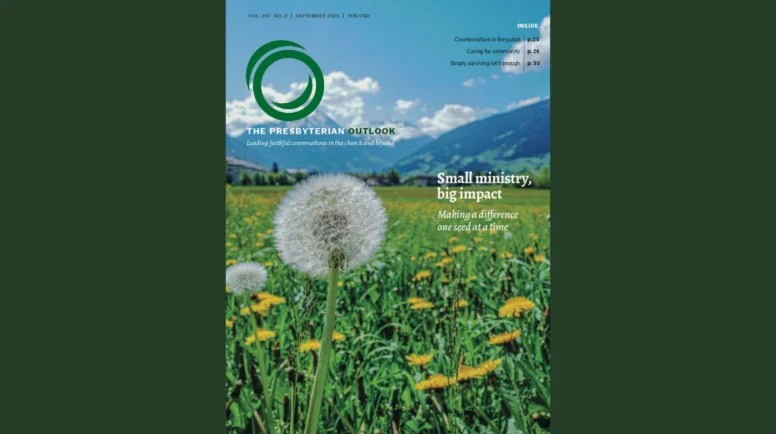
I recently saw a photo of a toddler, cheeks puffed, blowing on a dandelion, the seeds catching the light. Every floating seed was a small, potent possibility launched by a breath full of wonder. That’s what ministry looks like, too. Who knows where the wind of the Spirit will carry our small offerings? Who knows what might bloom?
Ministry isn’t about epic moments. It’s about the accumulation of tiny, often imperceptible seeds…
I wish I could say I never second-guess myself now, never stew over the smallness of my efforts. But I’ve come to believe that ministry isn’t about epic moments. It’s about the accumulation of tiny, often imperceptible seeds: a phone call answered at the right time, a joke in a sterile waiting room, a meal delivered to a doorstep. Real ministry is doing your best with what you have, trusting God to multiply it in ways you may never see.
Recently, I looked up Reverend Dunkelberger, who is now retired after 55 years in ministry. “Do you remember that conversation we had when I was feeling called?” I asked him.
“I do,” he said. “You just needed to be freed up.”
Now, he’s an Outlook subscriber. He’s also on my Christmas card list. In a follow-up email, he wrote, “You breathed a little life into an old, battered war horse.”
Ministry may batter and bruise us. But by the grace of God, seeds get planted – sometimes without us even realizing it – until someone calls 32 years later just to say thank you.
So, keep planting. Keep showing up. Our job isn’t to force the growth or measure the harvest. Our job is to trust that the God who called us, flaws and all, will do more with our offerings than we could ever imagine.