As a child of the 1980s, I grew up on syndicated reruns of “The Jetsons.” Hanna-Barbera’s futuristic counterpart to “The Flintstones” successfully predicted much of our everyday technology, including video calls, AI assistants and robotic vacuums. Where it succeeded in imagining tools, however, it failed spectacularly in imagining people. The future it offered was sleek and efficient — and stunningly homogeneous. There are no brown people. No people of color at all. Even the family android sounds White.
Acclaimed science fiction writer N.K. Jemisin writes about “The Jetsons” in her essay, “How Long ‘Til Black Future Month”:
“This is supposed to be the real world’s future, right? Albeit in silly, humorous form. Thing is, not-white-people make up most of the world’s population, now as well as back in the Sixties when the show was created. So what happened to all those people, in the minds of this show’s creators? Are they down beneath the clouds, where the Jetsons never go? Was there an apocalypse, or maybe a pogrom? Was there a memo? I’m watching the Jetsons, and it’s creeping me right the f*!$% out.”
That omission matters.
Science fiction writers have a name for the work of imagining futures: world-building. Before a story can unfold, writers carefully map geography, history, social structures and power dynamics.
But world-building is not just the work of fiction.
We are always constructing the world we inhabit — through our policies, our institutions, our habits, our silences, and our courage. Religion aids us in this work, proclaiming a vision of the world as God intends, and calling us to do the patient, difficult work of moving toward it. One such vision is Beloved Community.
In her 2017 memoir My Life, My Love, My Legacy, Coretta Scott King writes that Beloved Community is “a realistic vision of an achievable society, one in which problems and conflicts exist, but are resolved peacefully and without bitterness.” It is not a utopia. It does not deny conflict or suffering. Instead, it names a way of being together marked by hope, goodwill, and a commitment to justice that “transcends all boundaries and barriers and embraces all creation.”
Beloved Community is often misunderstood as a gathering of like-minded, likable people who get along easily. But Beloved Community includes opponents and enemies. It calls us not to humiliation, but to understanding; not to domination, but to dignity. It asks us to resist injustice through nonviolence, not because it is easy, but because violence leaves behind only bitterness, while nonviolence makes room for something new to grow.
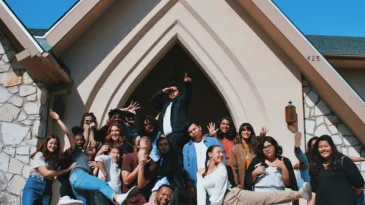
Unlike “The Jetsons,” Beloved Community envisions a world that “transcends all boundaries and barriers.” A table at which everyone – even creation itself – has a seat.
Is that “realistic,” as King says?
Today, with all our polarization, Beloved Community feels impossible. But Coretta Scott King did not speak from a place of naïveté. She lived with death threats, surveillance, grief and exclusion. She led in a male-dominated world that discounted and dismissed her as a Black woman. She knew the cost of the vision she named. And still, she called Beloved Community “achievable.”
Imagination is not neutral. The futures we fail to imagine have consequences — and so do the futures we dare to claim.
Beloved Community is not wishful thinking. It is a moral compass. It gives us direction when the path is unclear and reminds us who belongs, when fear tempts us to draw smaller circles. To call it realistic is to insist that exclusion is not inevitable, cruelty is not necessary, and division is not our destiny.
The question before us is not whether we will participate in world-building. We already are. The question is whether the future we are building now will reflect what we are able to envision and willing to protect. If we love justice, inclusion, and peace, then those commitments must shape our policies, our churches, our neighborhoods. Beloved Community must be built – carefully, imperfectly, faithfully – by people who trust that love still has creative power.