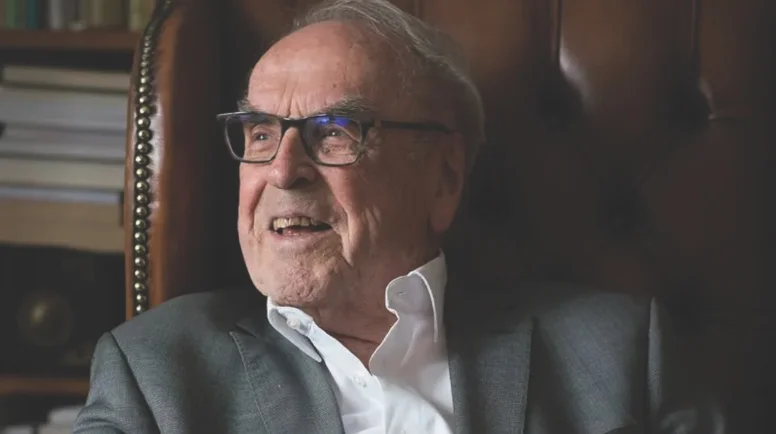
More than a year after Jürgen Moltmann’s death at age 98 on June 3, 2024, the time is ripe to reflect on the work and legacy of one of the most influential Reformed theologians of the 20th century.
Early life and theological formation
Jürgen Moltmann was born into a non-religious family in 1926 in Hamburg, Germany. During World War II, he was drafted into the German military and was assigned to defend his hometown from Allied air raids. According to his own recollection, God entered his life one night when an explosive bomb hit the platform where he stood with a close friend. The bomb tore his friend apart while leaving Moltmann miraculously unharmed.
“During that night,” Moltmann wrote in his 2009 book A Broad Place: An Autobiography, “I cried out to God for the first time in my life and put my life in his hands.” As God entered Moltmann’s life, so did theological struggles. In the book he observed, “My question was not, ‘Why does God allow this to happen?’ but, ‘My God, where are you?’ And there was the other question, the answer to which I am still looking for today: Why am I alive and not dead, too, like the friend at my side?”
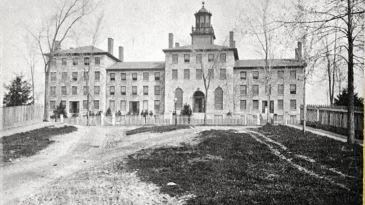
Toward the end of the war, Moltmann was captured by Allied forces. An American chaplain gave him a Bible in a prisoner of war camp in Belgium — an encounter with Christianity that changed his life forever. After the war, Moltmann studied theology at the University of Göttingen, learning from eminent systematic theologians Hans Joachim Iwand, Ernst Wolf and Otto Weber, as well as biblical scholars Günther Bornkamm, Joachim Jeremias and Gerhard von Rad. Under Weber’s supervision, Moltmann wrote his dissertation on the Reformed theologian Moyse Amyraut (1596–1664). In 1957, having completed a pastoral internship in a congregation in the northern German city of Bremen-Wasserhorst, Moltmann finished his Habilitationsschrift (the highest university decree) on reformer Christoph Pezel (1539–1604).
The first trilogy
In 1964, Moltmann’s theological breakthrough happened with the publication of his Theology of Hope: On the Ground and the Implications of a Christian Eschatology. Alongside Wolfhart Pannenberg, among others of his generation, Moltmann departed from the influence of European existentialism on Christian theology in Germany and of the Word-of-God theologies of Karl Barth and Rudolf Bultmann.
As Moltmann later explained in “The Adventure of Theological Ideas,” a 1996 article in Religious Studies Review, “We rediscovered the dimensions of real history,” where “‘history’ was just another word for the ‘crisis’ of social, political, and cultural institutions.” At the heart of this reorientation toward history was his rediscovery of eschatology.
For Moltmann, God’s reign is not just beyond time. It enters history from the future: what he then called an adventus or, much later, the coming of God, pulling history forward and transforming it. “From first to last, and not merely in the epilogue,” Moltmann declares in Theology of Hope, “Christianity is eschatology, is hope, forward looking and forward moving, and therefore also revolutionizing and transforming the present.”
“Christianity is eschatology, is hope, forward looking and forward moving, and therefore also revolutionizing and transforming the present.” — Moltmann
In Theology of Hope, Moltmann sought a theological response to The Principle of Hope, by Marxist philosopher Ernst Bloch. Still, Moltmann’s intent was much greater. As he later explained in “The Adventure of Theological Ideas,” he had set out to present “Christian eschatology as an active doctrine of hope”: “to criticize current social, political, and ecclesial conditions and to give hope for an alternative future to the oppressed and suffering of our present time.”
Moltmann argued that Christian eschatology is not about escaping present suffering but rather about injecting hope for the here and now. This hope arises from God’s future breaking into the present to renew, reshape and transform this world and to propel the faithful to participate in this transformation. If the eschaton is not above and beyond – not a hereafter – but instead meets humanity from God’s future, then Christian theology must not reduce redemption to privatized salvation or postpone it into an otherworldly eternity.
Moltmann argued that Christian eschatology is not about escaping present suffering but rather about injecting hope for the here and now.
For Moltmann, God’s ever newly creating love sends believers back into the world to participate in its transformation. Because God is at work in the world, the faithful live out of hope for the future and become restless in the face of the suffering and injustices of the present.
Moltmann’s eschatological turn toward the inbreaking of God’s future inspired theologians worldwide and prompted some of the most significant theological debates in the second half of the 20th century. In Germany, Moltmann and his Catholic colleague and friend Johann Baptist Metz provoked the development of a new political theology. On the Western side of the Atlantic, Moltmann influenced Black theologian James H. Cone and Latin American liberation theologians such as Gustavo Gutiérrez, Jon Sobrino, José Miguez Bonino and Leonardo Boff. In Korea, many consider Moltmann the spiritual godfather of minjung theology. As Moltmann later acknowledged in “The Adventure of Theological Ideas,” ever again, hope emerged “as the motivating force behind liberation in this world.”
Theology of Hope offered not simply a new kind of eschatology but a distinctive theological approach. In that book and the two that followed – The Crucified God: The Cross of Christ as the Foundation and Criticism of Christian Theology (1972) and The Church in the Power of the Spirit: A Contribution to Messianic Ecclesiology (1975) – Moltmann “employed the method: the whole of theology on one focal point,” he later explained in “The Adventure of Theological Ideas.”
If Moltmann took the resurrection as his focal point in Theology of Hope, in The Crucified God he turned toward the cross. Here, Moltmann sought to develop a theology after Auschwitz. He identified the cross of Christ as the ultimate act of God’s solidarity with human suffering. The cross, then, refers not just to a past act that once and for all secured individual salvation from sin. Rather, the cross defines Christian identity and practice evermore. It calls the faithful to active compassion for and solidarity with all who suffer and, following the example of Christ, to an unceasing engagement on behalf of justice.
The cross, then, refers not just to a past act that once and for all secured individual salvation from sin. Rather, the cross defines Christian identity and practice evermore.
As Moltmann said in The Crucified God, the cross becomes the only possible theological response to the contemporary church’s twofold crisis “of relevance and … identity.” For Christians, he continued, “the ‘vertical dimension’ of faith and the ‘horizontal dimension’ of love for one’s neighbor and political change are not alternatives.” Both concerns find their answer in the cross of Christ.
In 1975, Moltmann followed up with The Church in the Power of the Spirit: A Contribution of Messianic Ecclesiology. Here, he presented a Christ-centered perspective on the church. If God’s future brings hope for the transformation of the world, the church should be gripped by the same life-giving and renewing hope. The church is not only a community of worship but also one that joins Jesus Christ in working for justice and peace in this world. It can do so because it is itself the body of Christ, empowered and continuously transformed by the Holy Spirit, such that it becomes a visible sign and symbol of God’s inbreaking reign.
In the church, God’s love for the world must become tangible through the pursuit of justice and peace.
Again, Moltmann challenges churches not to retreat into mere affirmations of traditional dogma and worship, but rather to address the political and cultural challenges of their day. In the church, God’s love for the world must become tangible through the pursuit of justice and peace.
Moltmann’s methodological turn
Throughout the 1960s and 1970s, Moltmann engaged in multiple theological conversations with scholars including Jewish theologian Pinchas Lapide and Orthodox theologian Dumitru Staniloae, as well as Christian-Marxist dialogues. His ongoing dialogue with liberation theologians from the Americas helped him appreciate the contextual nature of all theology.
After a tense encounter at a 1978 conference in Mexico City with Black theologians from the United States and liberation theologians from Latin America, Moltmann felt compelled to redirect his own theological endeavors. “I became existentially aware that I could not claim others’ experiences for my own theology and that I would have to accept myself in my own context,” he later wrote in “The Adventure of Theological Ideas.”
Despite his unbroken sympathy with and active support of liberation theologies, he could not develop a theology from the perspective of the oppressed. From that point, as he noted in “The Adventure of Theological Ideas,” he turned his attention to “the long-term problems of Christian theology, which had been pushed aside by the tradition without ever being resolved.”
This methodological turn led Moltmann to write the five volumes of his Systematic Contributions to Theology: The Trinity and the Kingdom: The Doctrine of God (1980); God in Creation: A New Theology of Creation and the Spirit of God (1985); The Way of Jesus Christ: Christology in Messianic Dimensions (1989); The Spirit of Life: The Holy Spirit and the Theology of Life (1991); and The Coming of God: Christian Eschatology (1995). In 1999, Moltmann concluded this series with a personal account of his theological methodology, titled Experiences in Theology: Ways and Forms of Christian Theology.
In significant ways, Moltmann’s Systematic Contributions to Theology parted ways with his earlier writings. As he later described it in “The Adventure of Theological Ideas,” most fundamentally, his thinking evolved “from the dialectic of history toward a holistic consideration of nature.” Most notably, he said, his emerging awareness of the ecological crisis led Moltmann to develop an “ecological doctrine of creation,” in which he “set human history into the context of the earth’s nature.” He also absorbed influences from feminist theology, mediated to him through his wife and fellow theologian, Elisabeth Moltmann-Wendel: namely, he said, “the new ‘thinking with one’s body’ and with one’s senses.”
Theologically, Moltmann’s shift from an exclusive focus on the dialectic of history to a holistic perspective of history and nature led him to expand his Christological focus on the cross and resurrection into a trinitarian conception of history within God. In his 1996 essay “Jürgen Moltmann’s Systematic Contributions to Theology,” published in Religious Studies Review, M. Douglas Meeks suggests that Moltmann developed “an eschatology of immanence and presence,” in which he repeatedly asserted “two points: 1) God’s being is affected by the world, for the world is in God, and 2) God is in the world giving it life toward its glorification with God.”
Indeed, Moltmann’s later work is best known for his social doctrine of the Trinity and his development of an ecological theology.
Indeed, Moltmann’s later work is best known for his social doctrine of the Trinity and his development of an ecological theology. Moltmann proposed his full-fledged social doctrine of the Trinity with the explicit aim of increasing the doctrine’s practical significance. (For a critical evaluation, see Karen Kilby, “Perichoresis and Projection: Problems with Social Doctrines of the Trinity,” in her 2021 book God, Evil and the Limits of Theology.)
He rejected what he saw as the traditional Western overemphasis on the oneness of God. Instead, Moltmann opted for what he saw as Eastern social conceptions of the Trinity, as found in the writings of the Cappadocian fathers. According to Moltmann’s interpretation (then shared by many others), when the Eastern church fathers tried to explain God’s triune nature, they began their reflections with the Father, the Son and the Holy Spirit as they appear in the Bible. According to this reading, the Cappadocians only subsequently developed arguments for the unity of the divine essence. They did so mainly through three ideas: first, that the Son and the Spirit proceed from the Father; second, that the three hypostases always act in common in and toward the world; and third, that they mutually indwell in one another (perichoresis — an idea first attested to in John of Damascus).
To avoid the ascription of hierarchy into the Trinity, Moltmann only affirmed the monarchy of the Father on the constitutional level of the Trinity. As far as the Trinity of life is concerned, Moltmann argued that the three divine persons relate to one another in a nonhierarchical way by mutually dwelling in one another. In Moltmann’s arguably most controversial trinitarian claim, the mutual self-giving love realized on the cross not only affects human salvation but also God in God’s self.
Because God’s essence is nonhierarchical relationships, human beings – and the church, in particular – need to strive for mutual, nonhierarchical relations as well.
If we are created in the image of this trinitarian God, Moltmann averred, human beings need to live and act likewise. We are called to community with one another, expressed in nonhierarchical, loving, just and self-giving relations with one another. As the body of Christ, the church is called to model such a community for the world by working for justice and peace, for reconciliation and social transformation, and by siding with the poor, the oppressed and the marginalized.
Because God’s essence is nonhierarchical relationships, human beings – and the church, in particular – need to strive for mutual, nonhierarchical relations as well. Herein lies the doctrine of the Trinity’s practical significance: We must do as God is. Human society ought to be modeled after the communal, triune God. Human societies have no room for hierarchical structuring, whether in the private, the political, the economic, the social or the ecclesial sphere.
In his Systematic Contributions to Theology, Moltmann also developed a theological response to the growing ecological crisis by rethinking the relationship between the Creator God and the world as God’s creation. As Meeks observes in Jürgen Moltmann’s Systematic Contributions to Theology, “what we find in these volumes is a “focus on nature and experience”: “God gives room for creation, indwells creation, quickens creation with life, and makes possible embodiment toward the transfiguration of creation.”
God actively engages the world in an ongoing process of continuously creating and renewing.
Moltmann thus rejected the notion of a Creator who remains distant and aloof from the world. Drawing on the Kabbalistic concept of Zimzum, a self-limiting contraction within God’s self, Moltmann suggested that God makes room for creation within the Godhead. Moreover, God actively engages the world in an ongoing process of continuously creating and renewing. Christians are called to be good stewards of God’s creation and to become actively engaged in God’s creating work.
Late works
Even in the last years of his long life, Moltmann remained engaged and engaging. Two of his last books address issues with which he grappled personally. The loss of his beloved wife, Moltmann-Wendel, in 2016 prompted new reflections on death and resurrection in his 2021 book Resurrected to Eternal Life: On Dying and Rising. The climate crisis led him to publish his last book, Weisheit in der Klimakrise: Perspektiven eine Theologie des Lebens, in 2023.
Christians must appreciate that God’s creative activity is inseparably connected to God’s redemptive will for the world, humanity, social structures and all creatures.
Here, he drew attention to climate change, which he understood as not just an ecological but also a theological problem. Moltmann continued to warn against hopelessness and defeatism. The church needs to offer the world hope and renewal by advocating for environmental justice, sustainability and care for God’s creation, while at the same time demonstrating solidarity with and on behalf of the suffering world and all living creatures. Advocacy, however, is not enough. Christians must appreciate that God’s creative activity is inseparably connected to God’s redemptive will for the world, humanity, social structures and all creatures.
Legacy
“For me,” Moltmann wrote two decades ago in “The Adventure of Theological Ideas,” “theology is imagination for the Kingdom of God in the world and for the world in the Kingdom of God” (original emphasis). Moltmann’s theology has rightly enjoyed a global reception. He urged the faithful to become engaged in the world in solidarity with all suffering creatures, including the earth itself, and in the hope for God’s future, which continuously transforms the world. The claim that God’s future breaks into the present, transforms it and pulls it forward toward God has been the enduring theme of Moltmann’s theology. This inbreaking future is reason for Christians to hope rather than to despair when we face a history of suffering and death.
Hope does not make one blind to suffering — neither one’s own nor that of others.
At the same time, Moltmann never proposed cheap optimism. With his claim that the Son of God himself experienced absolute god-forsakenness on the cross, and that the Father suffered the loss of his Son, Moltmann presented a counterpoint to the theme of hope. Hope does not make one blind to suffering — neither one’s own nor that of others. Rather, hope in God’s future and the acknowledgment of creaturely suffering cause Christians to join in God’s renewal of the world by becoming themselves agents of transformation and change — agents who oppose suffering, oppression, injustice and the ecological apocalypse. Today, Moltmann’s entire corpus of writings still inspires Christians not to become complacent, not to content themselves with traditional forms of belief and worship, not to take refuge in an otherworldly spirituality, but rather to participate joyfully in God’s creative, redeeming and transformative love.