At Grace Covenant Presbyterian Church in Asheville, North Carolina, they sometimes write their own songs for the worship service. In the summer of 2024, in anticipation of the fall elections, Ray Landis, director of music ministries at the church, wrote a song called “We the People.”
But that September, Hurricane Helene devastated the Asheville area, causing fatalities, leaving people homeless and destroying businesses. The congregation converted its sanctuary into a distribution center for food, supplies, and other items that neighbors might need.
“‘We the People’ became such a healing and nurturing song,” said Landis.
Generally, the church sings a theme song for a month; they sang “We the People” for several months.
“This song became like medicine for us and the community,” said Marcia Mount Shoop, pastor of Grace Covenant. “We sang it every Sunday. Everyone memorized it. We sang it in rounds, added drums, built on it.
“It was like a heartbeat for us.”
‘A necessary participant’
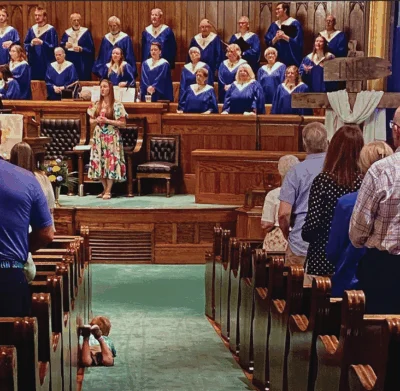
The Bible instructs Christians to use music in worship to express praise and adoration to God, specifically mentioning psalms, hymns and spiritual songs. In the early years, Presbyterian church music was primarily shaped by the exclusive use of Psalms. Today, the repertoire is broader, and services may include traditional hymns, anthems and psalms, as well as other genres, such as contemporary Christian music. In general, the emphasis in worship is on having everyone in the congregation participate in singing.
The process for selecting worship music typically involves discussion between the pastor and a music director, with the goal of offering music that aligns with the pastor’s sermon in some way.
“I see music as a necessary participant in the liturgy. It does not sit outside the liturgy,” said Tony McNeill, affiliate professor of worship and seminary music at Columbia Theological Seminary in Decatur, Georgia. “I’m not a slot filler who randomly picks music.
“Some of the first questions I ask when I make a decision are: What do we want people to know at the end of this worship service? What do we want them to do as a result of coming to this service? What new habits do we want to encourage people to take on or consider as part of their Christian life?”
The type of music consistently chosen by a church helps create the culture of its Sabbath worship. And some congregations offer multiple services, each featuring a distinct musical style.
At Myers Park Presbyterian Church in Charlotte, North Carolina, there are two 10 a.m. services: worship in the church’s Oxford Hall, which features more contemporary music, and worship in the sanctuary, where music is considered more traditional.
Josh Richard, the church’s communications director, regularly attends the Oxford Hall service, which he describes as more casual and a place where his young children can wander.
Related reading: “Big churches sound alike. Little churches are the ‘Wild West’ of music, study finds” by Religion New Service
“In Oxford Hall, the music is led by a band, while in the sanctuary it’s led by the choir and organ. One has my children dancing around, the other has them awe-struck by the big pipe organ,” said Richard. “Those expressions of worship look different, but for us it’s one congregation worshiping the same God through the same scripture and the same message.”
When it comes to types of music, the lines can sometimes be blurred because genres evolve. Today, Myers Park is grappling with how to define the distinction between the music offered at its two services more clearly.
On the worship page of its website, the church proclaims, “One body, many ways to worship.”
Today, there are generally three people who decide what music will be played at Myers Park: Cameron Moore, coordinator of contemporary worship and arts; Mark Kemp, director of worship arts, and Joe Clifford, the church’s pastor. All of the clergy and full-time music staff – seven pastors, two musicians – and Richard go on a worship planning retreat once a year and use a calendar of Sunday themes for sermons in the coming year to help them make decisions.
“The retreat gets us on the same page,” Clifford said.
“We each come and bring the best we have in our different realms together and in conversation,” Kemp explained. “Joe (Clifford) counts on me to know what best hymns and choral music fit. I count on Joe to help me know where Scripture is leading us in conversation. We count on Cameron to know what music from his genre is best.
“Then we let God work through all of that to inform us what God is revealing to us that day.”
Kemp said sometimes the Scripture makes the musical elements obvious.
“This past Sunday, we were in Jonah, and I thought we needed to start worship conveying the power of God and creation, so we started with the hymn ‘The Mighty God of Power Speaks’ and then Tom, our organist, took that conversation and his introduction with the organ started with a big ascending riff. The people two pews in front of me jumped. It startled them into the moment. Then we all had a big grin as we sang of God’s power and creation and how God rules over all things.
“There are so many different ways to do this,” Kemp said. “That is where we depend upon the Spirit to guide us. All of these things are just music and noise when we don’t do it in the spirit of God and God’s guideship.”
Clifford said a good worship service was one where “the worship service had integrity and was cohesive and was successful in proclaiming the word from God that needed to be proclaimed.
“I think we can tell in worship when (the music) works. You can feel it.” — Joe Clifford
There is a contemporary and a traditional service at Bayside Presbyterian Church in Virginia Beach, Virginia, where Chi Yi Chen Wolbrink serves as director of music ministry.
Chi Yi, who sings and plays drums and keyboards, was once a choral associate at Princeton Seminary, where she worked alongside 25 international pastors and conducted a touring choir that visited different churches of various cultures every Sunday. This experience is part of the reason she is committed to including worship songs from around the globe in the service at Bayside.
“Also, I feel I’m really blessed because I’m teaching at Norfolk State University, and there is a lot of spiritual Negro music at the institution. We are blending that into our music too,” she said.
Raised in Taiwan, Chi Yi was also a member of the committee that selected the music included in Glory to God, the official Presbyterian Church (U.S.A.) hymnal released in 2013, which gathers over 800 hymns, Psalms and spiritual songs from diverse traditions and musical styles.
When she’s choosing worship music for her own church, she asks the pastors questions such as, “Do you want to be quiet first, rejoice first? What is your flow? What music would help with better communication with the congregation?”
At Bayside, she said, “We are also very good with intergenerational involvement. We have children playing chimes and adults playing handbells.”
The church has a children’s choir, which Chi Yi views as one way to train children to participate in worship.
At White Memorial Presbyterian Church in Raleigh, North Carolina, the 9:30 a.m. and 11 a.m.services feature traditional music, accompanied by a choir, typically supported by organ and piano. At 10:45 a.m., there is the OnPoint@1704 service, described on the church’s website as “where music leadership is provided by our OnPoint@1704 Band. Acoustic instrumentation includes guitar, banjo, violin, Celtic whistles and more.” Eric Nanz, associate director of music and worship arts at White Memorial, said he tries to choose songs he believes people will enjoy singing.
“I feel like intentionally finding songs that are easy to learn and sing makes a big difference in congregational participation. Participation is so much better when you have singable songs,” said Nanz.
Undergirding the whole of worship
The style of the music should not be the priority, said McNeill of Columbia Theological Seminary.
“The style for me should take a backseat to the theology,” McNeill said. “There are some contemporary songs with bad theology. There are also some traditional hymns with bad theology. Once you get past the style, what is it saying about God? As music directors, we are charged with the task of providing good theology before style.”
At Grace Covenant Presbyterian, where worship may begin with a drumming circle, there is intentionality about using global music to help shape their community.
“Once you get past the (song’s) style, what is it saying about God?” —Tony McNeil
“Our music at Grace Covenant is kind of a unique feature of the way we do worship, because we are focusing on decolonizing worship,” said Shoop.
Ray Landis, director of music ministries at Grace, said he tries to help the church create a culture where the music is not centered “on the western music traditions” where “language has become very patriarchal.”
Landis sometimes replaces words or composes new songs for service. In addition to drumming, rhythm instruments are sometimes passed out for anyone interested in using them. Lyrics are usually projected on a screen.
“We have noticed when people are not holding hymn books, they are more engaged with the music,” said Landis.
At Caldwell Presbyterian Church in Charlotte, congregants stand, wave their hands and clap to the music in a very “un-Presbyterian way,” said Dot Killian, interim associate pastor at the church.
Killian also refers to the service as “very blended,” due to the merger of a predominantly Black congregation and a White congregation.
“Caldwell is a very emotive church,” she said. “It has a gospel choir, and they do a lot, along with hymns.”
But Killian has also brought in saxophonist Carl Ratliff from nearby Rock Hill, South Carolina, to play during service.
“I love jazz and found a lot of church folk do too,” Killian said. “I believe the music can undergird the sermon. It softens the heart. It opens a different door, and that’s what I’m aiming for.”