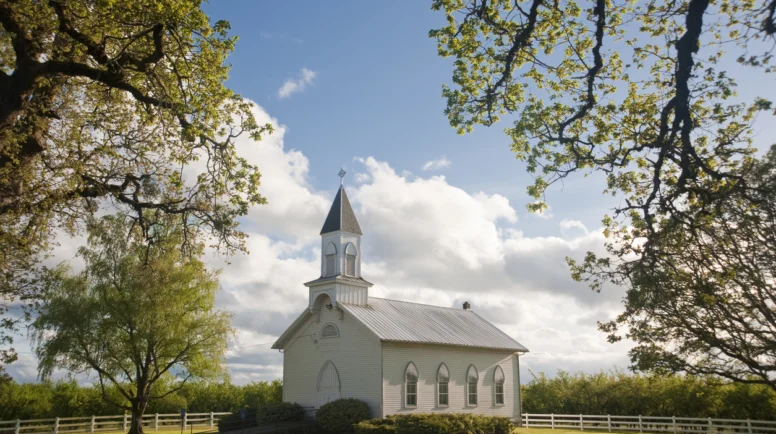
We have entered a new year — a season of resolutions, hope and fresh starts. As we close the book on 2025 and look toward 2026, I want to offer a proposal: let’s make 2026 the year of the rural church.
I have worked with rural congregations since 2021 and previously served as a solo pastor in a rural church from 2004–2012. I can say without hesitation that rural churches are a delight. They are deeply rooted institutions in their communities, maintaining a Presbyterian witness with limited resources and remarkable commitment. They are tightly knit, shaped by long relationships and a strong sense of mutual care. And they often surprise us with the ways they serve their neighbors.
Let’s make 2026 the year of the rural church.
I have shared some of their stories in these pages, and I could share many more.
Faithful — and under strain
Rural churches are also under significant stress. This is no surprise to anyone who spends time with them. Membership is declining. Buildings need attention. Insurance costs are rising. New models of pastoral leadership can be difficult to embrace.
Rural congregations need attention, support, encouragement and prayer. This work is happening in some places — often beautifully — but I am proposing that we go further. At every level of the PC(USA), we should ask how we can more intentionally support these vital congregations.
What I have learned from rural ministry
For the past four years, I have focused on rural congregations as director of the Town Square Collaborative at the University of the Ozarks in Clarksville, Arkansas. What began as a program to support rural PC(USA) pastors has grown into a hub that equips rural congregations across denominations.
This work has deepened my appreciation for rural churches. They are not perfect. Rural communities are not the quaint Hallmark-movie version of small-town life. Nor are our small towns the caricature of rural America portrayed in works like Hillbilly Elegy. Instead, rural churches’ ministry contexts are nuanced and complex, and churches are often doing extraordinary work and bearing witness to Christ in every presbytery in our denomination.
Rural churches’ ministry contexts are nuanced and complex, and churches are often doing extraordinary work ….
That faithfulness deserves our respect — and our attention.
Attentiveness over assumptions
It is attentiveness I want to commend for 2026. As Allen Stanton writes in Reclaiming Rural, “to know one rural community is to know one rural community.” Rural places resist easy categorization. Bureaucratic labels and census codes often miss the point. Increasingly, I believe this simple truth: if a community understands itself as rural, then it is rural.
Rural identity matters more than rural demographics.
Sociologist Robert Wuthnow puts it this way: rural places function as moral communities — places where people feel an obligation to one another and to shared ways of life that shape belonging, responsibility and home.
Because rural communities are distinct, rural churches are equally diverse. There is no one-size-fits-all model. Even more than urban or suburban congregations, rural churches are profoundly local. Listening to their stories and understanding their rootedness in place is essential if we hope to serve them well.
Making space in our denominational life
Some presbyteries already center rural congregations thoughtfully and creatively. Others could follow their lead. Can we make space at the presbytery level — and beyond — to listen more intentionally to rural churches? Can rural congregations be centered in our conversations and our planning this year?
I believe such attentiveness would be rewarding both for those who learn and for the congregations themselves.
Rural is not just small
Last summer, we hosted the first Rural Ideas Conference at the University of the Ozarks. One United Methodist pastor remarked that it was the first time in his ministry that he had gathered in a space where all the churches were rural.
I would love to see more rural-centered events across our denomination. Some already exist, but there is room to grow.
As we do this work, it is important to distinguish between rural churches and small churches. While they share some challenges, rural congregations face distinct realities shaped by geography, culture and community identity. Exploring those differences — and building collaboration around them — would be a gift to rural churches and a strength for the PC(USA) as a whole.
Political realities worth understanding
Any honest conversation about rural churches must also acknowledge political realities. Progressive political expression has become normative in many denominational spaces. While this is not inherently problematic, it can create tension with rural congregations.
Many rural churches exist outside the political mainstream of the PC(USA). They are often politically “purple,” if not red — yet in their local contexts, they may be among the most progressive institutions present. Most rural congregations do not understand themselves as political first and foremost, but instead as relational and communal.
Most rural congregations do not understand themselves as political first and foremost, but instead as relational and communal.
When these realities go unacknowledged, rural congregations can feel alienated — and denominational leaders can misunderstand them. The political witness of rural churches is not something to lament. It is vital to healthy discourse in their communities and deserves careful, charitable attention.
An invitation for 2026
This is only the beginning of the conversation. Rural congregations play an invaluable role in the PC(USA)’s witness across the nation. That witness should not be ceded but strengthened.
We can do this through financial support, leadership development, and — most importantly — listening and relationship. My hope is that in 2026, we will give rural congregations the attention, care and respect they deserve.