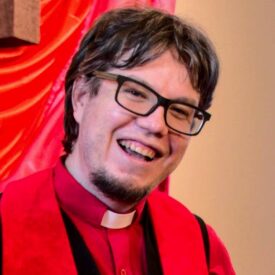
I approached the mic at the presbytery meeting with some trepidation. I am not shy about speaking in public, nor about sharing my beliefs — but it’s always nerve-wracking to answer questions about your faith statement and journey (a requirement for pastors who move and switch presbyteries).
A peer asked: “In your statement of faith, you say, ‘Through Jesus’ sacrifice, all the sins of the world are and will be forgiven, even of those who claim to be unbelievers.’ Do you consider yourself a universalist, then?”
My heart pounding, I replied simply: “Yes.” And stepped back from the mic.
Fortunately, after that, the laughter of the group buoyed my spirits. I went on to explain that I’m a “Reformed universalist” – valuing John Calvin, Karl Barth and Shirley Guthrie Jr. as well as exploring the works of Ilaria Ramelli, David Bentley Hart, and Al Kimel. Christian universalism, as I use the term, is the conviction that God’s redeeming work in Christ will ultimately reconcile all people to God. Though universalism appears in many Christian streams of thought, my focus here is its deep compatibility with the Reformed tradition. My universalist understanding is not a departure from the Reformed faith — but a faithful unfolding of it.
Universalism misunderstood
Now, universalism is often caricatured as a sentimental departure from rigorous theology, more idealistic than a robust doctrine of grace. But I see it as grounded in God’s sovereignty, centered in Christ, and committed to grace: all classical marks of the Reformed tradition we Presbyterians hold dear.
But I see it as grounded in God’s sovereignty, centered in Christ, and committed to grace: all classical marks of the Reformed tradition we Presbyterians hold dear.
As 20th century theologian and Columbia Seminary professor Shirley Guthrie Jr., put it in Christian Doctrine:
To work at Christian theology from a Reformed perspective, then, does not mean that we are asked to hold the fort and defend what Calvin and his followers thought three or four hundred years ago. Being loyal to them means that we do not simply repeat what they said, but that we take seriously what they themselves taught us about the superiority of the Word of God over every human word – including theirs! It means to ask the question they themselves taught us to ask: “What is the living God we know in Christ and in the Bible doing and saying in our time, here and now, where we have to think and live as Christians? (Christian Doctrine, revised edition (1994) p.18)
Christian universalism is often misunderstood. It isn’t the idea that anything goes or that all paths are equal. It’s the belief that God’s redeeming love will ultimately reconcile all people to God through Christ.
It’s the belief that God’s redeeming love will ultimately reconcile all people to God through Christ.
It is rooted in Scripture; 1 Timothy 2:4 states that God “desires everyone to be saved and to come to the knowledge of the truth.” 1 Corinthians 15:28 affirms that, in the end, God will be “all in all.”
Enter: Calvin
Ah, but wait — what about double predestination? 16th century theologian John Calvin affirmed that that God has chosen some for salvation and others for damnation. Yet, he did not intend to depict God as cruel. Rather, double predestination emphasizes that salvation is not a human achievement. It is only through God’s grace (sola gratia) that we are saved, not by our own works.
Calvin’s intent with predestination was to comfort people torn over what they perceived as eternal consequences for either leaving or staying the Catholic church during the Reformation. By emphasizing God’s sovereignty, Calvin reassured his flock of God’s almighty nature: if God chose them for salvation, nothing they could do could prevent it.
Related reading: “Is celebrating and studying the Reformation still valuable?” by Dawn DeVries
Yet, over the centuries that followed, what Calvin intended for comfort became a litmus test of his followers. Calvin’s disciples identified five key theological arguments (known as the acronym TULIP): total depravity, unconditional election, limited atonement, irresistible grace, and perseverance of the saints. According to the followers of Calvin, if God saves some and damns others, you better act as though you’re saved, since no one who is truly saved would act as person who was damned.
Barth’s response
This is where 20th century theologian Karl Barth comes in. Responding to the horrors of two world wars and the rigidity of earlier Protestant systems, the Swiss Reformed theologian placed Christ at the center of the doctrine of election — the teaching that God chooses who will be saved.
Instead of seeing election as God’s sorting mechanism between the saved and the damned, Barth asked us to look again at what God has already done in Christ. Jesus, he said, is both the elected one and the rejected one.
According to Barth, God has said, “yes!” to all humanity through Jesus. In Christ, God takes upon Godself the full weight of human rejection, sin and death, and still answers with love. Even our strongest “yes” doesn’t come close to Christ’s resounding “yes!” Even our most powerful “no” cannot overpower it. This is grace upon grace — irresistible.
True, Barth never declared himself a universalist. Still, the scope and logic of his theology – rooted in the unassailable will of God made visible in Christ – opened the door for those who would. And as a “Reformed universalist”, I take that door and walk through it.
The same belief in divine sovereignty that led Calvin to assert God’s power over salvation leads me to a vision of God whose will is not to divide, but to reconcile. Not to condemn the world, but to save it.
Restorative, not retributive, justice
Christian universalism, then, is not a softening of God’s sovereignty — it’s a deeper trust in it. It refuses to imagine a God able to be thwarted by human sin or limited by our sense of what justice is. Many who affirm eternal punishment wrestle with this same tension: how can a just and loving God desire everlasting torment? Christian universalism answers these questions by returning to the scriptural portrait of divine justice as the setting-right of all things.
Christian universalism, then, is not a softening of God’s sovereignty — it’s a deeper trust in it.
In Christian universalism, true divine justice is restorative — not punitive or retributive. God’s judgment does not aim to punish endlessly, but to heal, refine, and restore creation. Universalists encourage us to see that God acts through grace, just as the Reformed tradition insists, and this grace reaches every soul, until all are made whole.
In Scripture, the prophets often speak of fire that refines, purifying metal by melting away waste. Isaiah envisions God saying, “I will turn my hand to you; I will thoroughly purge away your dross and remove all your impurities” (Isaiah 1:25). Malachi echoes this image, describing God as wielding “refiner’s fire” and “fuller’s soap,” both images of cleansing, not destruction (Malachi 3:2-6). Even Paul writes to the Corinthian church that everyone’s “work will be revealed by fire” and that which is not of God will be destroyed (1 Corinthians 3:13-15).
God’s grace is consistent with God’s goodness
The seventh century theologian and monk Isaac of Nineveh lifts up this idea:
It is not the way of the compassionate Maker to create rational beings in order to deliver them over mercilessly to unending affliction in punishment for things of which He knew even before they were fashioned, aware how they would turn out when He created them – and whom, nonetheless, He created. (The Ascetical Homilies of Saint Isaac the Syrian, the Second Part c. 688 CE, trans. Sebastian Brock (1995).)
Isaac teaches that eternal torment contradicts the very character of God. He insists that divine fire is not meant to torture, but to heal. God’s justice, he says, is never retribution, nor vengeance, but mercy made radiant. I know this sounds strange to our ears today, but even our word therapy, derived from therapeuō, to heal, has its roots in therma (fire, heat).
God’s justice, he says, is never retribution, nor vengeance, but mercy made radiant.
To will endless suffering would make God’s creative act morally incoherent. Later thinkers, like John Stuart Mill in the 19th century, press the same point: If we say that God’s goodness is different in kind from human goodness, we risk saying that goodness has no real meaning at all. (from An Examination of Sir William Hamilton’s Philosophy, qtd. in David Bentley Hart, That All Shall Be Saved, p. 78)
Mill’s warning is not that God’s goodness is greater than ours, but that calling evil “good” simply because God wills it makes the word “good” itself meaningless. God’s grace must be consistent with God’s goodness. And if grace is truly unearned, then it cannot be withheld. Divine justice, in this light, is not retribution, but restoration, the healing of every wound. To be made whole is to be restored to the fullness of relationship with God, with one another, and with creation itself.
God’s grace must be consistent with God’s goodness.
The harrowing of hell as theological key
The early church pictured this vividly in the story of Christ’s descent to the dead after his crucifixion and before his resurrection. In the harrowing of hell, Christ’s redeeming love reached even those thought beyond reach. The gates of hell were broken open, not to condemn, but to free. If God’s nature is unchanging, then the same grace that emptied the grave will not rest until every corner of creation is redeemed, reconciled, and made whole.
Grace that is not for all is not grace at all – but favoritism masked as providence, scarcity dressed up as sovereignty.
Grace that is not for all is not grace at all – but favoritism masked as providence, scarcity dressed up as sovereignty. The God revealed in Christ is neither tyrant nor miser. Grace is not God’s exception; it is God’s nature.
Rooted and restless: A Reformed posture
Now, for many in the Reformed tradition, the most immediate objection to Christian universalism is confessional: What about the Westminster Confession? Or the Heidelberg Catechism? A straightforward reading of those 16th and 17th century confessions leaves little room for universal reconciliation.
But the Reformed tradition has always made a distinction between Scripture and the confessions. The confessions are authoritative guides with Scripture as their basis — not the other way around. The confessions are not immutable, and they do contradict each other, as our understanding of God and the church’s role changes in various times and places.
We read the confessions looking for how our forebears understood the Word of God in their time and place, in their context. When we vow to be “guided by the confessions,” that guidance may take place away from specific words and doctrines in light of how the world has changed since that confession was written. The confessions are not an obstacle, but a conversation partner — one that can be challenged, deepened and even joyfully corrected when the gospel calls for it.
To be Reformed is to be rooted and restless at the same time.
To be Reformed is to be rooted and restless at the same time. We stand in a tradition that treasures the wisdom of those who have gone before us, even as we trust that God still speaks, still acts, still reforms the Church according to the Word. Christian universalism is not an alien import — it is one more flowering of the same deep roots: God’s sovereignty, God’s grace, God’s reconciling love in Christ Jesus.
We reform, not for novelty’s sake, but because the love of Christ compels us. We confess, not to guard our boundaries, but to proclaim the good news. And we hope — not because it is easy, but because the God revealed in Jesus Christ has given us every reason to believe that, in the end, no one will be lost forever.