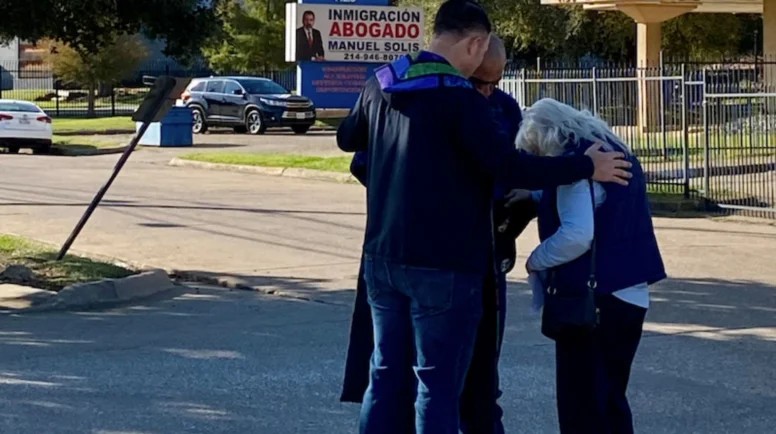
Why clergy are showing up at ICE check-ins in Dallas
Clergy of all faiths in the Dallas, Texas, area are banding together to provide pastoral care to migrants visiting the Immigration and Customs Enforcement (ICE) field office in Dallas, while also organizing for resistance and emergency response amid increased detainment of their asylum-seeking neighbors.
“After the first couple of days, I knew that’s where I needed to be,” said Armel Crocker, commissioned pastor through Grace Presbytery. “These people need to know they are not walking alone. That people love them.”
“These people need to know they are not walking alone. That people love them.” — Armel Crocker
Crocker is one of 40 multi-faith clergy who formed CLEAR (Clergy League for Emergency Action and Response) in Dallas-Fort Worth last year. The group initially gathered to lament and pray with their neighbors, but their work has since expanded.
“This is happening in my backyard, not Los Angeles or Chicago or Minneapolis,” said Crocker.
How CLEAR clergy provide pastoral care outside the Dallas ICE field office
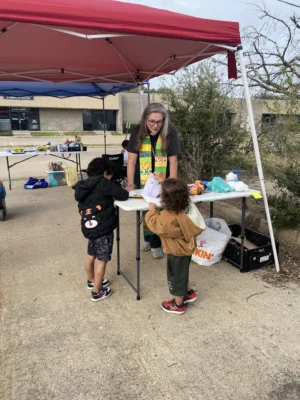
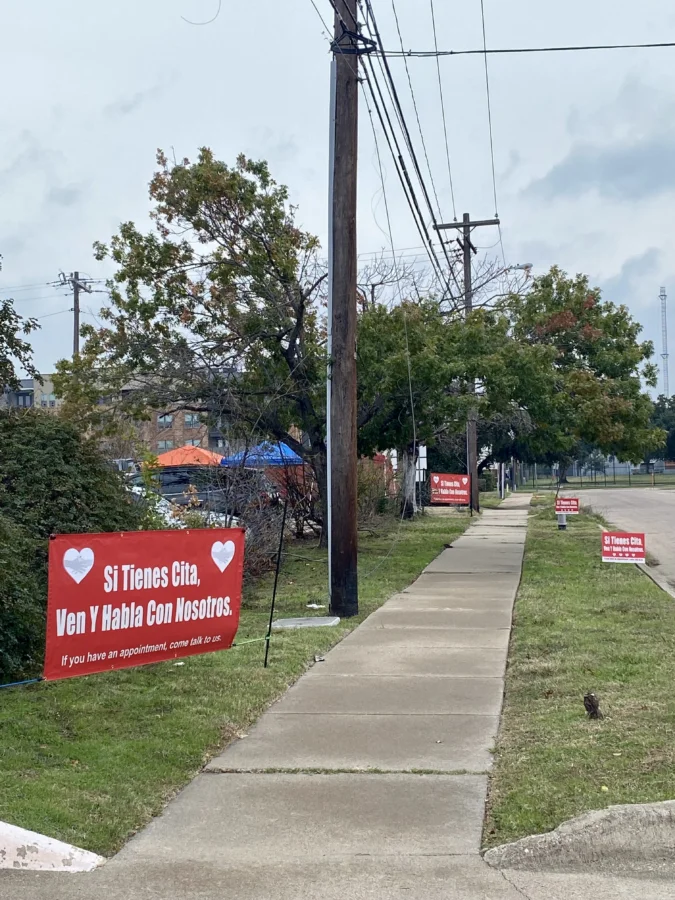
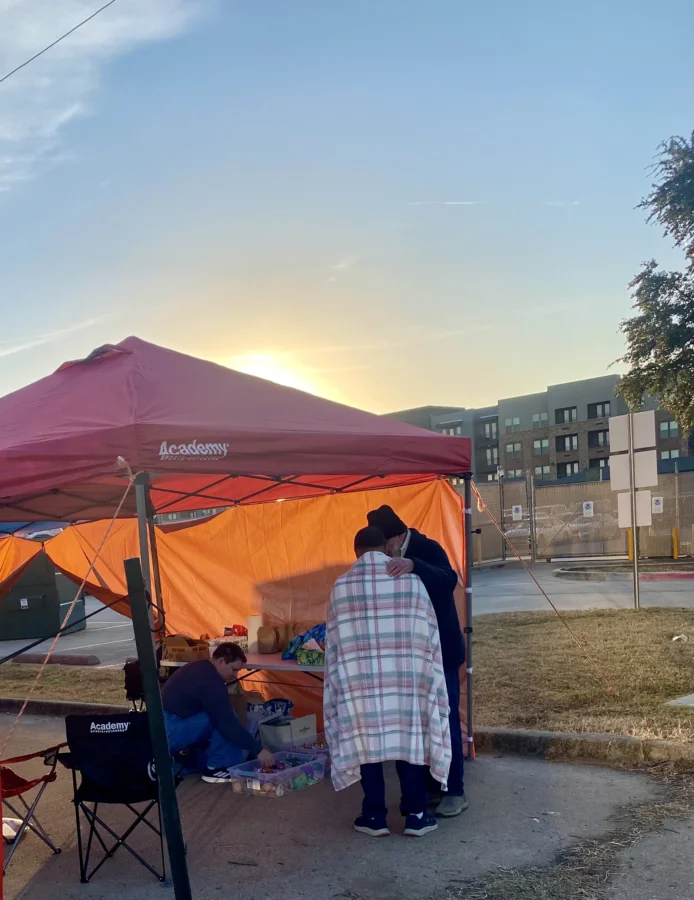
Every Monday through Saturday, CLEAR clergy serve at what they call a respite center — tents set up behind the ICE facility on North Stemmons Freeway. There, clergy members have contact with each visitor, typically 50 to 100 people each day, who arrive for their annual check-in appointments with the federal government as part of their immigration cases, Crocker explained. CLEAR provides a pastoral response and works directly with La ColectiVA NTX, who manage intake forms, documentation, and aftercare logistics.
“These are people who are doing everything right,” said Crocker. The Dallas Morning News recently reported that most detainees in Dallas have no criminal records.
In addition to the respite center, the clergy members hold a prayer vigil on Monday mornings in front of the facility. “We pray for everyone that works at this facility as well as the migrants visiting,” Crocker said.
Crocker said a large percentage of people who come for check-ins are sent to detention centers in Texas or Louisiana.
Why Texas has become the center of U.S. immigration detention
Texas has the highest number of immigrant detention centers in the United States, with 26 dedicated facilities, according to the Texas Immigration Law Council. Migrants are also housed in federal prisons and contracted county jails across the state, bringing the number of facilities to approximately 60.
These include the South Texas Family Residential Center in Dilley, where 5-year-old Liam Conejo Ramos from Minneapolis was sent with his father. Texas also has the highest daily population of detained individuals, often exceeding 9,000, according to Transactional Records Access Clearinghouse (TRAC) immigration data.
According to Crocker, the ICE facility in Dallas has a quota to detain 75 people per day.
What happens when migrants are detained after routine ICE appointments
Clergy at the respite center assist community members with paperwork, help them locate their alien numbers, and determine where visitors have parked their vehicles.
“If the individual doesn’t come back after two to three hours, we start the process to find out where they’ve been sent,” Crocker said.
The clergy then contact family members after someone has been detained and help them locate vehicles and make other arrangements.
“Every day is different. Some days, fewer people are detained because all the beds in the [state’s] detention centers are full,” Crocker said.
Earlier this week, Crocker witnessed a moment of reunion. A single mother who had been detained for three months was reunited with her 8-year-old daughter. A neighbor had been caring for the child and brought her to the CLEAR respite center. Clergy kept the girl entertained with coloring books, juice, and snacks until her mother arrived. Crocker and another pastor then walked the child to the door of the ICE facility.
“I am very rarely moved to tears, but this morning, taking that little girl to the door of the ICE facility, I had tears running down my cheeks,” said Crocker.
“I am very rarely moved to tears, but this morning, taking that little girl to the door of the ICE facility, I had tears running down my cheeks.” — Armel Crocker
“What this country is doing to human beings is breaking my heart,” Crocker said. “We have to use our White privilege to do something good.”
“It is critical to bear witness to what is happening. The news reports only say so much,” said Amy Moore, parish associate at NorthPark Presbyterian Church. Moore helped form CLEAR in April 2025. “We need feet on the ground and eyes present to witness. This is essential to bring about change.”
Faith leaders help organize rapid response and resistance to new detention centers
CLEAR clergy were also present Monday night in the small town of Hutchins, about 20 miles south of Dallas, where residents and the mayor spoke out against a proposed 1-million-square-foot warehouse slated for conversion into a detention center that would house 9,500 people — roughly 3,000 more than the town’s population. The federal government has not confirmed the proposed facility, but documents obtained by the Washington Post indicate that ICE was evaluating the Hutchins site.
Laura Walters, an ordained minister serving in the Dallas area and a member of CLEAR, said supporting Hutchins city leaders and residents is a key part of the group’s work.
“We are preparing for resistance and rapid response,” said Walters. “We want to help folks organize on a local level.”
A recording of the city council meeting on February 2, 2026, shows the Hutchins mayor and multiple residents speaking against the proposed detention facility.
“A horrific ice storm secretly entered Hutchins in the middle of the night … This is amoral,” said one resident.
“Our town has less than 6,000 residents, and we are supposed to stuff 10,000 human beings in one warehouse … this is treating humans like livestock and animals,” said another resident.
Yet another person said that if the facility is built, “we would be getting an ICE detention center before we get a grocery store.”
“Someone had to imagine ICE into existence. So, then we as Christians can imagine our healing and mending the world.” — Laura Walters
“It’s a humanity issue,” said Walters. “And we can all agree on the issue of humanity and work together for the common good.”
“Someone had to imagine ICE into existence. So, then we as Christians can imagine our healing and mending the world. We can re-imagine the world. Be part of the mending,” Walters said.
On February 16, 2026, a local news station reported that the ICE detention center sale in Hutchins was blocked after the property owner rejected the offer.
‘This is joyful work’
Walters encouraged churches to become involved in resisting ICE detentions, saying, “This is joyful work. You will see a lot of faith, a lot of love, a lot of hope.”
“This is joyful work. You will see a lot of faith, a lot of love, a lot of hope.” — Laura Walters
“We get carried away by society’s rules, but Jesus said the two greatest commandments are loving God and loving our neighbors,” Moore said. “For me, that is the driving force. It’s not easy, but that is what we are called to do.”