
In a cultural moment shaped by exhaustion, division and fear, many people are turning, somewhat unexpectedly, to a queer hockey romance for comfort. Heated Rivalry, a 2019 novel by Rachel Reid that has since been adapted into an HBO series, tells the long-arc love story of two professional hockey players, Shane Hollander and Ilya Rozanov. Set within the hypermasculine world of professional ice hockey, the novel traces their relationship across years of secrecy, rivalry and tenderness. For those willing to look closely, Heated Rivalry is more than a romance (though yes, there is a lot of sex in the book and show).
While Heated Rivalry is not new, its resurgence — particularly among women and LGBTQ+ readers — is telling. The enthusiastic response to the HBO adaptation invites theological questions worth asking:
Why are people so hungry for this kind of love story right now?
And what might people of faith learn by paying attention to the stories sustaining joy and empathy in public life?
At its core, Heated Rivalry offers something increasingly rare in contemporary storytelling: an unapologetically tender love that is neither ironic nor tragic. Shane and Ilya differ in nearly every way — nationality, family background, temperament and emotional language — yet they learn, slowly and imperfectly, how to see and choose one another. Their love is not sanitized or simplistic. It is shaped by trauma, fear, desire, miscommunication and vulnerability. But it is also patient, embodied and deeply mutual.
That kind of love matters in a world often governed by suspicion rather than trust. We are inundated daily with stories of conflict and collapse: political polarization, institutional failure, violence and dehumanization. Even within the church, conversations about identity, belonging and difference are frequently framed as zero-sum debates. In such a climate, we search for human connection and for happy endings. Heated Rivalry responds with a counter-story: love practiced as trust rather than deployed as a strategy for survival.
Why are people so hungry for this kind of love story right now?
Shane and Ilya repeatedly face moments when understanding the other costs them something — safety, reputation, control or comfort. They must learn how to listen when it is difficult, how to stay present when it would be easier to disappear and how to tell the truth even when it threatens the world they have built. Their love is not passive. It is demanding.
For Christians, this portrayal resonates with a biblical vision of love that is likewise active and costly. Scripture does not describe love as mere affection but as a practice that shows up in bodies, choices and public commitments. “Love puts up with all things, trusts in all things, hopes for all things, endures all things” (1 Corinthians 13:7, CEB). This is not abstract but lived. When Shane and Ilya choose one another again and again, even when the stakes are high, readers glimpse a love that refuses to look away.
When Shane and Ilya choose one another again and again, even when the stakes are high, readers glimpse a love that refuses to look away.
It also matters that this story unfolds in professional hockey, a space often associated with rigid norms of masculinity and silence around queerness. Heated Rivalry imagines what it might look like for authenticity and intimacy to exist even there. In doing so, it offers a quiet vision of inclusion, not through speeches or policy debates but through relationships. Liberation, the novel suggests, comes not only through structural change (though that matters) but through the courage to live truthfully within imperfect systems.
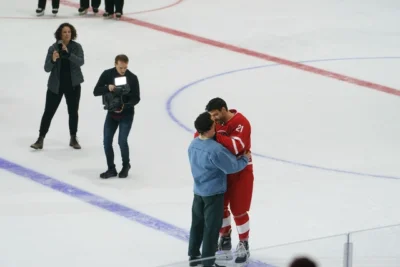
The emotional turning point for Shane and Ilya becomes possible through another couple. Episode three centers Kip Grady and Scott Hunter, whose story, first told in Game Changer, traces a movement from secrecy to public love. Their courage changes the landscape. Without their witness, the future for Shane and Ilya feels bleak. Because Scott and Kip go first, hope becomes imaginable. When Ilya finally calls Shane and says, “I’m coming to the cottage” in episode five, the line lands with such force because it is no longer only about two people choosing one another. It is about what becomes possible when love is no longer hidden.
This may help explain why the novel and show resonate beyond the queer community. Many readers, especially women, recognize themselves in the emotional labor, longing and hope embedded in the story. Reid gives sustained attention to her characters’ inner lives: childhood wounds, the ways love can both heal and expose and the slow work of learning how to be known. In a culture that prizes efficiency and productivity, Heated Rivalry insists that love takes time.
Stories like Heated Rivalry remind us that love is not tidy. It is relational, risky and transformative.
People of faith should pay attention to that insistence. The church often proclaims that love conquers all, yet sometimes struggles to embody that claim when love becomes inconvenient or complicated. Too often, Christian discourse prioritizes certainty over curiosity, boundaries over belonging and doctrine over relationship. Stories like Heated Rivalry remind us that love is not tidy. It is relational, risky and transformative.
This does not mean the novel is beyond critique. Questions about authorship, representation and voice matter, especially in queer storytelling. Readers may rightly ask what it means for a woman to write a love story centered on queer men and how power and perspective shape whose stories are told and amplified. Those questions should not be dismissed. Still, the widespread embrace of Heated Rivalry suggests many readers have found something life-giving: a vision of love that feels honest and generous.
Theology, at its best, pays attention to where people encounter grace.
Theology, at its best, pays attention to where people encounter grace. God is not absent from popular culture but often moving within it. When a romance about two hockey players becomes a shared source of comfort and hope during a bleak season, it is worth asking why. What desire is being named? What wound is being tended? What kind of world is being imagined?
Perhaps we needed Heated Rivalry now because it dares to be sincere.
I dedicate this article to Chris, who invited our book club to read Heated Rivalry; who was rejected by his church growing up for being gay; and who still gives me, a pastor, a chance to be part of his story. Chris begged me to do a sermon series on Heated Rivalry. Chris, this isn’t quite a sermon, but it’s for you, and for all of God’s beloved people. Love is love.