Being Catholic, for me, and for many of us, is as much about heritage as it is about religion.
It’s part of who we are.
It’s that my Nana’s house had portraits of Mary, Pope John Paul II, and John F. Kennedy (our first Catholic president) hanging on the walls like a holy trinity of their own. It’s that I went to Mass every week and can still smell it if I close my eyes. It’s that I loved the rituals and the way the communion wafer melted on my tongue.
I still have the rosary I made by hand in art class at Catholic school. It sits on my dresser now, a quiet reminder of my connection to my upbringing, my people, and my faith.
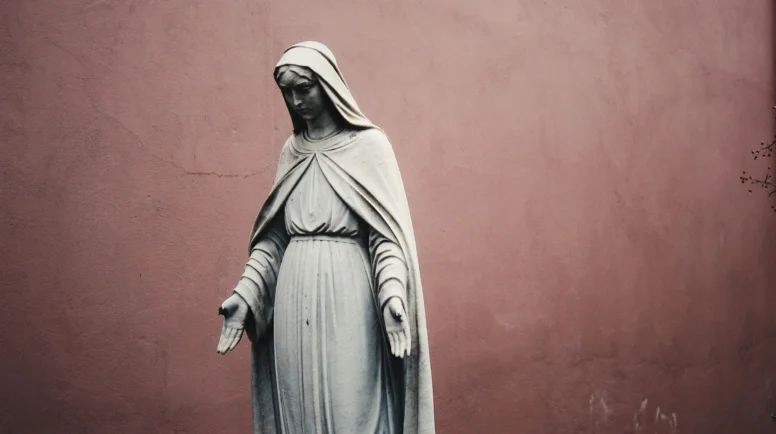
And some of my Presbyterian peers will be surprised to learn that I still have a very old portrait of Mary hanging in my house, just in case I need to ask her to intercede for me from time to time.
I am a happy Presbyterian pastor. And I love my Catholic roots — especially when it comes to prayer. Because there are some prayers that never leave you.
Recently, I officiated the funeral of a friend’s father. In the days leading up to the service, her mom asked me if we could include the Hail Mary.
Of course, I said yes. But the request stayed with me.
She told me that she and her husband had prayed it together daily as his health declined. As his world grew smaller. As they both knew what was coming. They said it together. Every day.
And suddenly, the words I had learned as a child, words I haven’t prayed regularly in years, came rushing back to me, fully intact, without effort:
Hail Mary, full of grace,
the Lord is with thee.
Blessed art thou among women,
and blessed is the fruit of thy womb, Jesus.
Holy Mary, Mother of God,
pray for us sinners, now
and at the hour of our death. Amen.
I didn’t have to look it up. I didn’t have to think about it. It was just … there. Stored somewhere deep in me.
We carry all kinds of things in our memory banks. My childhood phone number. The lyrics to songs I haven’t heard in years. Random facts that serve no real purpose.
But there are also deeper things we carry.
Psalm 23.
The Lord’s Prayer.
The Hail Mary.
Prayers that were handed to us. Prayers we didn’t choose, but somehow, they chose us. And in moments when we need them most, they return.
As I prayed the Hail Mary again in that space of grief, what struck me most was the final line: “Pray for us now and at the hour of our death.”
Of course, we want God to be with us. That’s what we say in so many of our prayers. That’s what we believe.
But there is something deeply human and deeply comforting about imagining not just the presence of God, but the presence of someone we can picture.
A face.
A hand.
A motherly figure holding ours.
Someone who knows what it is to love and to lose and to stay.
I began to understand, in a new way, why my friend’s mom wanted that prayer included. It wasn’t just tradition. It was companionship. It was the echo of a daily practice that had carried them through the hardest season of their lives.
It was a prayer that had already done its work. And that’s what prayer is, at its best. Not just words we say in the moment, but words that shape us over time. Words that settle into our bones. Words that become so familiar that they no longer require effort, only presence.
As Protestants, we sometimes pride ourselves on spontaneity in prayer. We value authenticity, fresh language, and speaking from the heart. And there is so much beauty in that.
But there is also something sacred about inherited prayer. About words that have been said for generations. About phrases that have been repeated so often that they become part of who we are.
There is something powerful about knowing that when you pray a prayer like the Hail Mary, you are not praying alone. You are joining a chorus. A communion of saints. Voices across time and place, all saying the same words, all holding the same hope: “Be with us now. And at the hour of our death.”
I think about the people who handed me those prayers: teachers and nuns and my whole big, loud, loving Catholic family. And I am grateful.
Grateful for the prayers that were given to me before I knew how much I would need them.
Grateful for the way they still live in me.
Grateful for the Catholics I love today who invite me back into those familiar words.
Because sometimes, those prayers feel like a warm, comforting blanket. Always there when you reach for them.
And sometimes, in the moments when words are hardest to find, they are the only ones we have.