Task force expands, accountability overtures merged
As commissioners met online for the 227th General Assembly of the Presbyterian Church (U.S.A.), the Reformed Identity Around the World (RIW) Committee took up concerns about the closure of World Mission in 2025 and the elimination of mission co-workers. On Tuesday, the committee voted to recommend a 17-member task force to investigate how those decisions were made and used that action to answer a separate accountability overture.
Related reading: Catch up on PC(USA)’s mission cuts
RIW-01, which recommends the task force, passed in a 49-8 vote with an amendment. . The committee then voted 54-5 to answer RIW-07, an overture from Philadelphia Presbytery seeking a report on those same decisions, with its action on RIW-01. The move combines both overtures into a single process, with the task force reporting back to the 228th General Assembly in 2028.
If approved, the task force would examine whether the Unification Commission and the Interim Unified Agency, now known as Presbyterian Life & Witness (PL&W), followed General Assembly policies in making these decisions. It would also review consultations with global partners between 2018 and 2025, report on how funds designated for mission co-workers are being used after the program’s closure, and recommend appropriate steps toward acknowledgment, confession, repentance and repair. The estimated cost to the denomination, drawn from per capita, is $43,100 over two years.
Related reading: “Arizona presbyteries commission Mark Adams and Miriam Maldonado as mission co-workers” by Eric Ledermann, Outlook reporting
Commissioners converted the overseeing group from a commission to a task force, with Diane Kenning of the Presbytery of Plains & Peaks noting that a commission exercises a council’s authority while a task force researches and reports.
The committee expanded the task force from 11 to 17 members after Jose Luis Torres, a theological student advisory delegate from the Seminario Evangelico de Puerto Rico, argued the conversation was bigger than 11 voices. Melanie Clarkson, a ruling elder commissioner (REC) from Trinity Presbytery, added that 11 members could not guarantee the racial, regional and LGBTQ+ diversity the work required.
Commissioners debate how to honor former mission co-workers
The consolidation drew the committee’s sharpest disagreement. Vice Moderator Matt Bussell, who made the motion to answer RIW-07 with the action taken on RIW-01, said nearly all of RIW-07 had been absorbed into RIW-01, and that a single overture would let the assembly act more effectively than two separate bodies with large budgets addressing the same issue.
Blake Severson, a teaching elder commissioner from the Presbytery of Yukon, objected. RIW-07 dealt with the elimination of people who believed God had called them to that work, he said — a different matter than ending a form of ministry, and one deserving its own accounting.
That tension surfaced again over whether to honor the co-workers. Sarah Clingman, a young adult advisory delegate from Grace Presbytery, asked whether anyone could confirm the amended overture honored co-workers and their experience.
Dennis Smith, a commissioner, overture advocate for several overtures dealing with the elimination of mission co-worker positions, and a retired mission co-worker, cautioned against formal recognition before doing the harder work. Any gesture that did not do “the hard work of recognizing what happened and the way that those actions were perceived,” he said, would be received as “dismissive, perfunctory … a little bit of empty ceremony.” Bussell countered that the committee had just spent hours doing that work by calling for the task force.
PL&W leaders defend mission restructuring
The actions followed a long question-and-answer session with PL&W leadership, including Stated Clerk and PL&W Executive Director Jihyun Oh and Mienda Uriarte, PL&W senior director for partnerships beyond the PC(USA).
Oh traced the decision to fold World Mission and eliminate mission co-worker positions to decades of membership decline outpacing giving, and to six actuarial models that showed five paths, all ending in the loss of a meaningful global presence. The chosen path, she said, was the one sustainable option.
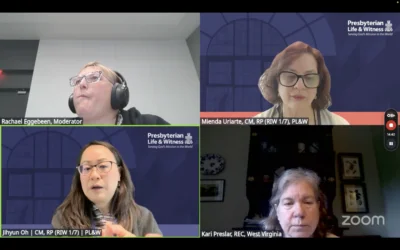
Oh said the announcement of the shift from World Mission to Global Ecumenical Partnerships “came out the same week as USAID being completely cut,” which was timing the agency could not have foreseen. She told commissioners that when the story broke about the shift, she asked herself, “How did that go from transition to elimination or dissolution or closure language?” She said she wondered whether the federal cut had led people to conclude the denomination was “doing the same thing.”
Caitlin Supcoff, a REC from Mission Presbytery, asked what was being done to repair damaged relationships after the terminations. Uriarte said the agency has reached out to mid councils, congregations and network leaders, and that with global partners, “there was very deliberate communication to basically check in, to see how they were doing, what was needed, and where do we go from here.” She described the response as largely supportive, with partners “wanting to make sure that we were okay.”
New mission statement moves forward
On Monday, the committee approved an amended RIW-02, ”Calling for a New Missiological Statement for the Presbyterian Church (U.S.A.)” by a vote of 54-2. This overture, submitted by the Presbytery of the Cascades, directs staff and a moderator-appointed advisory group to develop a new missiological statement to ground the denomination’s global engagement moving forward, addressing questions that range from its basic theology of mission to the racial-equity impact of past structures, including the dissolution of World Mission.
Related reading: “Overture authors defend global mission” by multiple authors
The adopted version directs consultation with 11 named groups, among them missiological scholars, former World Mission staff, global partners, racial-ethnic caucuses, immigrant worshiping communities, and “communities historically harmed by mission practices, including Indigenous communities and churches in the Global South.”
Together, RIW-01 and RIW-02 create a backward-looking accountability review with a forward-looking framework for how the denomination engages with the world.
Together, RIW-01 and RIW-02 create a backward-looking accountability review with a forward-looking framework for how the denomination engages with the world.
Committee advances nuclear, Syria and Jeju overtures
The committee also acted on three overtures outside the mission-restructuring thread. It approved RIW-03, a Mission Presbytery overture on nuclear disarmament, 43-13, reaffirming the 223rd General Assembly’s 2018 call and asking congregations to undertake a year of study on the risks of nuclear deterrence.
It approved RIW-08, a Presbytery of Susquehanna Valley overture, 49-8, directing the denomination to grieve the Jeju April 3rd Tragedy – in which 14,000 to 30,000 people were killed on the South Korean island between 1947 and 1954 – during a worship service at the assembly, and to press the U.S. government to investigate American responsibility through the U.S. Army Military Government in Korea.
The committee approved an amended RIW-09, a religious-freedom overture from the Racial Equity Advocacy Committee, 54-3, directing the stated clerk and PL&W to advocate for Syrian Christians and other minorities facing persecution. The committee broadened the overture’s advocacy directive, framing concern for Syrian Christians within a wider call to protect all of Syria’s religious and vulnerable communities, not Christians alone.
Israel, Gaza and Cuba proposals await action
The committee closed Tuesday with open hearings on overtures it will take up today. Four concern Israel and Gaza: RIW-04 and RIW-06 would have the denomination name Israel’s actions in Gaza a genocide, RIW-05 would call for a full trade embargo, and RIW-10 would affirm Kairos Palestine II, a statement issued by Palestinian Christians in November 2025.
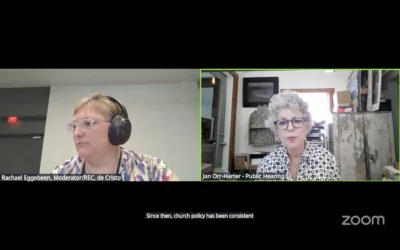
During the open hearing, speakers urged the committee toward an arms embargo, a trade embargo and naming the situation in Gaza a genocide. The lone dissenting voice was Forrest Claassen, executive of the Synod of the Trinity, who asked the committee to strike the words “genocide” and “apartheid,” saying they increased the danger faced by Jewish people in his region.
A fifth overture to be taken up today, RIW-11, would commit the denomination to solidarity with the Presbyterian-Reformed Church of Cuba and call for lifting the U.S. embargo.
All committee recommendations go to the full assembly for consideration in plenary, where they can be debated, amended and voted on again.