Recently, I preached a sermon inviting people to close their eyes and listen for the birds’ song. A preteen quietly walked to the front of the sanctuary, stood behind me and placed their stuffed owl on my shoulder, gently hooting like the owl. It made me smile — they were listening to what I said.
After worship, however, I heard that some people found the moment disruptive.
In a variety of churches, I have heard the phrase, “Children should be seen and not heard.” This was one of the few times I sensed an even stronger expectation: that children should neither be heard nor seen.
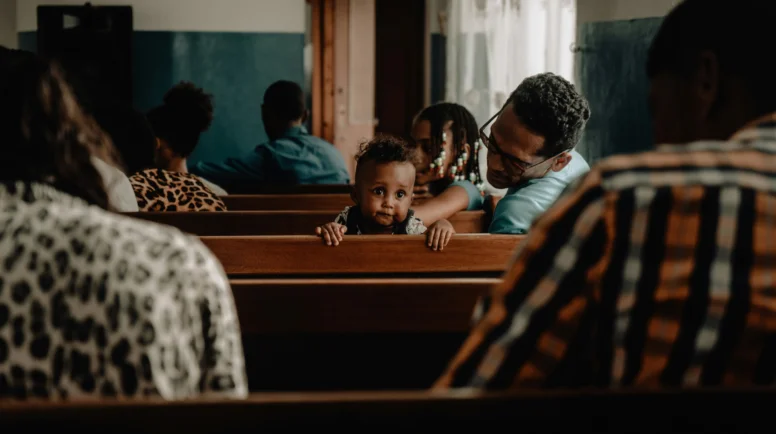
As a minister, I’ve fielded complaints about “disruptions” in worship, usually referring to kids being kids. On any given Sunday in the church I serve, you can hear children laughing and talking during the service — and sometimes adults, too. One member once told me, “I’d rather hear a baby crying than an old person snoring — it means there is life in the church.”
In worship services I’ve led, both snores and baby cries are welcome. Rather than seeing these sounds as disruptions, I’ve come to see them as signs of people engaging worship in the ways available to them.
I value inclusivity and aim to create worship spaces that welcome people of all ages and abilities. The Presbyterian Church (U.S.A.) offers multiple resources on creating worship that includes and empowers people who are often marginalized. Isaiah 56:7 describes God’s house as “a house of prayer for all people.” Yet true inclusion cannot rest on the work of one or two people alone. Churches need to talk openly about what inclusion means, what values shape worship and what expectations congregations carry into the sanctuary.
I welcome a loud, slightly chaotic worship service. In our congregation, neurodivergent children and adults may talk to process their thoughts, pace instead of sit still or use fidgets throughout worship. Sometimes, when I say something from the pulpit, one person repeats it aloud — a form of echolalia that helps them process language and their environment. At times, when I invite people to pray the prayer of illumination, one person enthusiastically responds, “Yeah! Illumination!” quoting a movie.
This is normal for me. I realize it is not everyone’s lived experience, and some people find these verbalizations disruptive. But often our definition of disruption depends less on the action itself and more on the assumptions we bring into worship.
Worship expectations
How do we decide whether something is distracting in worship? The answer is often deeply subjective. What one person experiences as disruptive may be another person actively engaging in worship.
Expectations shape definitions of disruption. If someone expects worship to be silent, orderly and pastor-led — where only the pastor speaks, the congregation stands when instructed and everyone remains still — almost any unexpected sound or movement can feel disruptive. But if worship is understood as an interactive, intergenerational encounter with God and community, marked by grace and participation, those same moments may be experienced very differently.
Expectations shape definitions of disruption.
Inclusion means creating worship that is accessible to all people. Accessibility is about more than elevators and ramps, though those matter greatly. I often remind people that “ADA compliant” is the bare minimum. It is the least we can do. As important as the ADA is, it does not account for many sensory needs involving lighting, noise or overstimulation. Some of the behaviors churches label as “disruptions” may actually be responses to sensory overwhelm.
Years ago, I worked with a colleague at a neighboring ELCA congregation to address accessibility concerns we noticed in many mainline churches. Worship spaces often created barriers around movement and participation, and services were typically designed with older congregations in mind.
Partnering with a local children’s therapy center, we helped launch a service in partnership with the nationally known organization “Rejoicing Spirits,” which creates worship intentionally inclusive of people with intellectual disabilities. Each congregation shapes the service differently, but interactive worship, movement and verbal participation are often encouraged. At our location, children could move through a ball pit or climb while participating in worship.
While “Rejoicing Spirits” created meaningful access for people with intellectual disabilities, it still fell short of full inclusion. Many parents attended because they and their children had previously been excluded from traditional worship spaces. Some shared stories of being asked to leave because their child paced during worship. A pastor had considered it disruptive. Yet for many neurodivergent people, pacing and stimming are forms of regulation.
“Rejoicing Spirits” made worship more accessible, but not necessarily more inclusive, because these families still remained separated from established congregations rather than fully welcomed into them.
Jesus disrupted
Jesus regularly challenged the status quo and pushed against the assumptions of empire. His life and ministry disrupted what many people considered normal or appropriate.
One of the clearest examples appears in Matthew and Mark, when Jesus overturns the tables in the temple. He responds to economic exploitation and the abuse of poor people within a sacred space. To those watching, Jesus surely appeared disruptive. Imagine someone walking into your sanctuary and flipping over the communion table.
Yet wasn’t exploitation itself the greater disruption of sacred space?
Perhaps Jesus’ actions were necessary to expose corruption hiding in plain sight.
In both Gospel accounts, Jesus quotes Isaiah 56:7: “My house shall be called a house of prayer.” The verse continues, “for all people.” God desires sacred spaces that welcome all people. Scripture does not promise that this work will be easy, but it does call us to try.
How to respond
Conversations about worship, values and expectations are a good place to begin talking about accessibility and inclusion. These discussions can reduce anxiety around “disruptions” and help congregations reconsider what truly belongs in a house of prayer for all people.
Conversations about worship, values and expectations are a good place to begin talking about accessibility and inclusion.
Sometimes one person’s behavior may genuinely distract another worshiper. But the larger question matters too: Who has historically been excluded from worship spaces? Who has been told, directly or indirectly, that their presence is unwelcome?
Many intellectually disabled people were excluded for generations — first through institutionalization, and later through schools and churches that were unsure how to include them. Too often, institutions simply stopped trying.
When someone seems disruptive in worship, it is worth asking not only how others are affected, but also whether that person has previously been pushed outside the circle of belonging.
When a child or adult makes a loud noise during worship, it is OK to smile or simply continue on. Parents often carry enormous anxiety about whether their children are welcome. A kind word after worship — “We’re glad your child is here” — can communicate profound grace.
When I reflect on the preteen hooting with the stuffed owl, I wish more people had seen what I saw: a young person joyfully participating in worship.
Some members of the congregation did approach the child afterward to thank them for their presence and enthusiasm. That response embodied the kind of church I hope we become — one that asks not, “How do we stop disruptions?” but “How do we more fully welcome people into worship?”
Sometimes we forget that we are not always the intended audience for every expression of worship. Worship is ultimately about praising God together and offering joyful noise in all the varied ways human beings are created to do so.