This article appears on Presbyterian Outlook with the permission of the Presbyterian News Service. The Outlook has a paywall to help fund our independent journalism. If our paywall prevents you from reading the full story, you can read it freely at pcusa.org/news.
What’s the role for faith communities in helping more of God’s children to secure safe and affordable housing?
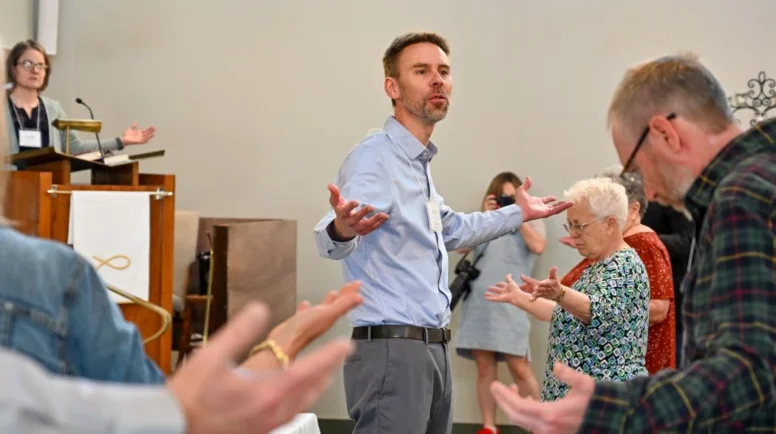
That was the central question behind Thursday’s day-long Faith-Based Development Summit hosted by the City of Louisville, the Local Initiatives Support Corporation and the United Church of Christ Church Building & Loan Fund. The Goodwill Opportunity Center in West Louisville hosted more than 100 attendees, who heard from speakers and panels discussing lessons learned, financing and home repairs — and what churches can do to ease the nation’s housing crisis.
The first speaker at the interdenominational summit was the Rev. Mark Elsdon, a PC(USA) pastor, speaker and author who edited “Gone for Good? Negotiating the Coming Wave of Church Property Transition” and wrote “We Aren’t Broke: Uncovering Hidden Resources for Mission and Ministry.” Elsdon, who co-founded Rooted Good and is a principal at Threshold Development Group, has partnered with the PC(USA) on its Good Futures Accelerator Course.
Elsdon posed a provocative question at the outset, one he heard a few years back during a conference in San Antonio: Could we solve the affordable housing crisis with church land?
“Could church real estate improve income disparity and the lack of living-wage jobs?” he asked those in attendance. “I invite us to sit with this question all day today.”
Related reading: “The vital congregation of tomorrow” by Mark Elsdon
Ten years from now, the nation will see “a lot fewer churches and church buildings than there are today,” he said. “More people will miss those churches and their buildings than you might think.”
A study by Partners for Sacred Places a few years back indicated that just 9% of church visits are for worship. Elsdon noted the rest were for community or educational activities. On average, the average urban church contributed $1.7 million in economic value to their community. “That’s a big deal,” Elsdon said. “Their significance is beyond dispute. What happens when they’re gone?”
Each year since 2019, more churches in the U.S. have closed than have opened, Elsdon said. More and more families and individuals are experiencing worship differently than they used to, including online. It’s an experience Elsdon related to the rise and fall of Blockbuster Video once movie streaming became routine. “It’s as if we told that Blockbuster manager to try harder or hire a younger, hipper manager,” Elsdon said. “There is nothing the video rental store could have done” in the wake of the ability to stream movies in the comfort of one’s own home.
No one wants to see churches closed with a fence erected to protect an empty building, he said. “We have community centers in our neighborhoods right now. They’re called churches,” Elsdon observed. “This is a moment of extra opportunity for new life, a new future. We have a chance to reimagine how property can deeply support human flourishing in our communities.”
In many urban settings, churches “own incredible infill land, often at the heart of the city and on bus lines,” Elsdon said. One study estimated that California churches owned 171,000 acres of developable land — larger than the city of Oakland.
Elsdon brought some of his real-world experience with Rooted Good to the attention of summit-goers. Moravian and Evangelical Lutheran Church in America congregations saw “an expanded view for mission” and joined to form Common Grace Church in Elsdon’s hometown of Madison, Wisconsin. The ELCA congregation sold its building and expertise from Threshold Development Group helped transform it into an environmentally sustainable 32-unit building that opened a year ago. The congregation brought the proceeds from the sale to Common Grace Church, which is opening a community center this fall “that flipped the old model upside-down” by involving 30 organizations who will use the new center, “one of which is the church,” Elsdon said.
Related product: “Negotiating the Coming Wave of Church Property Transition,” A Presbyterian Outlook webinar featuring Mark Elsdon
He also spoke of the Hand-in-Hand Business Center at First Presbyterian Church of Gulf Shores, Alabama. The church transformed its Sunday school wing into a business incubator, attracting nine businesses which have boosted the church’s revenues. “They have welcomed people who didn’t know the church even existed,” Elsdon said, “and they did all this in about 18 months. The building is now mostly full all week long and is contributing mightily to the community.”
He turned to the folktale “Stone Soup,” comparing that fictional community’s task to the work of expanding and repurposing church property. “It requires all of us,” Elsdon said.
“We have the opportunity to together activate our church-owned lands for the good of us all,” Elsdon said. “We have land, assets and people. Repurposing church property is an opportunity to do something new.”
Indeed, in the coming years, many churches and their buildings will be gone. “But I am incredibly hopeful that new and helpful things will emerge,” Elsdon said, “and they’ll be gone for good.”
During a question-and-answer time that followed his talk, Elsdon talked a bit about “Gone for Good?” The UCC’s Church Building & Loan Fund ensured that each summit participant received a copy.
Of the people who contributed chapters to the 2024 publication, “most of us are still in touch,” Elsdon said. “I believe in stories and examples, but not models. It’s so place-based and community based, and every one is different.” Churches must decide if repurposing or redeveloping their property will gentrify the neighborhood or help it, he said.
“Just because we can do something doesn’t mean we should,” Elsdon said.
Still, “the neighborhood will change regardless. Do you want an empty church, or 26 units of affordable housing?” he asked. “We’ve got to think about what is the future possibility.”
Watch Presbyterian News Service next week for additional reporting on the Faith-Based Development Summit.
By Mike Ferguson, Presbyterian News Service