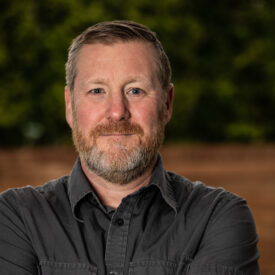
Robert Tolar had no intention of leaving the church he loved serving. But at age 63, near the end of his 17th year of service at First Presbyterian Church of Grove City in Ohio, he determined the epilepsy he had managed since he was 19 was advancing to the point he could no longer effectively provide full-time pastoral ministry to the congregation.
“It was becoming quite apparent that my epilepsy was getting worse and that I was forgetting things at church … people (would) say, ‘Well, I told you about this,’ and I’d have no recollection of it whatsoever,” he recalls of his complex partial seizure episodes.
“I made the difficult decision, even though I love pastoral ministries, to go ahead and give them a two-month notice to try to get them to the place where they could begin the process of calling a new pastor.”
Tolar’s final Sunday with the congregation and as a called minister was September 30, 2025, 17 years to the day of his arrival, and after 35 years of service in three PC(USA) churches.
He applied for long-term disability through the Presbyterian Board of Pensions (BoP) with the help of his wife, Paige, but the process of approval took nearly four months. Paige says the amount of paperwork, questioning and waiting was both mentally and financially devastating.
While both Paige and Robert praise the Presbyterian Board of Pensions for its help and advocacy, they say the plan’s administrative service provider, Lincoln Financial, put up extensive roadblocks during the application and approval process. Every participant interviewed by Outlook echoed this negative experience with Lincoln Financial.
In Tolar’s case, six weeks into receiving temporary disability payments as the claim for long-term disability was being assessed, he stopped receiving payments. Calls to Lincoln Financial were met with requirements for further documentation and the need to fax doctor referrals and other forms.
“Of course, nobody has a fax machine anymore,” says Tolar. “So we had to go to the library, find a fax machine – with all these documentations from doctors and from ourselves – and fax it to them.”
After submitting the requested information, they were told to expect a confirmation within 10 days. A call to Lincoln Financial on the 10th day resulted in the company saying they hadn’t received the documentation and Tolar would have to resubmit what he’d previously sent.
“We went from mid-November through January with no income whatsoever because Lincoln Financial said we had not updated our doctor’s reports,” Tolar says. Although the congregation was providing 30% of his income for short-term disability in the first 60 days, the remaining 70% from insurance was in limbo, pending Lincoln Financial’s approval.
Tolar was ultimately approved for long-term disability payments and Social Security Disability Insurance (SSDI) in January of 2026. Although he received back payments from mid-November, the couple says they were left with trauma from the process and the uncertainty.
Another difficult factor in this transition was the loss of community. When Tolar resigned from First Presbyterian, his presbytery reminded him that no contact should be made with former parishioners. For the Tolars, it was their community of friends, their support system.
“I still have a heart for Christ’s church and did not want to leave a church I loved,” said Tolar. “We found [a new congregation] where we both love the preaching, but we haven’t found a fellowship in the community that we had in our former congregation.”
Board of Pensions services evaluation
John Matekovic, the Board of Pensions vice president for income security, says the BoP has heard these concerns and is constantly evaluating the effectiveness of its overall service and how it can best represent Board of Pensions values.
“We understand there is frustration with how long-term disability is being administered,” acknowledges Matekovic. “There has been considerable turnover at Lincoln Financial, and we are working to address the continuity of service we provide to applicants and participants.”
He says some of the disappointment with applying for disability insurance is that it tends to be the least understood benefit offered in the BoP package. Compared to health and dental coverage and retirement and pension planning, Matekovic recognizes many plan participants don’t study the details of disability insurance as thoroughly.
“Healthcare is immediate. These benefits are not … which makes the process even harder because a person’s so unprepared for what’s coming down the road. And it’s the one benefit when you need it, you really need it,” Matekovic said.
Unseen illnesses
Jennifer Barchi contracted COVID in December 2019 at her son’s first birthday party. Her mother returned from an international trip feeling ill and attended the party, unaware (as much of the world was) of COVID’s possible effect on others.
“The birthday party was at the church, and they [the congregation] were invited,” she remembers. “A bunch of them got sick. One of them wound up hospitalized over time. And I just never got better.”
Very active and previously healthy, Barchi suddenly found herself experiencing severe fatigue and a series of long-lasting sinus infections. A brain fog set in that belied her ability to reason and her intelligence. As someone who graduated in the top 10% of her class at Stanford, she says, “I felt dumber, all my thought processes slowed down, and it was becoming harder for me to make good, sound decisions.”
In September of 2020, she made the difficult decision to leave her full-time call at Dickey Memorial Presbyterian Church in Baltimore and begin working at the Presbytery of Baltimore as its associate for church and leadership. At the beginning of 2023, Barchi reduced her role at the presbytery to half-time for a year before applying for temporary disability on February 1, 2024. A series of examinations and tests led to a May 2024 diagnosis of long COVID with multiple conditions including ME/CFS, POTS, mitochondrial dysfunction, and mast cell activation syndrome.
In 2024, when she applied for disability insurance, she was told she’d receive 60% of her last call’s salary, the half-time presbytery position, rather than the salary of a full-time pastor in which she’d served the majority of her ministry. When the Board of Pensions increased this percentage to 70% in 2025, she and others who began receiving long-term disability before the increase were not grandfathered in at the new rate.
In the struggle it took to qualify for long-term disability, Barchi’s wife, Lauren Smith, says she was repeatedly told by Board of Pensions representatives, “We are a fiduciary, and not a church.” When they sought help from the presbytery to get more information, Barchi says her stated clerk told her, “I had to do that with my husband, and it’s just the way things are.”
For Barchi and Smith, the prolonged diagnosis was complicated and frustrating because of the unseen nature of long COVID, which is a series of symptoms and conditions that affect each person differently. Even after receiving care and diagnostics at the Johns Hopkins chronic fatigue clinic, an independent medical examination was required to verify Barchi’s eligibility for long-term disability. It was an effort that caused additional stress and, after being approved for Social Security Disability Insurance, felt more like a fraud investigation than a verification of her doctors’ diagnosis.
(Note: Recent statistics from the Social Security Administration report less than a 1% rate of fraud in disability claims.)
“Even though I was granted SSDI, very shortly after that, the Board of Pensions informed me that I had to go through the yearly process or the six-month process [of verification] with Lincoln Financial,” she relays. “My condition is a condition where I have to pace my energy, and everything that I do costs. There is a health cost to it.”
With no end to her condition in sight, Barchi has begun to provide once-a-month pulpit supply for a small congregation, preaching and serving communion from a wheelchair. “I’m out for a week afterwards,” she says of the fatigue the effort causes.
And while this contribution to the life of the church gives her purpose, Barchi feels let down by the church for its lack of support for her and other pastors who’ve had no choice but to leave their pastoral roles and participate in long-term disability programs.
“In an organization that is a church organization like the Board of Pensions, within the disability side of things, they don’t have any pastors. There’s no one on staff who is a pastoral presence,” she laments. “At no time either, and this I’m sure varies presbytery by presbytery, but there’s no one in our presbytery whose job it is to be the pastor to pastors.”
For someone called to serve the church, who grieves losing the ability to serve in the way she feels called, the loss is especially devastating.
“You’re putting people through an incredibly traumatic process,” says Barchi. “You’re calling their integrity and their devotion to the church into question at a time when they and their family are incredibly vulnerable because this has completely shifted our identity as a family. We’ve had to grieve our dreams for the future. We’ve had to grieve our expectations of who we are and how we can operate. And there has been no one who has walked that road with us outside of our friends.”
“We’re all exhausted”
Kelly Updergraff was serving in her second call when COVID struck. The associate pastor at Trinity Presbyterian Church in Flower Mound, Texas, began experiencing extreme fatigue and was told by friends and colleagues, “We’re all exhausted. This is world trauma. Be very gentle on yourself.”
Unrelated to COVID, Updergraff was diagnosed with narcolepsy type 2, an autoimmune disease, fibromyalgia and hidradenitis suppurativa. By September of 2022, the symptoms had become so acute she could no longer work.
She began researching the process for long-term disability but felt her conditions weren’t serious enough when compared to others on disability. She was assured that any conditions that kept her from full-time employment were eligible for disability insurance and, with the help of Justin Hadden, one of two Board of Pensions death and disability specialists, she applied for and received long-term disability in May 2023.
“Justin is amazing,” says Updergraff. “He walked me through the whole process ahead of time and was like, ‘Here’s what we’re going to do, and here’s how you apply, and here’s what it will look like if you get long-term disability.’”
Hadden says he and his colleagues jump in as a connection between Lincoln Financial and the BoP when the transition from temporary to long-term disability is imminent. Alarmed that some had negative experiences with long-term disability applications, he says his hope is that the BoP could be hands-on when people are in need.
“We want to walk them through the process, let them know the differences between temporary and long-term [disability], and just really try and make that as smooth a process as we can for them,” he says of the approximately 145 long-term disability claimants he and his colleague advise.
Updergraff’s frustrations lie mostly with Lincoln Financial, which she feels is “biased against people whose disabilities are pain-based.” She says, “There are just a lot more hoops to jump through.”
Both Updergraff and Barchi have received prescriptions for GLP-1 medications, not for weight loss, but for treatment of other systems. Unfortunately, they both say the qualifications for continued prescribed use of a GLP-1 are adherence to a BoP-specified diet and weight management program, even though weight loss or management is not why these medications were prescribed. As a result, Barchi pays out of pocket for the medication, and Updergraff is unsure how long she will continue to qualify for it.
Untangling a confusing process
Long-term disability participants with whom the Outlook spoke each had different advice for others facing the eventuality – sudden or prolonged – of applying for the coverage.
Each participant had first applied for temporary disability while assessing their capability to return to work. The benefit is available after a seven-day waiting period and, since 2025, provides 70% salary replacement. Participants are eligible for this benefit for up to 90 days, and an evaluation to apply for long-term disability is automatically triggered near the midpoint of that period.
Loss of purpose was a common theme. Wondering how their call applies after a sudden, or even prolonged, period of illness was universal. For Barchi, the drive to continue serving, even in a part-time capacity, ultimately halved her benefit payments when she applied for long-term disability, as the benefit’s percentages are based on the last called position.
Hadden from the BoP sees this desire to serve in nearly every applicant he advises.
“One of the first things [pastors] always talk about when they’re applying for disability, something many of them ask is, ‘Well, when can I go back? I just want to be ready to go back.’”
Feeling disconnected from the church communities they served, the presbytery and the PC(USA) in general is also a universal experience. In an era where presbyteries are understaffed and in an environment in which rules prohibit pastors from contacting former parishioners, the loss of relationships is emotionally devastating.
Added to this sense of grief is needing to navigate a confusing process while at their most vulnerable. While many applicants for long-term disability have partners, family members or friends who can help them process paperwork and applications, some do not. Hadden says he and his colleague, with a combined 40 years of experience in benefits administration, “help become that [advocate], in a way.”
Despite this offered help, the experience of long-term disability can be isolating. For Barchi, her disability, the insurance process, and its ongoing requirements have made her feel powerless, even though her wife has been a steadfast advocate.
“There is a real sense of being not just forgotten by the church at large, but being betrayed by an organization that I love so much that I still want to serve it, which is really hard,” she says. “And it strikes me that among pastors, among those who are on the Board of Pensions, those who are on disability are likely in a spot where they have some of the least power because we don’t know who each other are.
“There’s no way for us to come together as an interest group that would have more power. But by the very nature that we are disabled, that we are disabled enough that we can’t work, our ability to actually do something is really limited.”