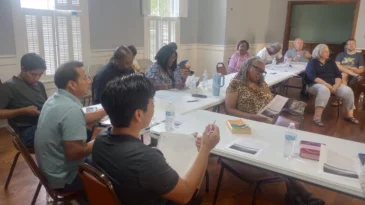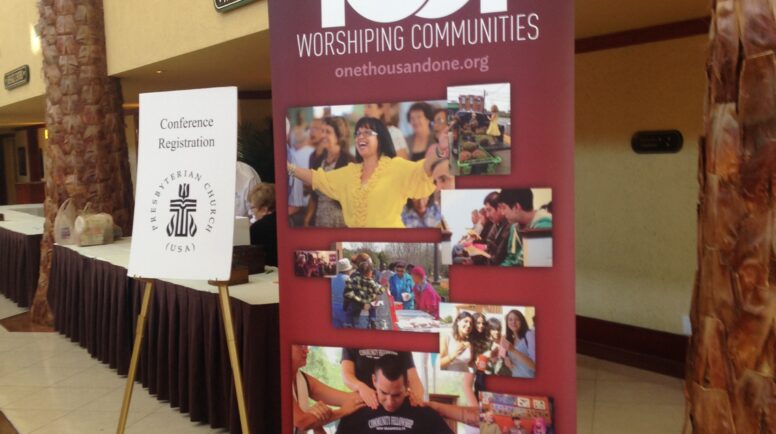
The first national 1001 New Worshiping Communities conference, “Pursued by Grace,” was held August 10-13 in St. Pete Beach, Florida. Previously held as a collaborative effort with the Presbyterian Church (U.S.A.)’s ministries of Evangelism and Church Growth, this year 257 participants gathered for worship, fellowship and to learn more about the calling to form new worshipping communities.
 The 2012 General Assembly approved the 1001 program – an evangelistic plan for the PC(USA) to create 1001 new worshiping communities from 2012 to 2022. So far, close to 280 communities have been formed, 1001 coordinator Vera White stated during the conference.
Those gathered represented presbyteries, established congregations, new worshipping communities that are already formed, and those at the early stages of exploration or emerging.
Attendees represented a broad spectrum of the Presbyterian Church with notable representation from Brazilians (worship included Portuguese praise songs), Koreans, Latinos and Africans.
CONFERENCE SOUNDBITES
For three and a half days, leaders of new worshipping communities and those curious about joining this ministry gathered for worship, plenary sessions, and workshops.
Workshops covered areas including to the changing needs of new worshipping communities, self-care, social media, coaching and stewardship. Special sessions were including for leaders in Hispanic, Korean, Brazilian, and African immigrant communities. Charles Wiley, the PC(USA)’s coordinator for Theology and Worship, also led a three-day intensive course on Reformed theology for leaders who have not attended seminary.
Plenary sessions featured speakers invited because they could speak to the specific needs of those leading new worshipping communities, according to conference planners. Rhashell Hunter, the PC(USA)’s director of Racial Ethnic & Women’s ministries, discussed the hallmarks of new worshipping communities, noting, “there is no one way to grow a worshipping community.”
Karl Vater, pastor and author of the book “The Grasshopper Myth,” addressed the specific needs of small churches, noting that 90 percent of churches in the world have fewer than 200 members. In a small church, Vater said, “mentoring is better than curriculum.”
Elizabeth Conde-Frazier, dean and vice president of education at Esperanza College of Eastern University in Philadelphia, implored people to move their chairs in order to physically look at one another during her session.
Rodger Nishioka, associate professor of Christian education at Columbia Theological Seminary, spoke about navigating change in the church. “Imagination and resilience are the two most important elements of leaders in this age.”

Worship included a variety of styles and messages designed to encourage participants. Keith Gunter, pastor of New Creation Church in Hendersonville, Tennessee (one of the 1001 New Worshipping Communities), reminded worshippers: “Our purpose is not to make our ministry supreme. Or our church supreme. It is to make Christ supreme.” Danny Murphy, general presbyter for Trinity Presbytery, proclaimed: “Courage is not the absence of fear, but moving ahead in spite of it.”
A Skype discussion with Marilyn Gamm, chair of the Presbyterian Mission Agency Board, was held August 11 to give participants with questions or concerns regarding the controversies of the past year a chance to come together for conversation.
Gamm read a statement addressing the decision of the Presbyterian Mission Agency Board’s Executive Committee to hire a law firm in late 2014 to conduct an independent investigation involving $100,000 in 1001 program grant money that had been sent to an unauthorized corporation set up in California. All of the money was returned, and Linda Valentine, the former executive director of the Presbyterian Mission Agency, has said none of those involved acted for personal gain. The investigation has so far cost the PC(USA) more than $1 million in legal fees. (Click here for a synopsis of the conversation and the full text of Gamm’s statement.)
In her statement, Gamm said “I take full responsibility for having taken the idea of doing an investigation to the Executive Committee. I stand by that decision.”
She also said her “support for the 1,001 New Worshiping Communities initiative remains strong and unshaken by any other events from the past year.” Gamm concluded by suggesting that “these challenges and crises” might be considered as opportunities to become “a leaner and more focused national church.”
Though refusing to answer any questions related to the investigation (citing attorney/client privilege), Gamm did respond to questions about trust (saying it “won’t be restored overnight”) and about the search for an interim executive director to succeed Valentine (once chosen, the interim may serve as long as three years).
A DIFFERENT KIND OF PC(USA) CONFERENCE
According to planning chairperson Keith Gunter, the goals for the conference were to gather the folks who know the ministry of 1001, provide hands-on resources and support relationships. “The strength of the conference is relationships,” he stressed.
“Programs don’t solve church problems,” he said, noting that pastoral care, relationships and prayer were integral to the gathering’s structure.
Gunter shared a few of the aspects of what makes this conference unique:
Community. The conference organizers were intentional about creating space with complimentary coffee and chairs to foster conversation and community building.

Hospitality. Gunter hoped attendees could leave work and responsibilities at home so they could be fully present. So the planning team tried to create a welcoming atmosphere of “peace and a prayer,” he said. At registration, a member of the planning team greeted each attendee – but not simply to distribute a name badge and schedule. Instead, the attendee was ushered into a hospitality room, invited to sit, served a snack or drink by the planning team member, and then asked how they’re doing and how the planning team member could pray for them.
Pastoral care. Three “conference pastors” were available daily for prayer, support and conversation.
Intensive. Why wasn’t this conference a part of Big Tent, held just a week and a half earlier in Knoxville? Gunter said that was because the work of developing new worshipping communities is new and difficult, so those involved in this ministry need more intensive time.
Gunter hopes people who hear about the conference “see this as the future of the church – giving life to the church that they so love … There’s a Spirit here that’s breathing life into a church that’s fighting.”
FUTURE CONFERENCES
In August 2016, the conference will return to its previous format and be once again held as a collaborative effort with Evangelism, Church Growth and Racial Ethic & Women’s ministries. Ray Jones, associate director for formation and evangelism, said the theme will be “Go. Disciple. Live.” (which was also the theme of the 2014 conference). Jones said that a planning team is already in place, will be meeting soon, and intends to have full information – including speakers – available later this fall. Next year’s conference will focus on “what God’s been doing, is going to do, and how we can keep joining God in mission,” he said.

The location – TradeWinds Island Grand Resort in St. Pete Beach, Florida – will be the location until at least 2017, said Chip Hardwick, the denomination’s director of Theology, Formation and Evangelism. Because of a multi-year contract with the resort, the price decreased dramatically, even making it more affordable than a PC(USA) conference center. Gunter said the location allowed the planning team to create a place where most meals are provided and where families can be included. (One pastor from central Florida said his adult children came with him – and look forward to this time together every year.)
Nonetheless, the southeastern location may prevent some from attending. To this end, conference leadership are considering what options – perhaps even a geographically- rotating location – may serve the most people in future years. “We want to be good stewards of the money invested and participants’ money. Where do we get the most bang for the buck?” asked Hardwick.
According to Hardwick, his staff is looking closely at things that were decided years ago, reviewing everything and taking steps to determine the right partnership.
Hardwick acknowledged that some have experienced “disappointments and challenges at the mission agency” in terms of supporting the ministries. However, he added, that “where God is at work is out at the bars and schools and RV parks … we should never get confused that what the mission agency does is somehow more important than what is going on in the trenches.”
He promised: “The conferences to come will be great places to come to see that action!”