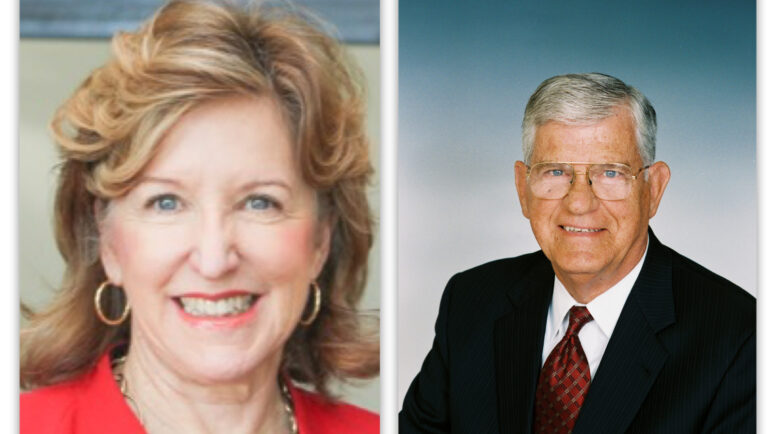
As I began to put together this issue of the Outlook dedicated to the relationship between faith and public service, I asked a number of elected officials whom I knew to be Presbyterian if they would talk with me about how their faith impacted their leadership in the public arena. I am grateful to Kay Hagan and Jim Martin for being willing to speak with me. They were generous with their time and forthright in their answers.
Kay Hagan

Kay Hagan was a state senator in North Carolina from 1999-2009 and a United States senator from North Carolina from 2009-2015.
Senator Hagan is the daughter and granddaughter of Presbyterians. Born in North Carolina, she grew up in Lakeland, Florida, and remembers attending Sunday school and worship every week. One vivid childhood memory involves a challenge sponsored by the church. Youth were invited to write an essay about “faith.” Hagan was chosen to read her essay to the congregation and was presented with a $100 30-year savings bond that she remembers as the most money that she ever received.
Faith, family and service went together for Hagan. When I asked her what compelled her to run for public office and if it had any relationship to her Presbyterian faith, she pointed to her family where Presbyterianism and public service went hand in hand. Her father was the mayor of Lakeland and her uncle, Lawton Chiles, was elected as a U.S. senator for 18 years and the governor of Florida for two terms, dying in office in his last month. She says of her family, “They were always participating in public service for the good of the community.” While others may have disparaged politicians, she knew her uncle and dad were “good, honest people” seeking the betterment of the community.
Her family and church reinforced the value that “to those to whom much is given, much is expected.” Her Presbyterian roots also emphasized the reality of free will and the charge to exercise that freedom in ways that uplift the entire community.
When I asked Hagan how she handled the often-contentious world of politics, she said, “You have to know your core faith and act on it. I am also a big believer in listening to your gut.”
What is core for her? That all people are created equal, that the strength of our communities (both local and national) is found in the depth and breadth of our diversity, that everyone should have access to quality public education and opportunities for jobs.
She is also a “big believer in the division between church and state.” She followed up by saying, “I am a full believer in my Christian faith and traditions, but I have great respect for other faiths and traditions.” To that end and in the tradition of Presbyterian ecumenism, Senator Hagan has long been involved with the organization NCCJ (National Conference for Community and Justice) whose mission is “To build a community free of bias, bigotry and racism.” She cited the transformative power of the NCCJ’s program “Anytown.” “Anytown” is a residential experience for high school students whose goal is, according to the NCCJ website, “to equip youth with the knowledge and skills to transform their home communities into places where individual differences are seen as positive tools that bring people together instead of keeping them apart.” Hagan’s support of this program stems from her belief that awakening can happen when people of all nationalities and faiths come together. Her own friendships and associations with people from many backgrounds and religions have taught her that “all religions blend together to form our society in the United States. There is not one right way.”
Hagan is a ruling elder and I asked her what she learned while serving on session that was relevant in her role as senator. She replied, “Within sessions you have a variety of perspectives but you have to show you are there for the common good. Different perspectives come together to advance the common goal —Jesus’ teaching.”
When asked about current challenges Americans are facing, she noted ongoing racial tensions, the importance of economic opportunities for all and the need for public education to be well-funded.
As our conversation came to an end, Hagan said emphatically, “I want to say this: We have great people in elected office that I am incredibly proud of, both Democrats and Republicans.”
Then she added, “We need a lot more people willing to serve in every level of elective office. We need a broad base of talented people.”
Jim Martin

Jim Martin served as governor of North Carolina from 1985-1993. He served six terms in the United States House of Representatives beginning in 1972.
Governor Martin is a PK, a preacher’s kid, who grew up in the church manse in Winnsboro, South Carolina. His father, Arthur M. Martin Sr., eventually moved into the role of executive secretary of the Synod of South Carolina and in that capacity organized interfaith pastors from the state to build support for the peaceful integration of Clemson College in 1963.
Martin is the second of four brothers, all of whom were shaped by “Pop’s instruction and mama’s discipline.” He remembers sneaking into the church to play the piano and occasionally turn on the pipe organ. Another childhood memory was not so pleasant: getting in trouble for playing pingpong on the Sabbath.
After graduating from Davidson College and marrying another Presbyterian, Dottie McAuley (they met at a Presbyterian summer camp), Martin continued his education and eventually returned to Davidson to teach chemistry.
When I asked what motivated him to run for public office, he said, “A lust for power in my heart.” He chuckled and then said that he initially got involved in local politics because he valued “two-party competition” and North Carolina was dominated by one party at that time. He was recruited to run for county commissioner and that led to running for Congress and eventually governor.
I asked Martin how his faith impacted his work as a political leader. “It was involved in the sub-conscious, not a kind of WWJD on issues, but always inbred in decisions because of your sense of morality, in the church, the Bible and in shared faith.” He also noted his awareness growing up of his father’s involvement in racial issues such as integration, “We were aware of it, approved it. We were proud of him.”
He noted that his Presbyterian upbringing gave him “a sense of obligation for service.” Adding, “Pop used to tell us how he admired prominent families who knew they had an obligation to serve the larger community.”
As we talked about the divisive climate of politics in recent years, Martin shared that when he served in Congress he lived with his family in Fairfax County, Virginia. That meant that he and his family attended church with other members of Congress regardless of which party they represented. Their children attended the same schools. They saw each other at the PTA meetings and neighborhood events. “When you don’t have that regular association through your kids or choir or community, you don’t get to know each other and then you don’t have the internal discipline to not demonize your fellow legislators. Getting to know others moderates the political behavior.”
Martin, a scientist by training and profession, has just completed a book on the relationship between faith and science. “Revelations Through Science” is set to be released early this fall. Ever the teacher, Martin explained to me the wonder of the relationship between RNA and DNA, telling me when I said I wasn’t sure I fully grasped what he was sharing, “If you don’t understand it, just say, ‘Wow! That gets to theology!’”