
 The 223rd General Assembly will address issues of racial justice in the convention hall and on the streets.
 Look for it, weaving in and out of the 2018 General Assembly of the Presbyterian Church (U.S.A.): a persistent, intentional focus on issues related to systemic racism and injustice.
Look for it, both in the work of the assembly and on the streets. When white police officer Darren Wilson shot and killed black teenager Michael Brown in Ferguson, Missouri, in August 2014, people took to the streets night after night in protest. St. Louis activists have remained mobilized and engaged ever since on issues involving poverty, racism and systemic injustice — and Presbyterian leaders want that commitment to inform the work of this assembly.
“It really inspires me to see what God is doing in this city through people of passion and people of justice who are ready to say ‘this is wrong,’ and are willing to do the work to make things right,” said Erin Counihan, who’s pastor of Oak Hill Presbyterian Church and has served on what’s been called the St. Louis Engagement Team, planning for this assembly.
“You see it all over the country right now. I hope the church can see more of that in itself,” Counihan said. “How is God calling us to face the hard stuff in our communities, and try new and just ways of addressing those issues?”
Here’s some of what to look for.
THE EVENTS
Saturday, June 16: From 9 to 10:30 a.m., Liz Theoharis – who is a PC(USA) minister and co-chair with William Barber II of the Poor People’s Campaign: A National Call for Moral Revival – will lead a pre-assembly event.
The co-moderators of the 2016 General Assembly, Denise Anderson and Jan Edmiston, are urging Presbyterians to read Theoharis’ book “Always With Us?: What Jesus Really Said About the Poor,” and to become involved with the work of the Poor People’s Campaign in their own states and communities. Think of this pre-assembly event as a primer on that work and on systemic issues of injustice.
Theoharis’ presentation will be followed by opening worship at 11 a.m., with Anderson and Edmiston preaching, lifting up concerns of poverty, race and privilege.
Last fall, J. Herbert Nelson, the PC(USA)’s stated clerk, convened what was termed the St. Louis Engagement Team — a group of about 10 people that met several times, looking for ways to connect this assembly with justice issues. That team determined that one point of focus would be what some call “debtors’ prisons” — the way people, many of them poor and of color, are locked up or kept in jail because they can’t afford to pay court fines and fees levied for relatively minor infractions. “That really is an issue in St. Louis,” said Tom Hay, director of assembly operations for the Office of the General Assembly.
The offering collected during the opening worship service will be used to support the work of ArchCity Defenders, a nonprofit civil rights law firm that provides legal services to people in St. Louis who are homeless or living in poverty.
Tuesday, June 19: At 3 p.m., a community action will take place — likely a march or rally, details are still being worked out. The idea is to publicly present the donations collected during opening worship and use that money to bail out people who are incarcerated for minor offenses but don’t have money to pay their fines. “While they are in jail, the fines increase,” Hay said. “They may have jaywalked. They may have been speeding.”
Some General Assembly committees likely will have finished their business when the community action takes place; others may still be working. Commissioners who are free may choose to participate in the community action, Hay said, along with General Assembly observers. “We are not going to say that we are expecting committees will quit” to take part if they still have work to complete, Hay said.
HANDS AND FEET
Thursday, June 21: The assembly will take a break from business Thursday evening, for a jazz concert by Grammy-winning tenor saxophonist Kirk Whalum — a celebration of the PC(USA)’s Hands and Feet initiative, with proceeds from the concert going to support Hands and Feet.
The idea behind Hands and Feet, which Nelson initiated, is that Presbyterians would be involved in the communities where the next three General Assemblies are being held: St. Louis this year; Baltimore in 2020; and Columbus, Ohio, in 2022. That involvement ranges from college students coming to do service work to the focus on justice issues at this assembly — including opportunities to “do some work outside the safety of the hotels and the convention center,” said Andrew Yeager-Buckley of the Office of the General Assembly.
This year, the Committee on Local Arrangements will have space in the exhibit hall for storytelling regarding justice and mission initiatives involving local congregations.
Several groups will come to St. Louis to do service work during the assembly, coordinating through St. Louis Urban Missions in Ferguson and AMEN St. Louis.
During the assembly, Presbyterian groups also are organizing other events that highlight needs in the St. Louis community, Yeager-Buckley said.
Monday, June 18: The Presbyterian Network to End Homelessness will make peanut butter and jelly sandwiches and offer prayers with and for people who are homeless. Later that day, that network will play board games and have conversation with local leaders and people who are homeless regarding root causes of hunger and homelessness and the church’s role in providing needed resources.
At dinner time June 18, the Compassion, Peace and Justice ministry area of the Presbyterian Mission Agency will share a meal and hold a prayer vigil with local leaders working in peace, justice and reconciliation.
Tuesday, June 19: A number of Presbyterian groups will hold a public rally, along with community leaders, calling for immigration reform.
BIBLE STUDY
Deborah Krause, who is a PC(USA) minister and academic dean and professor of New Testament at Eden Theological Seminary in St. Louis, and Raj Nadella, an assistant professor of New Testament at Columbia Theological Seminary in Decatur, Georgia, will co-lead Bible studies at the assembly — focusing on the theme “Kindom building in the 21st century.”
Krause said she and Nadella will focus on texts from the synoptic Gospels (Matthew, Mark and Luke) and that she plans to engage Mark’s Gospel in part by considering what it might have meant, what kind of “life-saving message” it brought, to those hearing it while living under the control of the Roman empire in the first century. One powerful theme in that Gospel is the idea of households, she said, which in that context meant not just a house but also the social and economic structures of the time. “For Jesus, that structure comes up wanting — it’s pretty bankrupt,” she said.
Following Brown’s killing, Krause became involved in the public protests. She said what’s happened over the past four years in St. Louis has been a “revelatory experience. … This revelation of our structural, systemic racism and how we embody that, how we live in our neighborhoods, our families, our households, and how church has been conscripted into that.”
Some nights, Krause said, she’d teach a class at the seminary on Mark’s Gospel, then drive to Ferguson and join her students at the protests. “The Bible became a pop-up book. It sprung up off the page into our lives in ways that have had a profound impact on my reading of these texts, on my personal piety, and on my teaching.”
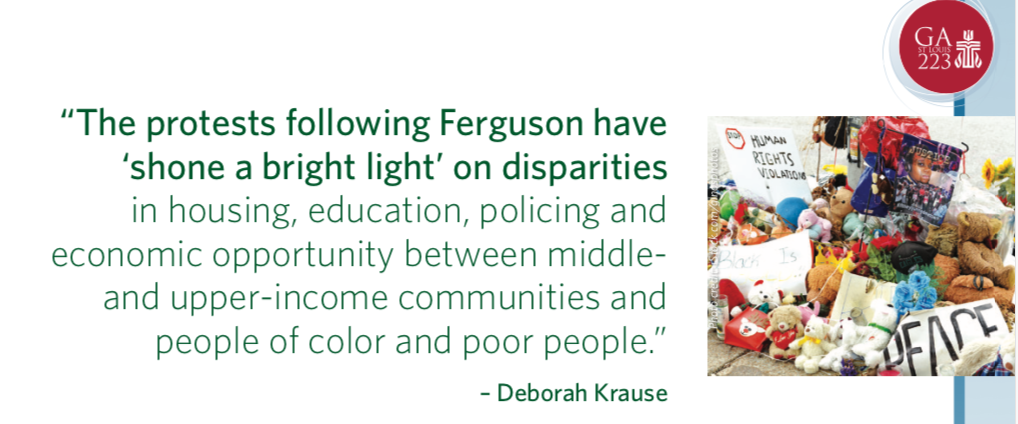
The protests following Ferguson have “shone a bright light” on disparities in housing, education, policing and economic opportunity between middle- and upper-income communities and people of color and poor people, Krause said.
White supremacy “normalizes this racist division. It’s easy to slip back into not seeing that,” particularly if people focus energy on the welfare of their own households and their own neighborhoods, she said. “It makes it very difficult to live out the theological claims alive in our baptism that we all belong to God, and we all belong to one another.”
THE COMMISSION
The assembly also will be considering items of business related to systemic racism and injustice. The Advisory Committee on Social Witness Policy, for example, is presenting recommendations it calls “A Gospel from St. Louis: Lessons from Congregations Seeking Racial and Economic Justice.”
 Also under consideration: a request for a reconfiguration of the Racism Truth and Reconciliation Commission that the 2016 General Assembly created in response to an overture from the Presbytery of Baltimore.
Byron Wade, a pastor from North Carolina, was named chair of that commission, but said the commission has never met because of difficulties in finding people to serve on it. The assembly’s action states that the commission should have 20 members, 15 of whom should be people of color, and that its chair should be a former General Assembly moderator or vice moderator.
So far, only eight people have been appointed to serve on the commission, and consequently “we have not met,” Wade said.
The original action called for the commission to form listening groups and report its progress to the 2018 assembly and make a final report in 2020. Wade said the request likely will be for this assembly to make the commission smaller and to have it report to the assembly in 2022.
There has been difficulty filling slots on the commission because “people in a sense are tired of dealing with race and racial issues,” Wade said. “They don’t know if the denomination will take racism and the change that needs to be made seriously.” Some younger people of color have declined invitations to serve because they don’t have the time or have other commitments, he said. “There has been a smorgasbord of reasons for why the commission has not been fully appointed as yet.”
THE COMMUNITY
There has been a lot of conversation about how to integrate the Presbyterian presence at the assembly with what’s already happening in St. Louis. One part of that was this question: Should the PC(USA) hold the assembly in St. Louis at all?
The acquittal in September 2017 of a white former police officer, Jason Stockley, who had been charged with murder after shooting a black motorist, Anthony Lamar Smith, in 2011 led to a new round of public protests. Part of the strategy of local activists was to launch an economic boycott — with some of the protests targeting shopping centers or stores, in an effort to bring attention to issues including minority contracting, bank loan practices and neglect of infrastructure.
During a series of protests at shopping malls and stores during the Christmas shopping season, “the goal was economic disruption,” said Craig Howard, transitional presbytery leader of the Presbytery of Giddings-Lovejoy, which encompasses St. Louis County (with 90 municipalities) as well as a swath of Missouri and southern Illinois.
That prompted some hard conversations in the presbytery about whether to ask the PC(USA) to pull the assembly out of St. Louis.
“We realized we were bringing our money to St. Louis by way of General Assembly,” Howard said. “We had to ask the question: ‘Is this something we want to do?’ ”
“We had some really hard conversations about it,” including the presbytery vision team, local pastors and the Committee on Local Arrangements, Counihan said. She realized that for the Office of the General Assembly, “they have signed contracts. They have spent money,” yet she works collaboratively with community activists on a range of issues – from education to police violence to food insecurity – and “I have to face these people in the streets all the time.”
Ultimately, the decision was made to keep the assembly in St. Louis — and to use that space “to raise issues of racial injustice while we are present, so it can become a fruitful assembly, and motivate us to do things once the assembly is gone,” Howard said.
“It can’t be just a business meeting. It can’t be just a family reunion,” Counihan said.
In the Ferguson uprising, “with the community screaming out after the death of Michael Brown, there’s been a reinvigoration, there’s been new energy to justice movements in the city,” she said, and collaboration among women’s rights activists, those protesting systemic racism, people concerned about incarceration, education, housing, jobs, minimum wage, policing, homelessness and more.
Howard recognizes that some General Assembly commissioners might not be comfortable with activism on issues of racial justice — he represents the whole of Giddings-Lovejoy Presbytery, from urban St. Louis to rural Missouri, and sees a range of opinions among Presbyterians.
Some pastors in the presbytery have become directly involved in the protests. Other congregations have developed church-school partnerships or provide food pantries — their focus is direct aid. And some Presbyterians work directly on advocacy and justice concerns.
Among the controversial issues is gun control, in a presbytery ranging from rural to urban.
 “Guns and Missouri are another animal — it’s a delicate dance,” Howard said. “It’s a delicate dance to talk about safe schools, knowing that part of the solution is some sort of control of weapons in some way, when people are packing. It’s easy to talk biblically about our role in doing mission in the world and our role in doing justice. But the reality is people like their guns. … How do we engage this with our own people?”
Both Howard and Counihan also have seen Presbyterians working collaboratively with young protesters, many of whom are not affiliated with organized religion and some of whom do not want church officials trying to take the lead.
“My experience in St. Louis in the last four years has been that the groups that are more affiliated with institutions are slower to do this work,” Counihan said. “So those of us in traditional, mainline faith organizations — we’re behind the lead.”
She works with Metropolitan Congregations United (a faith-based community organizing group) and also has ties to more loosely-connected bands of hard-working volunteers –
“this pop-up, rag-tag group of volunteers,” as she puts it – “who are doing this justice work and loving their neighbors and taking care of each other without the restrictions of institutional politics. … I really think it’s an exciting time to be in St. Louis. We’re a city that’s really dealing with what’s going on.”
Counihan is thinking hard about what lessons the St. Louis activists have to teach this General Assembly and the PC(USA).
“What could the church look like if we were able to be that honest with ourselves … if we had that commitment to making the change needed to be a more just church?” she asked. “We could do some stuff. We could do some stuff if we could be that honest with ourselves, that bold and that faithful.”