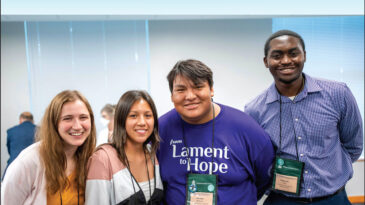
Motel 6 famously advertises, “We’ll leave the light on for you.” A clever slogan that embodies a sense of hospitality and home, and in St. Louis the lights are already on in anticipation of the arrival of family for the General Assembly. It is a homecoming of sorts as denominational “relatives” from north and south, east and west, gather for a time of discussion, decision-making, reflection and worship. The connections between churches and leaders who otherwise would not cross paths is renewed or established, and we recognize one another as kinfolk. Although others stay back to tend the home fires, still we are one family, sheltering under the promise of the kingdom and kin-dom of Christ.
The theme for this year’s assembly – “Renewing the vision: Kindom building for the 21st century” – strives to emphasize this connectivity. Warmly captured by Isaac Villegas in “The Kin-dom of mi abuelita” (published in The Mennonite), he describes it this way: “God’s kin-dom looks like my grandmother’s house – a house where there is always room around the kitchen table for another neighbor, another stranger, another guest, as God expands our vision for who are our kin, for who belongs in the household, for who can be served a bowl of arroz con pollo. … To be together as a church is the gift of salvation. To fellowship together is a glimpse of the kin-dom of God.”
We need not look further than our own Presbyterian constitution to find this idea of kin-dom interwoven with the foundations of our polity and underpinning the calling and marks of the church with their emphases on community, mutual love and witness as the one body of Christ. With this vision of kin-dom in mind, we may find ways to create family and a sense of home throughout the week of GA and well beyond by embodying the marks of the church through prayer. In so doing, our prayers can assist in focusing our intentions and interactions, enabling us to walk in the ways of faith and work toward the kin-dom we desire — not just for our denomination, but for our world.
You are invited to engage the following prayer practices during the week, privately and in groups, around tables, indoors or outdoors — in short, wherever you may find yourselves during the course of this gathering. We will begin by building our house of prayer using the four marks of the church as our cornerstones: unity (one-ness), holiness, catholicity and apostolicity (F-1.03).
UNITY: “The church seeks to include all people and is never content to enjoy the benefits of Christian community for itself alone. … Because in Christ the church is one, it strives to be one. … To be thus joined with one another is to become priests for one another, praying for the world and for one another.” (F-10302a)
Unity cannot be accomplished without building relationships, and intercessory prayer lends itself immediately to this intention. But beware: This practice often suffers from becoming generic, with scattershot prayers offered to cover a multitude of situations without making progress toward any real connection. This week at GA, you are encouraged to find a prayer partner on day one, preferably someone you don’t know well or at all. Find out something about them, offer to be in prayer for them and ask them to be in prayer for you each day during the week and, hopefully, beyond. By creating accountability, you also begin to form relationships. As you encounter specific struggles within churches and presbyteries represented, invest yourself in their well-being and wholeness through intercessory prayers during the week.
For those following the assembly from afar, you are invited to pray not only for your own delegates and the issues on your heart, but for the delegates of other presbyteries as well. Mapping or list prayers are helpful here. Simply pull up the “List of Presbyterian Church (U.S.A.) synods and presbyteries” (available with a quick search on Wikipedia) and devote some time each day to praying through the list so that, by the end of the week, you have prayed for all. While you may not know individual needs, you will have been in particular prayer for each one by name, thus making a connection with presbyteries far outside your daily interactions.
HOLINESS: “The holiness of the church comes from Christ who sets it apart to bear witness to his love, and not from the purity of its doctrine or the righteousness of its actions. … We confess the persistence of sin in our corporate and individual lives. … We also confess that we are forgiven by Christ and called again and yet again to strive for the purity, righteousness, and truth revealed to us in Christ.” (F-10302b)
This mark of the church reminds us that, on our own, we are prone to sin and, therefore, even our best intentions, doctrines and policies are not without stain. The suggested prayer practice here is examen, which is done at least once (ideally twice) daily. St. Ignatius, who conceived this approach to prayer, called on his brothers to closely examine the workings of their hearts and minds, the words they spoke and the actions they took (or didn’t take) throughout the day that reflected and bore witness to Christ (or didn’t). At the end of each day, preferably before retiring, set aside time for this prayer practice.
In its simplest form, begin by consciously acknowledging you are already in God’s presence. Second, give thanks for the day in particularity, naming your thanksgivings. Third, ask the Holy Spirit to open your eyes and your heart to receive fully and honestly what needs to be seen and understood. Fourth, thoroughly review the day. Where did you notice God’s presence? Where did you not? How did you respond to people or situations? When did you show love? When did you not?
In the environment of GA, there will undoubtedly be differences of opinions and perhaps even deeply held divisions that may bring up feelings of anger, bitterness or even distrust. This prayer offers opportunities to look honestly at our own witness and helps identify places of rawness and shortcomings. Were you rude to someone whose opinion differs? Were you indignant because a policy decision went another way? Did you reflect Christ’s holiness or did you reflect your own agenda and ego? Now offer those struggles and transgressions in prayer, asking God to forgive and transform you. Rest in God’s presence and be resolved to approach the next day with a renewed spirit of thanksgiving and love.
For those who are following GA from home, this practice is adaptable and encouraged. This prayer practice assists us in seeing our actions clearly as we move toward reconciliation with God and with one another, underscoring the need for both gratitude and forgiveness within our kin-dom. In so doing, we may hope (like the hymn says) that the world will come to “know we are Christians by our love.”
CATHOLICITY: “In the life, death, and resurrection of Christ, by the power of the Spirit, God overcomes our alienation and repairs our division. Because in Christ the church is catholic, it strives everywhere to testify to Christ’s embrace of men, women, and children of all times, places, races, nations, ages, conditions, and stations in life. The catholicity of the church summons the church to a deeper faith, a larger hope, and more complete love as it bears witness to God’s grace.” (F-10302c)
As you gather for worship or Bible study, you are invited to use the Scripture readings for prayer through the practice of lectio divina. God’s Word is revelation for all people in all times, it is not exclusively the property of any one person or denomination. It is the one Word, through which we may consider the breadth and depth of God’s love for all creation, without partiality, and God’s desire to be known to us.
This practice invites you to pray for illumination from the Spirit, then select a small section of Scripture to read slowly and attentively, aloud or silently, several times. Allow the words to wash through you, and if a word or phrase resonates, hold that word or phrase before you. Do not ask anything particular of this word, instead, open your heart and mind to the Spirit’s speaking this word, perhaps in a new way, to you. After you have been still with this word for some time, allow the prayer of your heart to form around it and lift this prayer up to the Lord. Remember to also listen and be attentive to God’s presence, ready to receive whatever is given. This prayer may be done whenever you have few moments of quiet between sessions, before or after meals, alone or as a group exercise with someone reading the passage aloud.
If you are particularly visual, are there images (perhaps a communion table set for worship), photographs from the day (found on Facebook or elsewhere) or even artwork being used as part of lessons or worship that you might employ in visio divina? Even the seal of the PC(USA) may be an useful image to reflect upon as you consider each element it represents for our denomination and for the catholic church. Visio divina follows the same basic steps, allowing the image to spark words or phrases as you engage with it.
Holy Scripture is a uniting Word, and through it we are emboldened in our witness and illuminated in our understanding. If we seek to embody kin-dom, then we must also be willing to regularly and seriously listen to and pray God’s Word as it guides, convicts, encourages and vivifies us.
APOSTOLICITY: “Because in Christ the church is apostolic, it strives to proclaim this gospel faithfully. … The church is sent to be Christ’s faithful evangelist: making disciples of all nations in the name of the Father, the Son, and the Holy Spirit; sharing with others a deep life of worship, prayer, fellowship, and service; and participating in God’s mission to care for the needs [of all people]; and to establish Christ’s just, loving, and peaceable rule in the world.” (F-10302d)
Inasmuch as we are called to go into the world to create a kin-dom of all people (not just the ones we know and like), the prayer practices suggested as a complement to apostolicity involve movement. Borrowing from our Jewish neighbors who employ mezuzahs to remind them of God’s Word and blessing whenever they enter their homes, you are invited to pray at each new threshold. As you enter your meeting rooms or plenary space, pause and say a prayer for a patient, loving and discerning heart, ready to listen openly to others and willing to engage in honest dialogue about issues before the gathering. As you leave, pause to reflect on which issues you struggled with, and how you may bring these questions, tensions or fears to God. Then take your prayers for a walk. Let these prayers move with you as you go in and out of rooms and buildings this week or at home. Turn off your cell phone, take out your earbuds, quiet your mind, listen to your heartbeat, take deep breaths. What thresholds have you crossed? Which ones are you afraid to cross? How might you enter into new relationships that expand your idea of God’s family and kin-dom if you open some new doors?
The General Assembly is only one week, but that doesn’t mean our work ends there. We are called to continually uphold the marks of the church as we gather together, inviting one another to the table, always willing to make room for one more. Everyone is welcome in God’s house, for it is a place of worship and prayer that unites us in Christ and encourages us in the ways of kin-dom. The door is always open, and the light is always on.
 Nadine Ellsworth-Moran is associate pastor at Reid Memorial Presbyterian Church in Augusta, Georgia.