Is it time to reconfigure the national structure of the Presbyterian Church (U.S.A.)?
What do Presbyterians at the mid council level have to say about per capita?
The work of the PC(USA)’s Special Committee on Per-Capita Based Funding and National Church Financial Sustainability is beginning to take shape, some four months after its members were appointed, although exact recommendations to the 2020 General Assembly won’t emerge until the end of 2019 (on financial sustainability) and February 2020 (on per capita).
But it’s becoming clear in the discussions of the committee’s two work teams that its members are thinking big – including considering whether the current structure of the PC(USA), more or less established when the northern and southern branches of Presbyterians reunited in 1983, still works given the current financial realities.
Laura Cheifetz, a minster from Georgia who is co-moderator of the special committee and who leads the financial sustainability team, sat in on a recent conference call of the Committee of the Office of the General Assembly (COGA), along with team member Scott Lumsden, co-executive presbyter of Seattle Presbytery.
Cheifetz told COGA that the team is looking at both revenues and expenses in the denomination. And it has been talking about how the concern over financial sustainability in the PC(USA) may not be that “there is insufficient money, because we are Presbyterians and we are wealthy,” but may focus more on how allocations are handled among the current six PC(USA) agencies.
Among its concerns: How does the Office of the General Assembly ask for money when it needs it?
The short answer: It asks the General Assembly to raise per capita.In 2018, there was resistance when J. Herbert Nelson, the PC(USA)’s stated clerk, proposed a significant increase in per capita – so he scaled back that request, leaving the Office of the General Assembly with less money than its leaders wanted, meaning it’s expected to exhaust its per capita reserves by 2020.
Nelson said during the COGA meeting, “I do agree with you” that it’s time to revisit the configuration of the national denominational structure. “There is a time to rethink what the whole structure looks like,” Nelson said. “I would be excited about that kind of conversation.”
 Kerry Rice, the deputy stated clerk, said in the 35 years since reunion there have been restructurings within some of the PC(USA) agencies, but “we haven’t had that bigger conversation” about the possibility of restructuring the denomination as a whole.
The 2018 General Assembly created the special committee after concerns kept surfacing about whether a per capita system (in which congregations are expected to send a per-member assessment to support the work of the broader church) is still viable or working well in a denomination that’s been losing members for decades. And the Way Forward Commission recommended taking a look at financial sustainability — in part to inform the work of other groups that also will be reporting to the 2020 General Assembly in Baltimore.
Led by Valerie Young, a synod executive from Texas who’s the special committee’s other co-moderator, the committee’s per capita team has scheduled a series of conversations this summer and fall with synod and presbytery leaders across the church. It’s trying to get a sense, for example, of whether presbyteries and synods collect per capita, how they collect it and if they could envision a better funding system for the PC(USA).
The Moving Forward Implementation Commission also has delegated to the special committee the job of overseeing a “collaborative self-study of the per capita model” to be undertaken by the six PC(USA) agencies – something the 2018 General Assembly instructed be done, following a recommendation from the All Agency Review Committee.
That likely will take place after most of the mid council listening sessions are complete — and will include conversation with agency leaders about how much each agency interacts with the per capita system or how it might do so; what the agency could do to help the per capita system; and ideas they have for per capita or alternate funding systems for the denomination.
The financial sustainability team is looking at both the revenue and spending streams for the PC(USA) — including looking at where the responsibility for particular initiatives from the General Assembly is placed, and whether there is duplication or overlap in the work being done.
Without a comprehensive missional and programmatic inventory across the agencies, it’s hard to understand “where the money is going or to reallocate money or how to reorganize when we don’t know where our asset mapping is,” said Eliana Maxim, a member of COGA.
Lumsden has raised questions about how the money is divided up among the six agencies — particularly between the Office of the General Assembly and the Presbyterian Mission Agency.
With a Presbyterian Mission Agency budget of more than $70 million, “there’s more than enough money there to do this work,” Lumsden said. “J. Herbert and COGA should not be in the position of having to beg for money at the General Assembly when there’s more than enough money to go around. … This is not sustainable.”
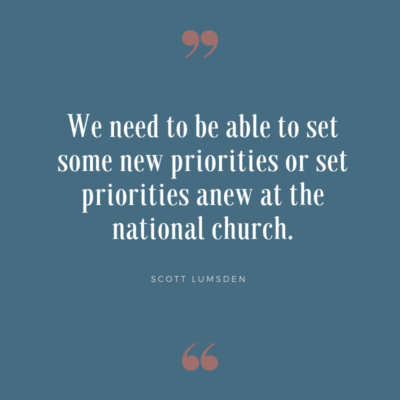
Instead of each agency setting its own budgets and priorities, “we need to be able to set some new priorities or set priorities anew at the national church” to accomplish what the General Assembly determines is most important, Lumsden said.
The Presbyterian Mission Agency Board plans to hold a consultation with mid council leaders August 4-5, following Big Tent in Baltimore, to discuss mission priorities – not “dollars and cents,” said Warren Lesane, who’s that board’s vice chair and also a member of COGA, but narrowing down the priorities from General Assembly to the top handful.
What are some of the roadblocks to making changes in denominational funding?
Inertia and resistance to change, said COGA member Stephanie Anthony, a pastor from Illinois.
“There have been ongoing battles and struggles going back 30 years,” Nelson said. PC(USA) agencies haven’t always worked together – “there’s been a competitive edge,” he said. “All of that is the elephant in the room nobody wants to talk about, which is keeping a lot of stuff from happening, but is very real.”
 The financial sustainability team also has talked about the role that General Assembly plays — overseeing the budgets of the agencies, but not necessarily having the time or bandwidth to analyze them in depth. The General Assembly also sometimes gives instructions for new work to be done on issues it considers important — for example, on racism or sexual misconduct.
Within the denomination, who’s responsible for doing that work? Who decides that?
With limited money, who sets the budget priorities?
And is there enough accountability and clarity about how all that works?
Those are the questions the special committee will consider going forward — and which are likely to continue percolating in the months to come, including at the Presbyterian Church (U.S.A.), A Corporation board meeting, to be held July 18-19 in Indiana. That meeting is being held in proximity to the Presbyterian Youth Triennium, which will draw more than 5,000 teenagers to the campus of Purdue University in West Lafayette, Indiana from July 16-20.