 I remember hearing a pastor once define church in a way that struck me as odd. He said, “The church is supposed to be a place where upon arriving, you look around and say to yourself, ‘What in the world could all these people have to do with one another?’”
I’ve found this definition of church to be profoundly true. While the sign on the door reads “First Presbyterian,” our pews on Sunday are filled with a mish-mash of born and bred Baptists, Pentecostals, Wesleyans (myself included) and those who grew up having no idea why one would need to know what “church” is. Beyond our intermixed denominationalism, I’ve come to discover that each Sunday our congregation is a diverse geographical mosaic. In my time at the church I serve, I’ve been pleased to meet Salisbury, North Carolina, natives, Northwesterners, Floridians, East-Coasters, and yes, people from Ohio who root for the arch nemesis of my beloved Michigan Wolverines (we’ve been practicing reconciliation — jury’s still out).
Even amidst the beauty of our diversity, there are also ways in which American mainline churches like ours practice unity as uniformity. Typical of Presbyterian churches, ours is a racially and socioeconomically homogenous congregation. Our Sunday sanctuaries are not reflections of the kind of diverse community we would encounter down the street at the barbecue joints and coffee shops that flavor our downtown with an earthy panache — and barbecue sauce.
Cultural critics are not surprised by the segregation of our religious spaces. As has always been the case, the church is a product of human culture. More than ever in our country’s history, people are choosing to live in neighborhoods where people look like them, vote like them and spend money like them. Group think has become our resting pulse. Our thought-worlds are myopic and shallow. In other words, the polarization produced by our news cycles and social media wars is maliciously manifesting itself in where we worship and where we call home. If the image of God is defined as unity as diversity, then that image in American Mainline Christianity is deteriorating.
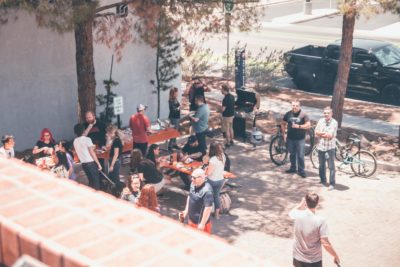
In this world of hard questions, there are no easy answers. On Sunday night, August 18, from 5-7 p.m., there was a church parking lot block party that offered a glimpse, a foretaste, of our answer. As I sat atop the uncomfortable dunk-tank throne, ready at any moment to be submerged by the wild pitches of First Presbyterian’s children and youth (I’ll get them back for that), I looked out at the swath of humanity before me. What I saw can only be described as a beautiful surprise.
Little black and white children piled into a bouncy house accompanied by shouts of glee. Youth representing different schools, different socioeconomic classes and different ways of life laughingly devoured ice cream and consumed hot dogs together. Residents from Country Club Drive and Martin Luther King Boulevard broke bread (read: wings and fries) as their children got back into the dunk-tank line for the umpteenth time. Strangers became neighbors, and the body of Christ got a bit bigger for us all. I wasn’t the only one delighted and surprised by this kingdom of heaven block party. I saw on the faces of many of our congregants a look that communicated, “This is what church is supposed to be like.”
As I took it all in, I couldn’t help but wonder, “What in the world could all these different people have to do with one another?”
The answer to that question will define our church in the future.
The answer is the name of the one who has brought us together.
The answer is Jesus Christ.
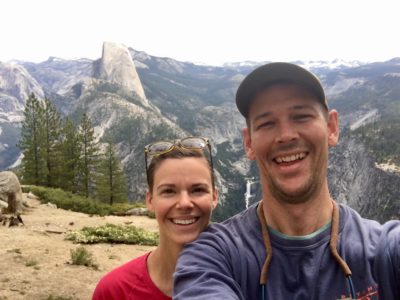 JOSHUA MUSSER GRITTER co-pastors First Presbyterian Church in Salisbury, North Carolina, with his wife Lara. They watch movies together with their dog Red.