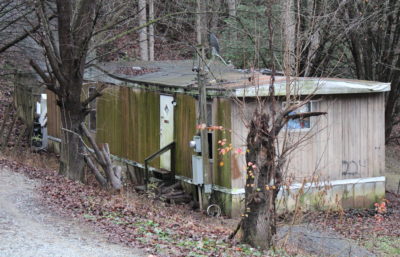
BRYSON CITY, North Carolina – This winter’s night, there was a bit of good news. After being homeless for six months, Christy and Jason had finally found a place to live, a trailer to rent halfway up a North Carolina hill – hard to come by in a market in which affordable rental housing is scarce and goes fast. For the first time in a long time, the couple could sleep with a roof over their heads.
There was bad news too. “It’s rough,” Christy said, shaking her head. “Really rough.”
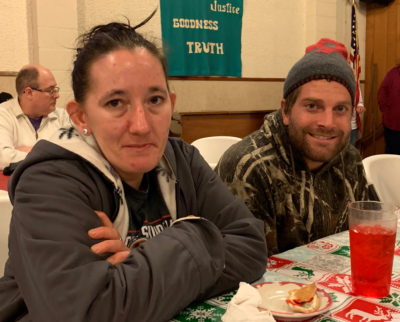
Describe rough. “It’s got rats in there – big as possums,” she said. The toilet worked, but the bathroom was “disgusting,” she said – with mold on the walls, dirt, a potent stench. The kitchen lacked a stove. As Christy worked to clean up the place, her foot sank through a rotten spot in the floor and she fell onto her back, staring up at “holes in the ceiling you can see right out,” at broken windows, stuck in the floor up to her knee.
She lay sprawled there for a minute, thinking of the $400 she’d already paid for the first month’s rent, money she could barely afford, wondering if she’d made a mistake.
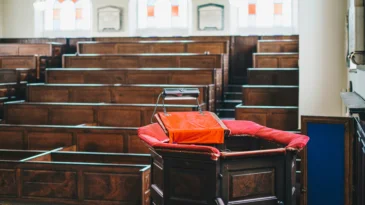
That night, Christy (who preferred not to give her last name) sat in the fellowship hall of Bryson City Presbyterian Church, talking with Kathleen Burns, who runs The Giving Spoon, a nonprofit which provides a hot meal once a week to anyone who shows up hungry.
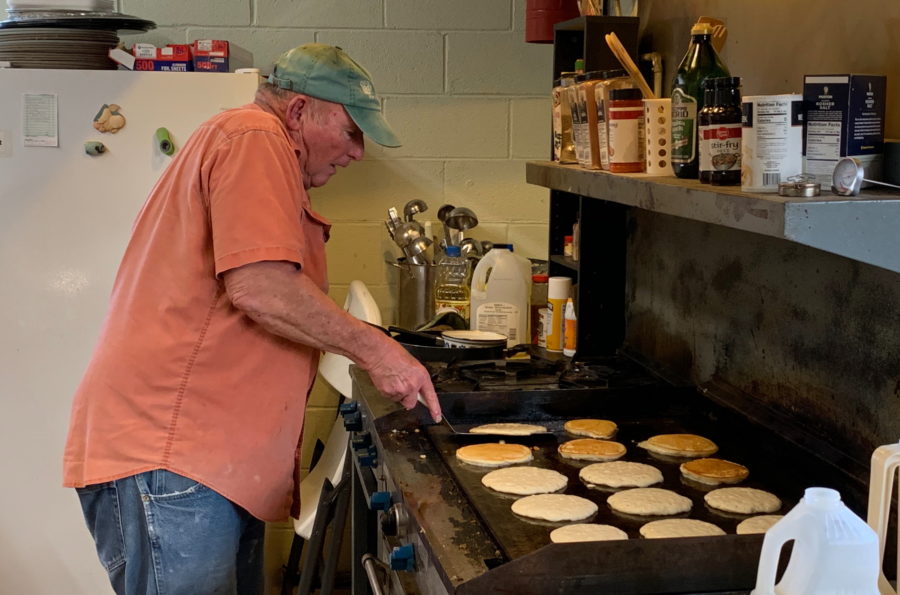
The Giving Spoon opened in February 2019, and now serves an average of 125 meals every week – with Burns and her crew of volunteers planning to expand soon from serving one night a week to two.
There’s “no f—- heat” in the trailer, Christy told Burns, her head hanging down. “No heater. … I wished I didn’t do it. I am in a pickle.” The trailer’s owner, her landlord, has a reputation for being reluctant to make repairs and “already lives in a big old mansion at the top of the hill.”
A few weeks earlier, Christy’s 15-year-old son had been shot in the head, playing around with a gun with a friend. “I just want to get my little boy home – he’s been in the hospital so long,” she said, her voice soft. “It seems like every time I start to get ahead, something knocks you back down.”
Her partner, Jason, had spent the afternoon ripping up carpet, tearing a rat’s nest out of the closet.
It was already dark. An 18-year-old boy – who said he’s been sleeping in a tent behind his parents’ house for months now, but that’s another story, asked, “Are you sleeping in that trailer tonight?”
Christy put her hand to her mouth.
“Got to,” Jason replied.
The face of food insecurity
The people eating pancakes and egg casserole in this church hall are part of the face of food insecurity in the Smoky Mountains of North Carolina, an hour or so west of Asheville. Among those around The Giving Spoon tables are senior citizens who live alone on fixed incomes, young adults who can’t find stable jobs, families with children and not enough food to go around.
This is a region that’s dependent on tourism, with clear economic disparities – driving the twisty mountain roads, you see an expensive vacation home, then around the next bend a shack with a crumbling roof and rusted cars in the yard.
Burns, who started this program in 2019 after a career in social work and mental health, knows the local statistics for Swain County – “We are among the poorest in all kinds of measures,” she said.
- In Swain County, 14.2% of the county’s population of 14,208 identified as food insecure in 2017, according to Feeding America, which tracks hunger statistics across the nation. That means 2,020 people in the county struggled with not having enough food to feed themselves or their families.
- Nearly two-thirds of the students in the Swain County public schools (64.1%) qualified for free and reduced price lunches in 2017-2018.
- In 2018, close to one in four children under age 18 in Swain County lived in poverty (22.9%), according to the U.S. Census Bureau. Even more live in households that the U.S. Department of Agriculture considers “food insecure.”
- Swain County was ranked 95 out of the state’s 100 counties when it came to food security among children in the Public School Forum of North Carolina’s Center for Afterschool Programs’ Roadmap of Need 2019.
And as difficult as things are in Bryson City, this is not a North Carolina problem. Food insecurity is an issue all over the country – in big cities and rural areas, in all age groups and races. Often, someone in the family is working, but there’s not enough money to pay all the bills. So people do what they can – going without food to pay the rent, the electric bill, to buy medicine.
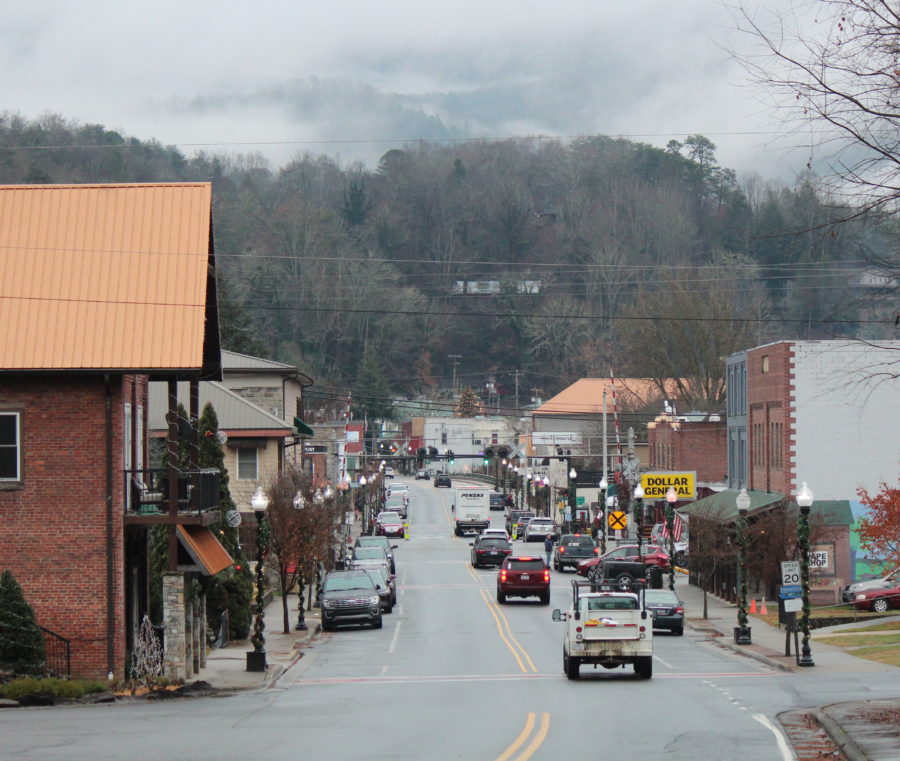
Due largely to problems with drugs and alcohol, it’s not uncommon, Burns said, for grandparents to be raising their children’s children – often with little money to go around.
The Giving Spoon rents space in Bryson City Presbyterian, and gets food from MANNA FoodBank. MANNA stands for Mountain Area Nutritional Needs Alliance, and serves 16 counties in Western North Carolina – a part of the state where hunger is persistent and pervasive. MANNA trucks deliver food to feeding programs and food banks all over the region – in an area that’s “very rural and very hungry, compared to the rest of the nation,” said Kara Irani, MANNA’s director of marketing and communications.
The Giving Spoon also has forged relationships with local businesses – with Burns and her husband, Harold, driving every week to the local Food Lion to pick up food which the grocery store donates. Just before Christmas, the PepsiCo Inc. distributor in nearby Whittier donated $700 – the PepsiCo employees volunteered to give the money to help others instead of having a holiday party for themselves.
Volunteers help too: that week, Kim Shuler baked and decorated 100 cookies. Shuler, who works for a local business, said she was not aware of homelessness or hunger as a problem in Bryson City before she began talking to Burns.
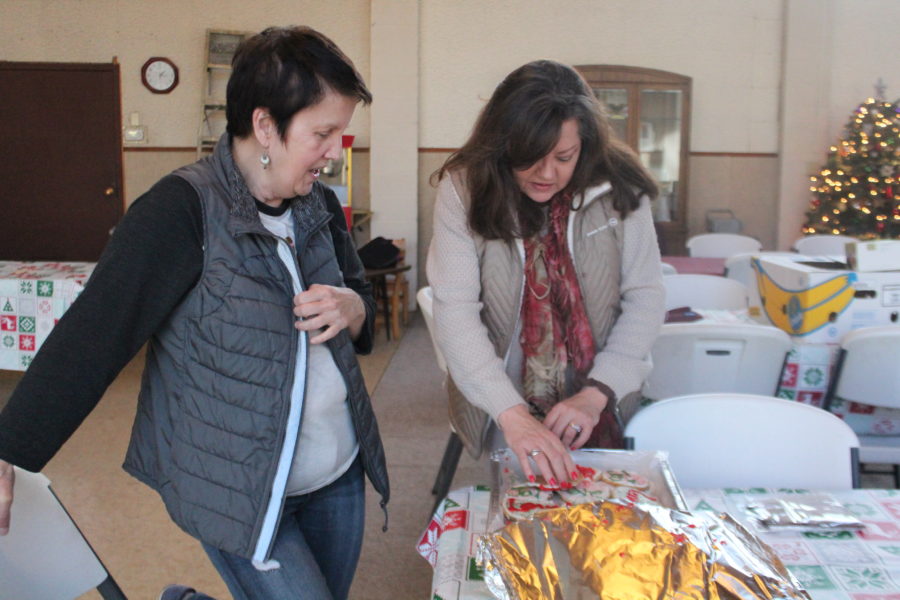
Food insecurity means “you do not have the means to have enough food for three meals a day,” Burns said. “I would say some don’t have enough means for one meal a day.”
Some have a place to live, but “they’re vulnerable because they are old. They have health conditions. And they’re eating alone, or they’re not eating.”
Shuler started paying attention: noticing the people sleeping on cardboard under the bridge. Some are addicts or mentally ill, Burns said. Some have had medical problems or been evicted. “You can see a lot of professional people that have lost their jobs and have nowhere to go,” Shuler said.
Getting by
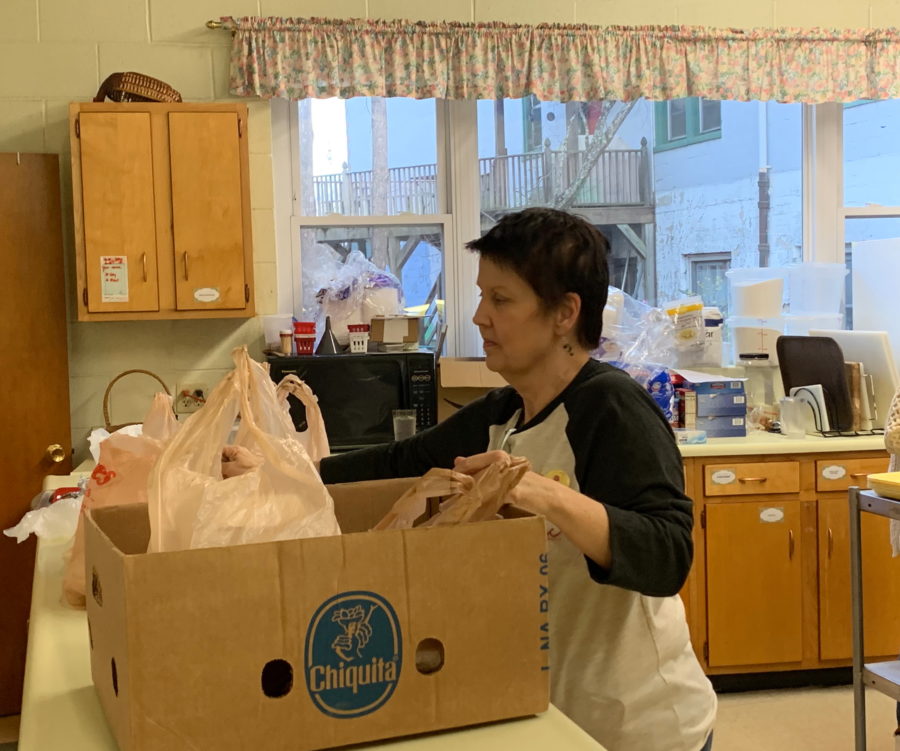
Along with serving a hot meal, Burns handed out gift bags filled with supplies from MANNA – deodorant, shampoo, personal hygiene products. A table to the side was filled with food people could take home: sweet potatoes, apples, cheese crackers, hazelnut cream-filled puff pastry – whatever MANNA or the grocery stores were giving away.
The Giving Spoon “helps me a whole lot,” said one guest, John, who only wanted to give his first name. “Because I only get $13 a month in food stamps.”
He moved to Bryson City at age 20 from New Jersey. He’s now 66. He owns his own home – “finally,” he said – but has little else to live on, pulled down by medical problems.
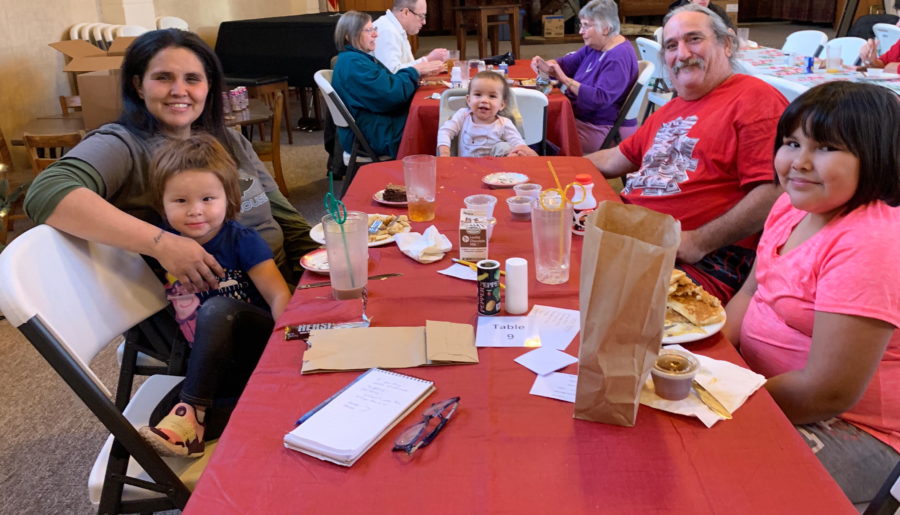
Kandi and Mike Fulford brought three of their 10 children for dinner. “We really appreciate it,” Kandi said. Sometimes the food stamps run out, “sometimes we don’t get enough to eat, and we come here and our bellies are full.”
Mike Fulford does physical work – construction, remodeling, plumbing and electrical, just about anything he can find. In 2019, he had three surgeries – the latest in November – and “it’s putting me out of work.” That night, he’d only been out of the hospital for two weeks.
Like a lot of people, the Fulfords live paycheck to paycheck. “We’ve had it when we’ve been doing really well moneywise,” Mike said. “This year has been really tough on us.” When the bad times come, “it don’t discriminate. It can hit anybody.”
Volunteer Terry Bevino, a retired teacher and school administrator, describes hunger as a critical and sometimes invisible need in the region. She knows there are children who don’t eat at night; their only food comes from the breakfast and lunch programs at school.
“It’s impossible to learn if they are hungry,” Bevino said. “You certainly know that you stand out, and that’s never fun for a kid.”
Sometimes, families split up to try to make things better for the children. Carla, who didn’t want to give her last name, has been living for months in a minivan in a parking lot across the street from the church, sleeping in the vehicle along with her fiancé and his mother. They’ve been homeless since July, because “the landlord was a jerk,” she said, and made the family of seven leave, even though they had paid their rent on time. Carla said she found a place for her children to stay, but there wasn’t room for all of them, so the adults are camping in the van for the winter.
What’s that like? “Horrible,” said Carla, who is 33. “Horrible.”
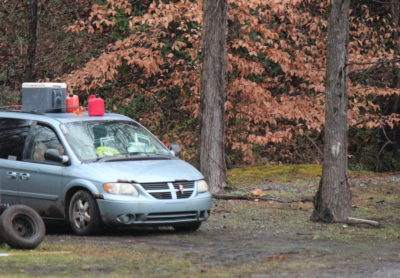
When it gets too cold, they “pray to God we have enough gas to start the van,” she said. They use the restrooms in local stores. They have a cooler, to store “whatever food we can get ahold of.” If they do hear of a place to rent, the demand is so intense they have to hand over the money immediately – the rent, plus first and last month’s deposits – or someone else will take it.
“It’s depressing, very depressing,” Carla said. “Our whole family is separated. We only get together one time a week, if that. People don’t understand how hard it is. … We’re surviving. It’s not really killing us, but it’s killing us,” and the children don’t understand “why we can’t be together.”
She is grateful to Burns for providing hot meals and helping her look for housing – either permanent or temporary. “Getting a house is our hope.”
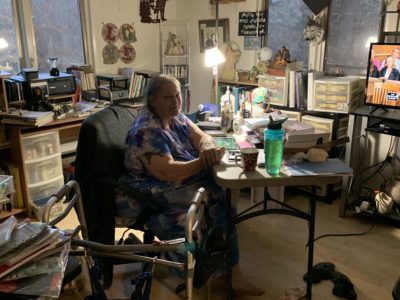
Each Thursday, Burns’ husband Harold delivers a carload of meals the volunteers have boxed up to go – one of them to Sonja McMillan, a senior citizen who has lived by herself in a subsidized apartment for the past 10 years. She has a home health aide who helps some, but she’s legally blind, can’t drive, can’t use the stove.
McMillan’s grocery budget is $50 to $75 for the entire month – that’s all she has to spend. “It goes pretty fast,” McMillan said. “I’ve done without quite a bit.” Thanks to The Giving Spoon, “I have a meal at least on Thursdays. This has been a godsend.”
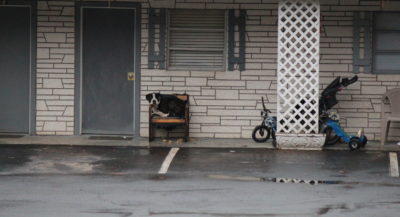
After visiting McMillan, Harold Burns drives a few miles out of town to a former motel turned single-room apartments that rent for $175 a week or more – an increasing trend in this tourist area, where housing is scarce and old-style motels can have a hard time competing with the newer hotels being built. Renting each room by the week or month, they can bring in thousands per room for the year – with minimal amenities and limited repairs.
Burns climbs out of his car, and knocks on the door of a room of a man he calls Pops. Pops is from South Carolina, where he worked for a long stint on a dairy farm and also as a police officer for close to 30 years. After he had a stroke, Pops moved to Bryson City to live with his brother. That didn’t work out, Pops said, so now he rents a room at the former motel – surviving on Social Security. After he pays his rent, he has $335 left to cover everything else for the month, Kathleen Burns said.
Pops loads the boxes of meals onto his walker. With a dog accompanying him, he rolls the dinners down the sidewalk, knocking on doors to deliver them to his neighbors, many of them elderly widows. “God bless you,” Pops tells Burns, walking into the night.
“The deeper you get into it, the more you learn,” Burns said, driving away. “Golly, Moses.”