COVID-19 has created a precarious and uncertain time for Presbyterian-related camps and conference centers. Will there be summer camp? Will the loss of revenue force some camps and centers to close?
It’s too soon to tell. These are tough times — but it’s also a season of innovation, as camps try to think through new ways of connecting with families, and to envision what virtual camp might look like if there can’t be a physical camp.
Also new: The Presbyterian Church Camp and Conference Association (PCCCA) has created an online portal, in partnership with the Presbyterian Mission Agency’s Office of Christian Formation and the web developer Worship Times. According to Joel Winchip, PCCCA’s executive director, this portal will allow individual camps to set up their own sub-domains through which to operate virtual camps from May 15 to August 15 — an online spot for everything from registration to setting up videos and virtual activities.
As the coronavirus pandemic became real in the United States, “the first couple of weeks, our camp staff was just shell-shocked,” said Brian Frick, associate for Camp and Conference Center Ministries with the Presbyterian Church (U.S.A.).
Facilities that book retreats and other gatherings for the “shoulder season” – leading into the spring and extending into the fall – lost all their spring bookings, and some had to furlough staff, Frick said. “That was the initial response, which was horrific for them.”
Since them, some have applied for forgivable loans under the Small Business Administration’s Paycheck Protection Program, which would give some relief. So far, very few camps have canceled summer camp, and some are taking registrations —knowing they might have to give refunds later, Frick said.
There’s a mix, from some that are saying, “We’ve basically lost summer, we need to figure out how to work around that,” to those who say “we have our fingers crossed” and are hoping to run in-person camps for at least part of the season, Pam Harris, a consultant with Run River Enterprises, told the Presbyterian Mission Agency Board during a discussion April 17 on the finances of Stony Point Center.
“Everyone at this point has said summer’s going to be different; we don’t know what that’s going to look like,” she said. “Everyone that we know has said safety is the first priority.”
Winchip said most camps are “continuing to put eggs in different baskets” — to keep options open as the response to the pandemic evolves.
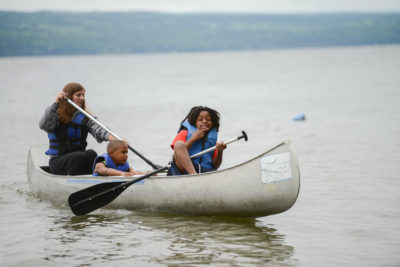
Along with the uncertainty has come creativity — partly an attempt to think in new ways about how camps can connect with families and congregations. What about a virtual Vacation Bible school? What might be some intergenerational opportunities? How about online tours of hiking trails or a video canoe trip across a lake? How can facilities learn to build connections with campers and their families not just for a week or two in the summer, but throughout the year?
Every Thursday, Frick convenes an online conversation with camp directors – a place for people to air their concerns, their hopes, their ideas.
Montlure Camp in Arizona, for example, is taking registrations via the portal for “Camp Reimagined,” a virtual camp with a combination of online activities and self-guided ones — some of them intentionally intergenerational. The Montlure staff is putting together “camper boxes” with T-shirts and other camp memorabilia (which will be available either for drive-by pickup or mailed) and is “encouraging campers to construct a space for camp” — maybe a tent in the back yard or a fort in a bedroom, the website states.
“We want you to know virtual camp is not a replacement for camp indefinitely,” it also says. “We know it isn’t the same. We know there is a lot to grieve about our time physically apart this year and that there is nothing better than physically being at camp together. But virtual camp is a way we can intentionally stay connected, have meaningful conversations about faith, and still have some fun (we promise!) in this weird time in human history.”
How will camps and conference centers fare financially during this weird time?
The ones that were struggling before COVID-19 hit – those without enough campers, donor support and reserves – “those are the ones we may lose,” Frick said. “They were in trouble before, and this is just the thing that will push them over. … If they have a high debt load, they are in danger because they don’t have cash.”
For about the past 40 years, roughly one camp a year would close, Frick said. “That was pretty consistent. I would say it accelerated a bit as the larger churches left” the PC(USA) for more conservative denominations.
But camps have also learned to innovate in order to survive, he said — for example, serving nonprofit groups beyond the summer season or conducting traveling day camps. Ferncliff in Arkansas conducts a nature preschool and has a warehouse for storing and distributing Gift of the Heart kits that congregations assemble for Church World Service and Presbyterian Disaster Assistance.
As with congregations that now are meeting virtually and are reconsidering ways of being community and worshipping together, camps also are considering what it means to be places – either virtual or real – where young people can explore their connections with nature and ask faith questions they might not be comfortable presenting in other settings, Frick said.
“One of the reasons that I stayed involved in church was I went to camp, and it was the first place where I was known for who I was and not what I did,” he said. “I could ask those faith questions” — things like “if God created the universe, then who created God? Camp creates the space for faith questions” that, inevitably, young people will ask about how COVID-19 is changing the world and their schools and families, what it’s teaching about humanity and loss and inequity and connectedness.
Whether in person or virtually, the questions are coming.