 While I was leading a church-sponsored trip, the father of a parishioner told me a family story. His two daughters had left the nest. His adult son, who was intellectually challenged, remained at home. Every Sunday, he, his wife and their son worshipped in their Lutheran congregation. One week, for some reason, it seemed prudent to stay home, and the father told his son that they would not be going to church that day. The young man was silent for a time, and then asked, “Won’t Jesus miss us?”
It was a touching question, one that highlighted the simplicity of the young man and the charm of what seemed to be his naiveté. Although I have described this scene in print more than once, the passing of time has led me to revisit it with an ever-increasing sense that it reveals something profoundly important. His unguarded description of how he experienced the church at worship is a reminder of what has dimmed for many of us in a secular age, or even been lost.
The whole of Western culture took a turn several hundred years ago that has led to our drawing a sharp line of separation between what we “know” intuitively, and what we can explain in a convincingly objective way. The latter is privileged in our society, while the former is held in suspicion. This is so even though some of the most important things we “know” had to be learned before we were even capable of speech.
It is unfortunately too common that we go to worship as though we were going to a classroom that’s been made a bit more welcoming with a bit of music. We may be looking forward to learning the lesson we expect to hear from the pulpit, or we may simply bear it, but what we expect, in any occasion, is to be taught something. No wonder that a 9-year-old, when told that the family must go to church on Sunday since it will be Easter, responded that she didn’t need to go since she already knew what Easter means. The lesson mastered, no repetition was necessary. At an early age, the girl has already acquired the sense that worship is basically a kind of school.
While it is true that when we are paying attention we are quite likely to learn something in worship, the acquiring of information is basically a side benefit, not the main point. It is the intellectually-challenged young man who gets the point. He is not equipped with the mental tools for processing information that is in the least complicated. In church, he does not bring any expectation of learning much that is new to him or finding intellectual support for the faith he already has. Since both of these capacities are important for most of the rest of us, his deficits may arouse our pity. However, it might be worth saving some of that pity for ourselves, who have our own deficits. Because, having been so carefully taught to doubt any conviction that cannot be demonstrated in a manner that passes for “proof,” we have unplugged a part of the original equipment with which we were born.
One might dare to go so far as to say that relentless cultural programming has caused us to disable parts of ourselves. Those inborn capacities that enable us to meld intuition and experience (without disarming our reasoning powers) have been nearly shut down, especially when it comes to our dealings with God. These capacities are still accessible when it comes to everyday relationships, so they are not entirely missing. But when it comes to the really big picture, the ultimate relationship, we are likely to find ourselves at a loss. The young man who worries that Jesus might “miss us” is abled precisely where many of us are disabled.
When he goes to church, he is immersed in a bath of experiences that he welcomes and embraces without worrying about testing them intellectually. It is not in his nature to be suspicious of what he senses and feels. Of course, this means that he is vulnerable, and his vulnerability requires protection from those who care about him. But vulnerability is appropriate in certain circumstances. Letting down one’s defensiveness, one’s guardedness, whether intellectual or emotional, is an essential component in the formation of our deepest relationships, certainly including the one with the holy God.
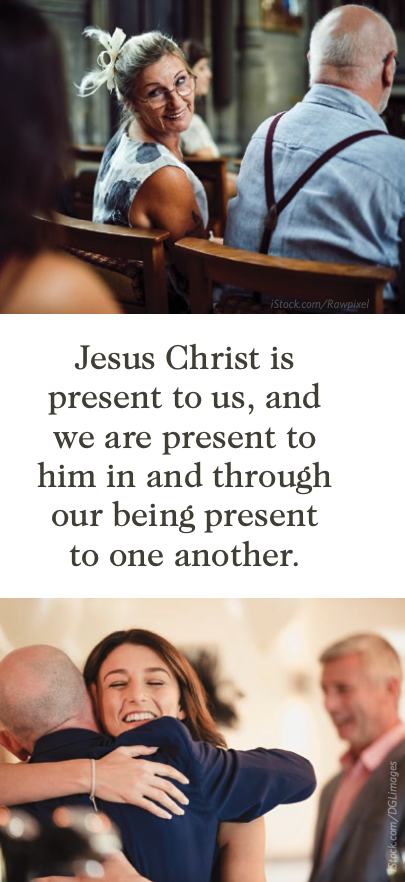 For the young man to worry that the Jesus he knows most intimately from church might “miss us,” is to draw attention to his sense of the presence of the risen Christ. Jesus Christ is present to us, and we are present to him in and through our being present to one another. The young man is welcomed at church and, finding a place in the assembly, he is included as an equal rather than separated from those whose abilities are different from his. He knows the sung and spoken responses, cued by familiar words, all engraved on his heart, never to be forgotten to the end of his life. He knows when to say “amen.” He joins in song as best he can, unrehearsed, with those who can carry a tune and those who can’t. He receives and offers the peace, hand in hand, face to face.
If he is so fortunate to be in a worshipping congregation that understands that worship is offered in and with the body as well as in the head, he will have mastered the commonplace gestures and movements that represent a body language that can be as profound as spoken words. He will join the parade moving toward the bread and cup, bodily rehearsing the lifelong, shared journey toward the heavenly feast. And, as he moves with the others, he will see their faces, young and old, faithful and not-so-much, in whatever diversity is represented in that place. He will taste and see that the Lord is good. He will receive the blessing offered at the dismissal, and never worry that he might have fallen short on sincerity here and there, or been distracted, or otherwise offended God by a momentary lapse of attention. In short, he will be present, and embrace presence, naturally and without self-consciousness.
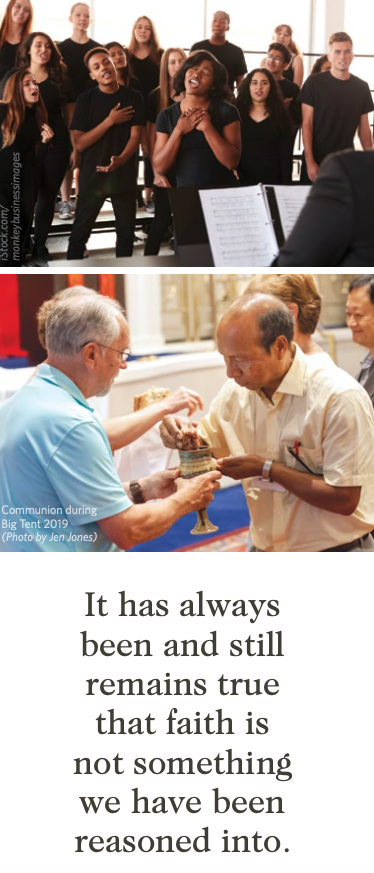
In an era marked by an uneasy skepticism about churches and about faith itself, those who are not yet ready to give it up find themselves looking for reasoned support for not throwing in the towel. But it has always been and still remains true that faith is not something we have been reasoned into. Yes, of course, we can find arguments to support our faith, but normally faith comes first, followed by a lifetime of mentally organizing the reasons that strengthen it. Faith is reasonable, so to speak, but it is more than an opinion about God, Christ and holy things. As such, faith is a response to a whole complex of experiences, some involving reasoning, others coming to us in subtle ways for which there may be no unambiguous explanation. To speak about it at all requires a variety of imaginative uses of language that exhibit the same kind of truthful subtlety as a painting does — or a hymn, a poem, or a carefully crafted story.
Worship has never been intended to be either a classroom or a concert hall. The Bible is not a textbook. Liturgical language is not the language of engineering or journalism. Worship is meant to be a meeting place. It is a place of “presence.” I am not talking about emotion, necessarily, nor excluding it either.
 Those who know at least a little about church talk know that “presence” is likely to be the sort of language expected when we talk about the sacraments. But preaching is also about presence. Preaching is not just lecturing on a religious or ethical subject, not exhorting, not motivational speaking, not explaining the historical context of 2 Kings or 2 Corinthians. Those things will happen, but they play only a supporting role in a unique kind of speech. The intention of this speech is to lead us to a state of attentiveness to the God who offers us a place of meeting in and through language carefully used.
The starting place for preaching is the language of the Bible. Biblical language has human fingerprints all over it. One can see it as a piece of art, even a kind of “graphic” art constructed out of ordinary words. It draws attention to the God who is able to be present to us in, through and in spite of the limitations of human speech. Sometimes, it uses indirection as the most direct means to create a meeting place. It invites us to be present to God, Christ, Spirit.
Preaching becomes its best self in the original and normal context of the sacramental meal, which serves as an invitation and foretaste of the meal to be shared by predator and prey alike, reconciled in the peaceable kingdom. Preaching is what the meal would be were it to be expressed in words only, and the sacramental meal points to and embraces that One whose life, death, resurrection and coming reign is meant to be central in our preaching.
Lord George MacLeod, a minister of the Church of Scotland, founded the Iona Community in 1938. He was pastor of a church in Glasgow that served a neighborhood in which most people worked with their hands. No doubt they were bright people, but, in worship, processing spoken language proved not to hold much attraction. MacLeod struggled to understand how to minister to them in worship, and concluded that a way to do that might be to recover a lost treasure — a celebration of the sacramental meal every Sunday, just like our Reformer John Calvin had pleaded: sermon and sacrament, side by side, each critiquing, amplifying, complementing and enhancing the other. The glory of the Word was made manifest in spoken words and in the same Word made manifest in action: taking, breaking, giving thanks and nourishing the hungry faithful in bread and wine — Jesus Christ, our food and drink
“Won’t Jesus miss us?” The young man serves to remind us of what we have so often lost: an inborn capacity to see and welcome God among us in the language of “doing” as well as in the language of the thoughtful mind (Luke 22:19). Philosopher Paul Ricoeur has reminded us that, when we have lost confidence in the naiveté of our childhood, there is nevertheless the possibility for what he calls the “second naiveté.” That sounds to me like setting aside our culturally induced suspicion of the peculiarities of the necessary languages of worship, both those spoken and unspoken. Particularly, permitting ourselves to enter less guardedly into worship in its “doing” mode. Whether it is the language of bread and wine or the language of Bible, prayer and preaching, it is all offered as one great meal, refreshment in our wildernesses.
 Ron Byars, professor emeritus of preaching and worship at Union Presbyterian Seminary in Richmond, Virginia, explores themes like these in his recent book “Believer on Sunday, Atheist by Thursday: Is Faith Still Possible?”