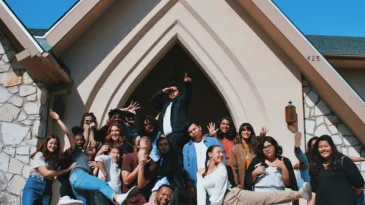
Businessmen Dick Van Houten and Ken Stuhr were the natural leaders, but I alone had formal training, so we took turns providing the preaching. Their moral support reinforced my vocational hopes. But after two years of waiting — “You’re still a bit young, Jack,” they said to my terribly mature, 23-year-old self — my thoughts shifted toward theological studies.
When Gary and Carol Castle approached Barbie and me to offer funding to help provide a seminary education, we heard the voice of God calling us to “come over to Gordon-Conwell Theological Seminary,” a logical choice for a northeastern evangelical.
I saw no need to earn a full M.Div. degree. But I did know that my education thus far, even with two semesters of Biblical Greek, had not answered for me the question, How can I assess which interpretation of a Biblical text is most accurate, especially when published commentators disagree. I also realized from our fledgling church experience (our new unaffiliated congregation had split off from another almost new unaffiliated congregation), that a few skills in church leadership might come in handy.
So off we went for two semesters of seminary study.
Freshmen orientation wasn’t fun, in so far as this non-denominational school sure had little good to say about non-denominational pastors. We were pressed to find a denomination, commit to it, become accountable to its leadership, and give it loyal support.
A first semester course on Biblical interpretation answered many questions regarding faithful exegesis and hermeneutics. But, “Prolegomena to Systematic Theology” introduced me to contextual theology, completely bending my mind toward ideas theretofore out of bounds. And just the listing of practical ministry courses highlighted how little I knew.
So when leaders at the home church asked me to consider bringing my now 24-year-old self back to serve as pastor, I responded, “I think I have a few more things to learn before I’m really ready to lead a church like this.”
They called somebody else to be their pastor.
I stayed in seminary.
I learned a few other unexpected things, like:
… how worship involves much more than singing simple ditties of pietistic adoration followed by a stirring lecture — and, indeed, operates best when it is itself a re-presentation of the gospel of grace,
… how Calvin’s proclamation of the saving power of special grace was matched by his promotion of God’s universal common grace,
… how many social justice movements have arisen on the winds of church revivals, as awakened Christians have asked, “If I’m supposed to love my neighbor as myself, which neighbors am I free to exclude?”
… how many great awakenings and revivals have led not to huge schisms — as my unaffiliated self had believed — but to denominational renewals and reconciliations.
… And how, in the final analysis, when you figure out exactly what you know to be right and true, ministry effectiveness will come as you embrace and work through the ambiguities such ministry brings.
In other words, I needed to learn much more than I had imagined. And, seminary provided just the laboratory I needed to learn it. It even sent me not to lead that fledgling non-denominational church but to assist in a large Presbyterian congregation: my major selling point being that they didn’t need to pay me the presbytery minimum, since I wasn’t ordainable.
Eventually I was ordained, called to my own Presbyterian Church (USA) congregation, and as soon as possible enrolled in the D.Min. program at Columbia Theological Seminary. There I gained lots more tools, especially the one absorbed more intuitively, the Reformed worldview, the surface of which I had barely scratched.
Through all those years of education, I became more conservative and more liberal, more evangelical and more activist, more traditional and more progressive, more entrepreneurial and more contemplative, more pastoral and more missional, more congregational and more connectional, and more ecumenical. Seminary can do that for you. Has it? If so, send us a letter and we’ll share it for others to read. The professors, administrators, alums, and contributors who made it possible deserve our thanks.
— JHH