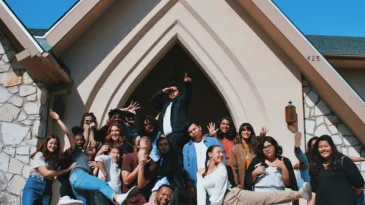
Imagine that happening today at one of our colleges. Imagine that happening at Yale.
Well, it did happen. In 1802, the Second Great Awakening burst upon the New Haven campus under the influence of its president, Timothy Dwight, the grandson of Jonathan Edwards. Fully one-third of the student body professed faith in Christ.
Could it happen again today? Could it happen at one of our Presbyterian Church (U.S.A.)-related colleges? Would we want it to happen?
Given the scant few reports of such outpourings over the last 200 years, even in Pentecostal and other revivalist tradition schools, our colleges seem to be content to leave such stories in the annals of “simpler” times.
We leave such memories back there because we Presbyterians have formed schools that embody our less sectarian values. We mostly leave to our churches the task of proclaiming the redeeming and transforming power of the grace of the triune God. Yes, that gospel message does circulate around our colleges but usually at whisper volume. And, our devotion to that gospel message, in turn, has driven us to pursue the deepest possible understanding of it. That pursuit has generated a high level of academic scholarship across many disciplines — and it’s that scholarship that particularly marks our schools of higher education.
The over-arching Reformed theological concept — the sovereignty of God — compels us to study every aspect of the cosmos operating under God’s providential care. Anything observable by giant telescopes or electron microscopes, anything conceived via logic or intuition, anything theorized by scientists or psychologists, anything imagined by composers or poets —any and all of it has turned into a God-given calling upon many a believing Reformed Christian. Many of those Reformed Christian scholars exercise their gifts and callings on PC(USA)-related college campuses. And, truth be told, most of those fields of study have been challenged and enriched by the research and creativity of non-believers, skeptics and even infidels.
So our campuses invite aspiring students to experience a mixed bag:
• saturation education in academic majors under the tutelage of leading scholars,
• a 360-degree view of the range of ideas in every field,
• up-close connections with international students,
• on-site classes on overseas campuses,
• exposure to the scholarship and friendships of believers and unbelievers alike.
And to do all that learning in an environment that encourages thoughts about the Sovereign.
Yes, talk about God is encouraged in our schools, and in fact, it’s experiencing a kind of revival on our campuses.
God-talk and even God-thoughts have come through a tough era in recent decades, one in which Enlightenment Rationalism/Empiricism played its academic- guild-bestowed trump cards again and again to knock God, faith, and Scripture out of the academic arena. But this new “post-modern” era has effectively eliminated the trump card system, forcing every field of thought and endeavor to make its case in the free market of ideas. And, no better place exists to do that than in the leading schools of church-related liberal arts education – yes, PC(USA)-related colleges and universities.
That’s not to say that that this endeavor is an easy one (see p. 12). As John Kuykendall, president emeritus of Davidson College has said, “The encounter of faith with knowledge yields results which are rarely pat or predictable; and the trend in more recent generations seems to have favored evading or abandoning the challenge of trying to hold faith and learning together.”
But our schools are trying more than ever to take on that challenge. They are doing so by providing interdisciplinary courses that explore the interface between faith and science, the arts, business, etc. They’re also doing so by providing expanded chapel programs and interfaith student fellowship groups and faith-based volunteerism.
In the process the proclamation of God’s grace seems to be rising above that of a whisper. And that’s a good thing. Who knows, maybe a spontaneous divine visitation waits just around the bend.
— JHH