“The utterances show that he no longer cares about relations with the bishops
who have been bold enough to stand up to him,” Lovemore Madhuku, a political
commentator from the University of Zimbabwe told ENInews. “[Mugabe] knows it’s
almost impossible to get the mainstream churches to follow him,” Madhuku added.
In his latest tirade at the Zimbabwe Catholic Bishops Conference on 21 April,
Mugabe said the bishops spread lies about the country’s situation. “There are other so-
called bishops who fall under what is called the bishops’ conference who are always
telling lies, no truth at all,” Mugabe said at the opening of a conference hall in the
town of Masvingo, south of Harare, for an apostolic sect, the Zion Christian Church.
He praised the leaders of the sect while attacking his critics.
“Look what these bishops of my own church are doing, always attacking me every
year. They say our government oppresses the people when the truth is that the bishops
don’t understand the wishes of the majority of the people of this country,” said
Mugabe, who was raised Roman Catholic and educated in church schools.
Joseph Tanonoka Whande, a columnist in the privately-owned Daily News said
Mugabe’s conduct was not consistent with his Christian background and urged
believers to stand up against the three-decade ruler. “I cannot understand Mugabe’s
behaviour against the church and how he reconciles his beliefs with what he is
doing,” Whande said in a column on April 21. “It’s no longer just politics. It is now
the perpetration of evil. We cannot continue to stand and watch as Christians are
abused by thieves and murderers who have ruined a nation so much blessed by God,”
Whande wrote.
Previously, the Catholic bishops, in a February pastoral letter, deplored violence by
supporters of Mugabe’s Zimbabwe African National Union – Patriot Front (Zanu-
PF) party. “We are concerned about politically-motivated violence,” the letter read
in part. “We urge our political leaders to desist from intimidating and mistreating
members of the public, the media and civic communities and uphold human rights.”
Mugabe’s attack on the clergy last week came days after police detained a Catholic
priest, the Rev. Marko Mkandla, after he gave a sermon at a memorial service for
victims of a government crackdown on dissidents in the 1980s that was believed to
have left over 10,000 people dead.
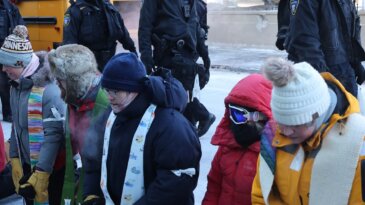
On April 9, riot police broke up a church service in the capital, Harare, and beat
up and arrested 14 people including priests attending the service. It was held to
commemorate a similar prayer rally in 2007 which was stopped by the police, who
beat several people, including Morgan Tsvangirai, now prime minister in a power-
sharing government with Mugabe. An activist from Tsvangirai’s party was killed as
police used live fire to disperse the congregation.
After falling out with the mainstream church, Mugabe has sought the support of
apostolic sects. Last year he attended an annual pilgrimage of one of the sects and
appeared in pictures wearing the church’s white robes and wooden rod. On that
occasion he railed against gays and lesbians and urged the adherents to oppose rights
groups seeking to have gay rights in Zimbabwe’s new constitution.
“This is a strategy to gain votes because members of these sects tend to follow what
their leaders tell them,” Madhuku said.
Despite the strained relations, churches still play a leading role in Zimbabwe,
providing low-fee education and health services as the country battles to recover
from a nearly decade-long economic crisis which saw annual inflation at one time
peak to 231 million percent. In addition, church hospitals are the major health service
providers to the poor as government hospitals still lack essential drugs and are often
short-staffed.