by Paul Roberts
As I write this, the annual birthday commemoration of Martin Luther King Jr. is just around the corner. In a recent discussion, colleagues raised this question: When so many people seem to treat our national commemorations merely as days off work, do they have meaning to us any more?
In response, one friend invoked a symbol that has become important to me in recent years: the Sankofa. Sankofa is a West African term originating from the Akan people of Ghana. The word is derived from the words SAN (return), KO (go) and FA (look, seek and take). The literal translation is “go back and acquire.” Known for their eloquence, the Akan people incorporated that definition into a proverb: It is not wrong to go back and fetch that which you have forgotten.
Accompanying their proverbial excellence, the Akan people devised extensive pictorial symbols called Adinkra that represent the Akan way of life. Each of these symbols can be associated with a proverb that propagates their accumulated cultural and spiritual values.
The symbol for Sankofa is an impregnated bird whose body flies forward, but whose neck and head are turned backward. While moving forward toward new possibilities, the Sankofa keeps its past in plain view. Its past helps to equip it for its future. My friend’s point became clear. Commemorations are important inasmuch as they provide opportunities to reflect on our collective history with an eye toward recapturing truths that may be fading from the nation’s ethos.
My friend’s words inspired my own Sankofa moment. Her message resonated with themes I heard last August when I participated in an event at Montreat Conference Center in Montreat, North Carolina, titled “Dr. King’s Unfinished Agenda — A Teach-In for Rededicating Ourselves to the Dream.” The three-day event attracted nearly 1,000 conferees from around the country.
I had the privilege of interviewing Congressman John Lewis in front of a packed audience in Montreat’s Anderson Auditorium on the second day of the event. As Lewis spoke, it seemed to me that the auditorium dimmed and that a single spotlight shined solely on him. His smooth, bald head gleamed as moved to the edge of the stage to get a better look at his interviewer. I admired the vigor in his step, the expressiveness of his face, the depth in his eyes, the humility in his demeanor, the strength in his hands.
“What is one lesson from the Civil Rights Movement you would pass on to younger generations?” I asked. He replied, “More than anything else, be hopeful, be optimistic, never become bitter, never hate (as Dr. King would say, hate is too heavy a burden to bear), and be prepared to forgive. Here’s an example. Two years ago, I returned to the church in Montgomery, Alabama, where I first met Dr. King and Ralph Abernathy. The city’s police chief met me there. He was white, not even 50 years old. He said, ‘Mr. Lewis, when you came here in 1961 our police department was not kind to you. Today, I want you to know we have a better police department. Before anyone can join the Montgomery Police Department, they must know what happened in Montgomery, Birmingham and Selma. They must know about Dr. King and Rosa Parks.’” Today, the Montgomery Police Department ostensibly encourages cadets to go back and fetch lessons about non-violence methodology to make their policing more effective. Sankofa.
This year to commemorate King Day in this season of global terrorism, religious and racial intolerance, preventable gun violence and political gridlock, I pledged to go back and fetch the essence of non-violence as characterized by our nation’s heroes. I pray others will do similarly.
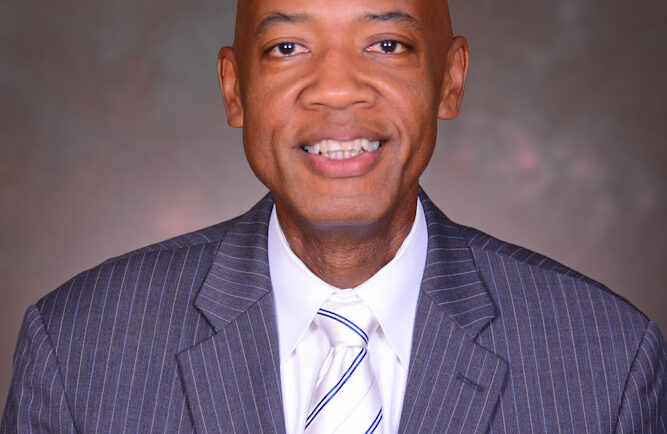
 PAUL ROBERTS is the president of Johnson C. Smith Theological Seminary in Atlanta. He has been married to Nina for 23 years and has three teenage children