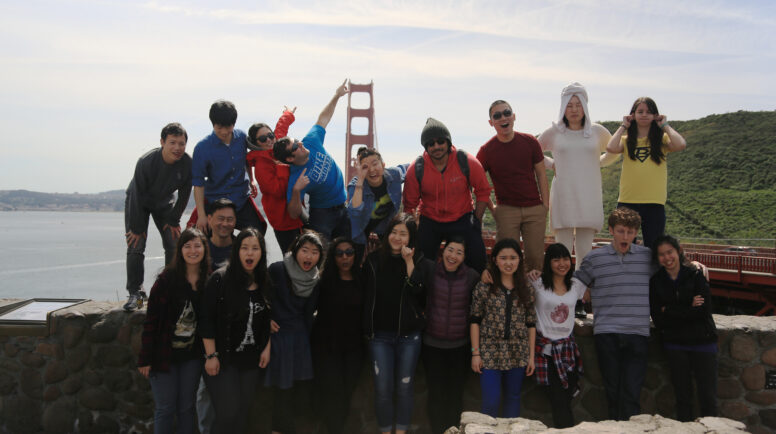

Friendship House enjoy the beach during
a fall leadership retreat.
by Polly Yorkioka
Last Fall, Netflix launched “Master of None,” a new series created by comedian Aziz Ansari. This semi-autobiographical comedic mini-series follows the life of Indian-American actor “Dev” who attempts to navigate single young adult life in his early 30s. At first, the show focuses on romance and dating, but then quickly moves beyond the traditional tropes of a prime-time comedy into the deep waters of racism and sexism (with episodes titled “Indians on TV” and “Ladies and Gentlemen”). Already, this short 10-episode series has a cult following among young adults.
Ansari provides a window into some of the most pressing issues for young adults in America today: the desire for authentic relationships, the question of how to respond to systemic racial injustice and the question of how to live a meaningful life. Interestingly, the show never discusses issues of religion or faith.
Perhaps this is not surprising. Religion, in many circles, is seen as increasingly irrelevant to modern life. In the church, it is commonplace to hear the lament that young adults are leaving the church in droves. According to a 2015 Pew Report, a survey of 35,000 American adults found 70.6 percent of the population identifies as Christian (down from 78.4 percent in 2007). More than one-third of millennials are not affiliated with any faith.
Yet, it is this same desire for authentic relationships — and the desire to face racial injustice head on — seen in “Master of None” that draws many young adults into the community of faith.
FINDING COMMUNITY, FINDING JESUS

Photo by Yiheng Zhang
For the last eight years I have watched young adults from around the world be drawn to Jesus through a loving and welcoming community of his followers at the International Friendship House. The International Friendship House is a residential missional community of internationals and Americans who seek to grow in faith and to reach out to internationals in Seattle. This residential ministry has been going strong for over 30 years as an outreach of University Presbyterian Church and has actually grown and flourished among millennial young adults.
Centered on a weekly meal, locals and internationals, students and workers, join together for a family dinner cooked by residents and guests. Each Tuesday, 40 to 50 young adults crowd into the dining room and living room with precariously overfilled paper plates. Laughter, conversation and music fills the air. The living room is a snapshot of globalization in process: young adults from all around the globe, eating a Saudi Arabian dish of chicken and rice, playing Korean games and singing a Chinese worship song before Bible study.
Through the love that they experience in this community, many young adults who previously had no interest in religion are drawn to the person of Jesus — and into missional community. What is it about a simple dinner that is so powerful?
VISION FOR GOD’S GLOBAL KINGDOM
What these young adults experience at Tuesday dinner is the kingdom of God, breaking out in hidden and ordinary places. The kingdom of God is a mystery to us, just as it was to the disciples of Jesus. However, when we see the power of God breaking into ordinary life, tearing down barriers between people, where the sick are healed and the broken-hearted are set free, there is no doubting that we are tasting God’s kingdom.

Tuesday dinner is about more than just eating foods from different cultures; it is a community that empowers young adults from different ethnic backgrounds to be Christian leaders who lead with vision for their global context. All too often, the church has treated students or internationals as a population to be welcomed and helped, rather than as Christian leaders who need to be mentored, equipped and instilled with vision. As the young adults of the International Friendship House serve through cooking, cleaning and opening their home, they are quietly and humbly leading their friends to Jesus. They are also empowered to lead boldly, to share their testimonies of God’s work in their lives during the dinners, to lead conversations about the refugee crisis or the Black Lives Matter movement. Through these dinners, young adult leaders are trained and equipped to be the next generation of church leaders — and their friends are drawn closer to Jesus.

Photo by Cameron Smith.
Last year, a young man named Yu was on exchange to the University of Washington from his university in Japan. Coming from a Japanese background, Yu was skeptical of religion; but curious by nature, he took a risk and began to check out Christianity. Yu took an even bigger risk and joined a mission trip to learn from and serve the poor in San Francisco’s Tenderloin neighborhood with his friends from the International Friendship House. Living for a week alongside followers of Jesus from around the world, praying in different languages for the people they met on the streets and eating meals with the homeless in soup kitchens, Yu experienced God’s kingdom and saw barriers broken down between teammates of different ethnic backgrounds and between students and people on the streets. He made a decision to follow Jesus, to be baptized before returning to Japan and to share his testimony in public with his friends. He now has vision toproclaim God’s kingdom globally as he serves in his campus Christian fellowship in Japan.
Each year, we see many young adults like Yu experience transformation through Jesus-centered multiethnic community. This generation longs for reconciled communities from diverse ethnic backgrounds; anything less seems inauthentic and powerless to bring transformation to our racially divided and enraged society. When we are silent on Black Lives Matter, young adults wonder what relevance the church really has for the real problems in our world today. When we stay in our insular ethnically homogeneous bubbles, young adults want out. Is it really any surprise that young adults are leaving the church?
OVERCOMING OUR HISTORY
The church in 2016 is just as racially segregated as it was in Martin Luther King’s day when he stated that “the most segregated hour of Christian America is eleven o’clock on Sunday morning.” According to a 2015 Lifeway Research study, while 86 percent of American church congregations have one predominant racial group, 67 percent of congregations think that their churches are doing enough to be ethnically diverse. While it appears that the majority of churchgoers are satisfied with ethnically homogeneous churches, this simply isn’t going to satisfy the next generation — at least not our emerging global leaders who are used to attending diverse public schools and universities, who come to the United States from all over the world and who long to have church leaders of color that they can emulate.
Sadly, our Sunday segregation has been intentional, not an oversight. The model for intentionally growing ethnically homogeneous churches has been a popular church growth strategy for decades. Proposed as a missions strategy in the 1970s, the Homogeneous Unit Principle recognized that people “like to become Christians without crossing racial, linguistic, or class barriers” (according to author Donald McGavran). It was intended to protect the beauty and diversity of global cultures and help ease the leap for people to convert to Christianity without being forced to leave their communities. However, this model shifted to become a formula for church growth in America: Put together as homogeneous a community as possible and it will grow more quickly. Soong-Chan Rah critiques this model in his book, “The Next Evangelicalism.” While the principle may in fact work in the short term to grow churches with speed, the reality is that the Western, predominantly white Protestant church is in decline. This is a dangerous shortcut that has undermined God’s call to reconciliation as well as our credibility and witness to the world.
My challenge to the Presbyterian Church and to our individual congregations is to deal with our sin of segregation and complacency about our ethnic homogeneity and to empower multiethnic leadership. We can’t blame young adults for leaving the church. We need to become the kind of church where people experience the irresistible power of the kingdom of God, where barriers are broken, where they can be known in authentic community, where there is true racial reconciliation that can provide hope in a hurting world.
CREATIVE RE-IMAGINING
The challenges before us are not easy, but they are not impossible. Jesus left us with the Holy Spirit saying, “But the Advocate, the Holy Spirit, whom the Father will send in my name, will teach you all things and will remind you of everything I have said to you. Peace I leave with you; my peace I give you. I do not give to you as the world gives. Do not let your hearts be troubled and do not be afraid.” (John 14:26-27) Our hope is in God, the author of shalom, the One ushering in the kingdom.

Last summer, University Presbyterian Church tried something new. We started a second house, similar to the International Friendship House, where eight young adult residents have the freedom to experiment and develop a missional community. All of us feel called to reach out to young adults in our city — to engineers moving to Seattle to work in the tech industry, to recent graduates who have aged out of their college ministries, to Muslim immigrants, to healthcare professionals. We come from different backgrounds, range in age from early 20s to early 30s and are from Washington, Texas, New Mexico, China, Indonesia and Kyrgyzstan.
Living together, we are developing rhythms of community life. We have evening prayer where we come together after long days at work and pray for the vision of the house and for one another. We have started Friday night jam session nights where friends bring instruments and we worship and celebrate communion. It’s a work in progress. We’re still learning how to love each other, how to reconcile after conflict, how to wrestle with our questions around ethnic identity, how to create inclusive community. We’re learning what it means to be leaders in our local church, as well as what it means to be a part of the global church. We want to keep Jesus at the center so that we can be a community that draws our friends, from all different backgrounds, into God’s kingdom.
I’d like to imagine that if “Dev” ever found his way to our house, he’d be intrigued. It’s possible that he’d write us off at first as being a little weird, but he would somehow find himself drawn in. I like to imagine that we would be the ones standing with him and fighting for justice when he faced racism in the entertainment industry. I imagine we could process his parents’ immigrant experience with him, sharing our own experiences and that we would visit each other’s families together. I hope that his view of Christians would be changed, that he would see that we lived with purpose and hope and that it would be appealing. And even if he never wanted to come to church or join a worship night, that he’d want to hang out with us because he could be real with us.
If we look around, we’re bound to find hidden, ordinary places where the kingdom of God is already present. We just need to open our eyes. We don’t need fancy new strategies to be relevant to young adults in order to draw them back in; we need to be the Jesus-centered ethnically reconciled church community that God has called us to be. When young adults — when any of us — experience God’s kingdom, it’s irresistible. When young adults are invited into this mission, given purpose and empowered to lead, they will be unstoppable.
 POLLY YORIOKA is associate director of ministry with internationals at University Presbyterian Church in Seattle. Polly oversees two of the church’s residential communities: the International Friendship House (university students) and Jack’s House (young working professionals).