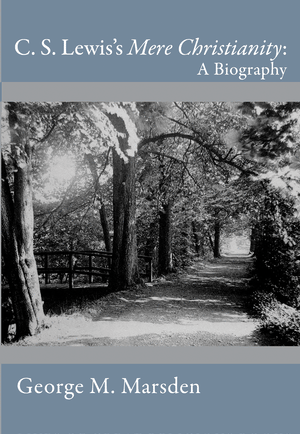
 George M. Marsden
Princeton University Press, Princeton, N.J. 280 pages
Reviewed by Michael Parker
The “Lives of Great Religious Books” series includes some of the greatest religious books of all time such as The Dead Sea Scrolls, The Bhagavad Gita and the Summa Theologiae. Moreover, their stories are presented by leading historians. Most recently George Marsden, an eminent historian of American religion, has taken on C.S. Lewis’ much beloved apologetic masterpiece, “Mere Christianity.” Marsden explores the question of why this particular defense of Christianity has not only endured but grown in popularity over time.
“Mere Christianity,” Marsden explains, has sold 3.5 million copies alone since 2001, been translated into at least 36 languages, is especially popular in the U.S. and is revered by Protestants, Catholics and Orthodox alike.
The book was originally presented as a series of BBC radio broadcasts in 1942. That was wartime, the German Luftwaffe was raining booms on London in the Blitz and invasion seemed imminent. Lewis was asked as a layperson to make the case for Christianity to a jittery nation. He had already been giving Christian talks to Royal Air Force troops in which, he reflected, “the greatest barrier I have met is the almost total absence from the minds of my audience of any sense of sin.” Therefore, he chose not to begin – as many evangelists do – by calling for repentance but by attempting to help his listeners discover within themselves a sense of guilt. Hence he spoke of an innate sense of right and wrong, universal human failings and the reality of evil.
The most famous – and perhaps most controversial – argument Lewis made for Christianity was his “trilemma” against the foolishness of the claim that Jesus was a great moral teacher but not divine. If Jesus’ claim was false, Lewis argued, he could not be a great moral teacher but was a liar, devil or lunatic.
Lewis’ talks drew a radio audience of up to 1.5 million. The success of these talks as well as the debut of the popular and much admired “The Screwtape Letters” that same year led to the publication of the talks in three separate books (1943-44) and later as a single volume in 1952. The book met with mixed reactions. Many were delighted with its confident tone and clear arguments. Others, such as George Orwell and Alistair Cooke, were dismissive of its popular style and defense of traditional Christianity.
Marsden notes the book’s apparent shortcomings: There is no mention or place for the social gospel; its view of women and marriage is out of touch, even for its own day; and some of his arguments, it is said, employ false dichotomies and straw men.
Yet the book’s virtues far exceed its weaknesses. Lewis’ nonsectarian “mere Christianity” lets the luminosity of the gospel shine through. It has been successful as a way of reintroducing Christianity in the formerly communist countries of Eastern Europe and China. It provides fundamentalists an alternative to the anti-intellectualism that would deny biological evolution, while challenging liberals to see through the scientism and naturalism of the age. Of greatest importance, Lewis goes beyond reason to appeal to the imagination through metaphor and analogy. Austin Farrer writes, “we think we are listening to an argument; in fact, we are presented with a vision.”
 Michael Parker is Presbyterian World Mission’s interim coordinator for Europe and the Middle East. He lives in Louisville, Kentucky.