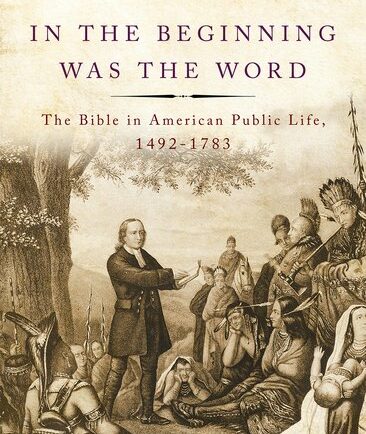
 Mark A. Noll
Oxford University Press, New York. 448 pages
Reviewed by John M. Mulder
Mark Noll’s fundamental thesis is clear: “It remains beyond question that Scripture has occupied an important place in [American] public life and so deserves to be examined historically with this-world concerns.”
Noll’s book makes two contributions to understanding and grappling with the enduring dilemma of biblical authority, meaning and interpretation. First, this is a history book, written with the erudition and lucidity people have come to expect from Noll’s extraordinarily productive research and writing. The volume’s focus was born from a simple question: How did people actually read and use the Bible? Its locus is colonial America, especially American Protestant and mainly Puritan culture.
Second, this is a treatise animated by deep moral and theological questions. Noll writes, “This book mostly sidesteps the main reason why the Bible has been important in American history, which is the claim of its adherents that it tells the truth.” Notice the word “mostly.” Noll is intensely interested in the questions of how and why some interpreters of the Bible were “deeper” and why others were “thinner.” Furthermore, he recognizes the life-changing power of the Bible to bring people into a relationship to God and awaken their consciences about how to follow Christ. At the same time, he sees the way in which the Bible was also used to bless the killing of Native Americans, the enslavement of Africans and a war of independence from the very nation that earlier interpreters had identified as God’s elect.
One of the striking elements of Noll’s analysis is the way in which he sees how the Bible has been inextricably linked to the issue of Christendom. The relationship between the spiritual truths of the Bible and the material assertions of worldly power deeply and profoundly affect any understanding of Christianity. Noll’s book ends with the Revolutionary generation in place and the union of church and state out of place. But that is not the end of the story, and Noll promises a second volume that will take the story from the birth of the republic through World War I (and, I hope, a third volume on the 20th and early 21st centuries).
It is common to hear that the era of Christendom is over. Noll’s work is a reminder of two things. One, the issue of Christendom hasn’t disappeared. Two, how people interpret the Bible says a great deal about how they envision Christendom — and vice versa. Those two questions lie at the heart of recent Presbyterian history. Noll’s book shows us that they are not novel debates; we are heirs of our past, even as we seek to discern God’s will for our future.
During the last 50 years, Noll has been one of the principal leaders, along with other evangelical Protestant scholars, who have continued the tradition of superb, critical analysis of the history of Christianity that was begun by the “church historians” of an earlier generation (Martin Marty, Sydney Ahlstrom and others). This book stands as a monument to his scholarly career, in which he has drawn on the insights of American “historians of American religion” and many other disciplines, but still adhering to his commitment to write history for the edification of the church. May his work continue, and may his tribe increase.
 John M. Mulder is minister for stewardship at Second Presbyterian Church in Louisville and the former president of Louisville Seminary.