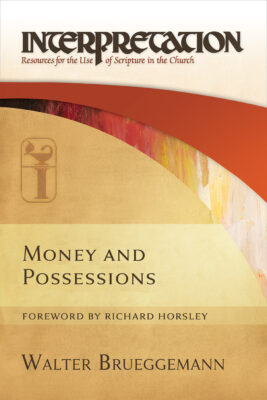
 Walter Brueggemann
Westminster John Knox Press, Louisville, Ky. 384 pages
This book is not a biblical manual on how to get rich. Nor is it a moralistic scolding, chiding the reader not to be so materialistic. The title does not sizzle, but the book does. It is not that the texts cited by the author are likely to be new to us, but that it is so very easy to encounter them without fully appreciating their essential gravity. The author examines them with attentive eyes, and testifies that both testaments understand economic neighborliness to be central to the common good.
Brueggemann argues, “The Bible is relentlessly material in its focus and concern. … Everywhere the Bible is preoccupied with bodily existence.” It takes seriously the destructive power of hopeless indebtedness, of interest rates that rise exponentially, of the helplessness of those who have nothing and depend on the mercy of those who have a lot. And so, it is not surprising that the Torah lays down the law, insisting that there must come a specific moment for real debts to be forgiven.
This is not just material for fall stewardship sermons. It is not only about personal budgets, but about the kind of life that is essential to faith. The book works its way through the Bible beginning with the Pentateuch, then the historical books, the psalms and wisdom literature, prophets, Gospels, epistles and the book of Revelation. Brueggemann engages the texts deeply, exegeting them both historically and theologically. Furthermore, he reads them with a profound understanding that they have to do quite as much with here and now as with there and then. In these texts we are encountering not philosophical reflection on matters generically spiritual, but with the living God, whose word for us is not so much to be dissected as to be heard and obeyed. Joyful obedience is life that flourishes “in sync with the purposes of God.”
Those who preach will find a treasure of interpretation here — not weapons with which to flail the congregation, but a truth so compelling that it is bound to subvert the facile assumptions that support the malignant confidence that, according to the bumper sticker, “Whoever dies with the most toys wins.”
Brueggemann observes, “The nervy determination to eliminate YHWH from the economy is essential to unbridled greed with impunity.” Enlightenment rationalism dismisses the God who calls for limits on greed as a primitive, embarrassing superstition. Thus follows the disengagement of God from any discussion of money, neighborliness and the common good, typically elevating the market economy to a sacred and thus untouchable status. “The result is the careful confinement of YHWH to private and interpersonal matters outside the public domain.”
In commentary on the book of Revelation, Brueggemann offers a perspective on its apocalyptic themes. “The world that is to end is not the planet Earth, as dramatic film spectaculars have it, but the ordered cosmos administered by the Roman Empire.” The contemporary version of that empire is embodied in economic systems tilted in favor of winners taking all.
The biblical God repeatedly confronts persons and society with an existential choice: God or Mammon. It is very easy to find ways of ducking that choice — but not forever.
 Ronald P. Byars is professor emeritus of preaching and worship of Union Presbyterian Seminary in Richmond, Virginia.