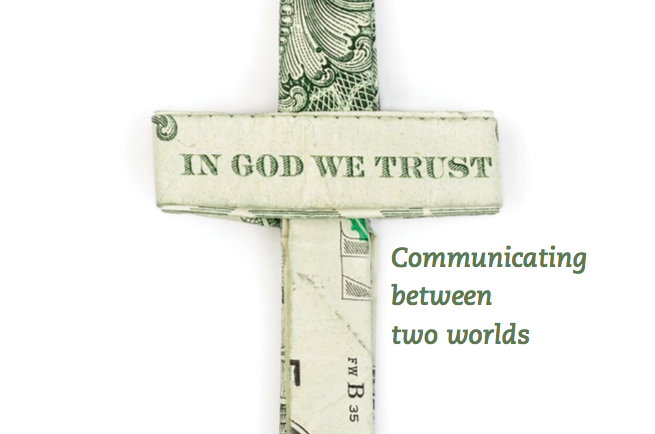
 STARTING POINT: THE NEED TO BECOME PARTNERS AGAIN
The worlds of theology and economics, of churches and business, of faith and the real economy are seldom seen as closely linked. They are often even viewed as adversarial realms, only rarely sharing common concerns, experiences or language. The one world centers on values like spirituality, the common good, the integrity of creation and social justice, while the other seems to concentrate on self-interest, monetary profits, cost reductions and competitiveness.
A closer look, though, indicates that religiously nourished attitudes and values also play a role in good business. Integrity, trust, honesty, reliability, fairness and loyalty are important in most business relations. Values like achievement, motivation, transparency, cooperation and quality do matter. Such values guide the daily work of many church members who work in business. Whether by fostering a good business environment or setting moral limits for certain business behaviors, values do play a role. Still, value conflicts arise if competitiveness and cost pressure compete with quality, if a good life/work balance competes with overwork or if profit interests compete with ecological responsibility.
Loose Points of Communication
Personal concerns of conscience, honesty, integrity of creation or social justice often compete with the “laws” of the market, the “hard” matters of business facts or shareholder interests. The first set of concerns is for people of goodwill or idealists. The other set seems to be about how the world really is.
In theology and economics as formal disciplines, the traditions in specific ways of thinking differ even more. Few theologians even deal with economic or business topics, and then mostly in a moralizing way. Very few economists or business administration scholars deal with theological topics, and when they do it is often in a functional way, asking what religion or ethics contributes to economic processes and success.
The tension between the spheres of life and between the corresponding formal disciplines has led to loose points of communication between churches and business, and between theology and economics. This constitutes a deficit on both sides. On the one hand, churches, governed by their dominant theology, focus on the world of faith, and they develop, at best, moral criteria for the public sphere. On the other hand, economic policymakers and business leaders, governed by the principles of economics and business administration, focus on the world of markets and corporations – and may sometimes in addition, or over the weekend, consider religious or moral dimensions.
This situation marks the deterioration of a once-close relation between realms that today seem nearly antithetic. Historically, in Europe and America, the economy has been religiously embedded and theologically grounded. Adam Smith, the founder of modern economics, today is famous for an economy guided by the invisible hand of a free market mechanism. The neoliberal idea of laissez-faire, laissez-passer – avoiding political intervention in a free market – originated with Smith, and it meant refraining from intervention in God’s creation. Basic economic categories can be drastically misconstrued if their theological embeddedness is not known or understood.
In Protestant ethics, religious attitudes gave meaning to achievement, productive action and efforts at world improvement. They formed the basis for industrialization, comprehensive economic growth and globalization. Religious sense made the economy grow. Without religion in the accustomed form, a skeleton has remained: a theologically and religiously non-related world, though one with proper economic laws, attitudes and rationalities.
In economics, there is a serious lack of the normative fundamentals of ethical reasoning, often reducing the discipline to the pursuit of unrestrained self-interest. Churches today want and need to play a more influential role in confronting and solving challenges to the economic common good.
Economics and Management for Church Leaders
What should church leaders learn in the area of economics? The first task is to persuade people who are used to thinking in hermeneutical or ethical terms that economics is neither bad nor good. It can be either. Economics and business are means to supply people with goods and services. That can be done in either a life-serving or a destructive way.
 The second task is to understand that economics functions on separate, distinct levels. One is the macro-economic level of markets, the state and embedding factors like the social and ecological environment, culture, etc. This level includes fixing the laws, order and framework of markets. The other major level is the micro-economic. It consists of consumers and corporations, mostly considered as the area of management and business administration.
By drawing finer distinctions, we can identify three levels of the economy. They are the macro-level of economic policy (laws, rules, treatises, etc.), the meso-level of corporations (corporate governance, corporate behaviors, corporate social and ecological responsibility, etc.) and the micro-level of consumers and citizens (consumption behaviors, public engagement, voting, etc.). Churches are involved on all three levels.
The competency in great need in churches and the larger ecumenical movement is the ability to understand, reflect and contribute to the public economic sphere. In theological terms, the churches’ distinctive contribution is public theology. South African theologian Nico Koopman thinks of public theology as the bridge to enter into a comprehensive interdisciplinary and transdisciplinary encounter.
World church bodies have expressed their views on globalization, on the monetary, economic and financial order, or on the economic system as a whole. (A list of resources is included on page 35 in this issue of the Presbyterian Outlook.)
The step of ecclesiological communication with economic circles has always been demanding. Personal contacts to experts in institutions like the IMF, WTO or World Bank are of institutional help, but often these encounters do not extend beyond a friendly diplomatic level. There is no communication about the means and ends of good business, the normative notions of the market system or the role of the state for the common good. Communication of this sort is not about the nature of economics, or about the self-understanding of economics or business administration beyond the needs and exigencies of daily business.
The theological and ethical dimensions of economics constitute an additional moral dimension. They are in the core and daily life of the economy. The ethical dimensions are found in how the horizon of economics is identified – whether quantitatively and functionally or in a socially, ecologically and culturally embedded way.
Examining the economy through such morally infused categories leads to competence building, this time relevant for both the theological and the economic world.
ECONOMICS IS A MORAL THING
Mainstream economists analyze the functional relations of prices, goods, flows of trade, economic growth, employment rates, fiscal spending, etc. They should, at best, statistically know and categorize the exchanges of products, services and monetary transactions that take place within a market economy. The numbers, though, only represent the quantitative dimensions of the economy. A good economist not only knows, symbolically speaking, the individual trees or bushes, he or she also considers the forest, the ground beneath it and the trees’ and bushes’ relation to each other.
A good economist embeds the individual quantitative processes. The ethical challenge is to widen the horizon of what economists and managers do and embed that as well. The challenge is not only to define criteria for the economy, but to suggest better, contextually widened economics.
The second dimension of economic competence building is management. Management is the ability to understand, shape and develop organizations in a purposeful way. Management, of course, is dominantly acquainted with corporate policy in private business. Looking at competencies for church leadership, few people would argue that there is a need similar to corporate management. Still, given a church’s administration, its formal bodies and processes of decision-making, its budget and assets, employees, public relations, etc., there is a need for competencies in structural organization. That need increases at higher levels of church hierarchies. Yet such competencies are not part of the regular, formal education of pastors and church leaders.
The challenge, though, is to offer those competencies in the adequate form. The functional, quantitative approach of classic management is alien to hermeneutical thinking. An add-on of MBA competencies, which is relevant for private corporations, often does not suit church organizations. Churches are value-driven and need value-oriented management. This dimension is failing in mainstream business administration, though it is at times partly covered in seminars on business ethics or corporate social responsibility.
 Topics for church leadership and management need to include basics of multiple business-related disciplines, including normative management, business administration, personnel management, finance and asset management, innovation, profiling, diversity management, resource mobilization and cultivation of creativity in organizational settings. The teaching should be interdisciplinary: The institutional context and theological foundations of the church should receive the same attention as competence building in instruments of management. Church leaders do not have to know all the details about management instruments, but they should understand their logic and their limits, and they should ask the relevant questions about guidance and control. Competence building will have reached its goal when participants can discover and identify the value dimensions and the structural, institutional components of leadership in organizations.
Sound training in economics and management for church leaders should incorporate the standard basics of both those disciplines, plus instruction that leads to a widened understanding of pluralistic forms of economic and management thinking. But it is vital to also systematically integrate these perspectives with the theological and ethical perspectives that are, after all, the distinctive business of the church.
 Martin Büscher is professor for economics/economic and business ethics at Protestant University Wuppertal/Bethel (Institute for Diaconic Science and Diaconic Management) in Germany. He also serves as dean of the GEM School.