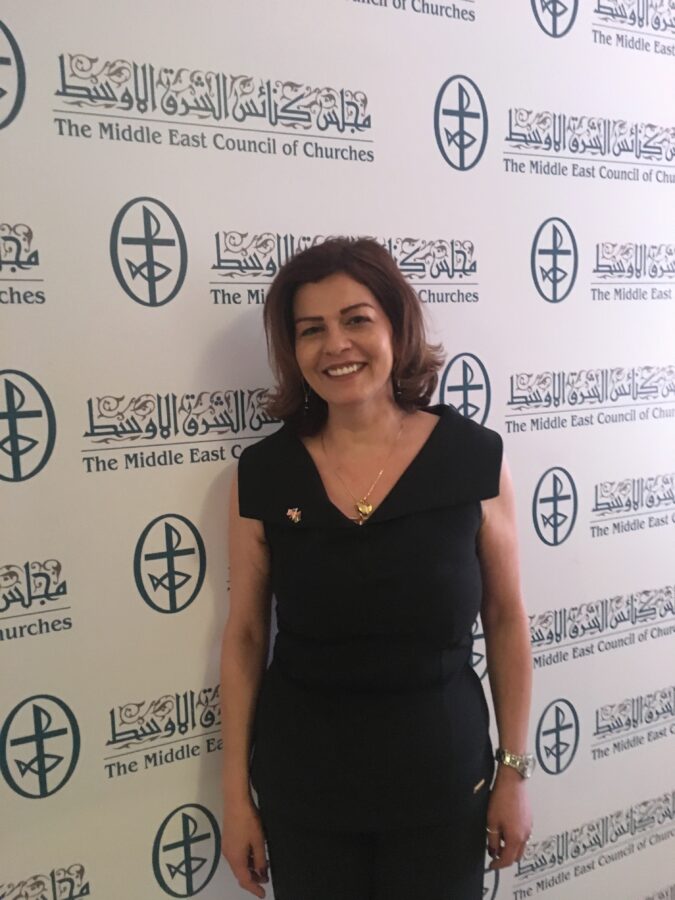
Wafa Goussous is director of the Jordan office of the Middle East Council of Churches and of the Orthodox Initiative of the Greek Orthodox Patriarchate of Jerusalem, all Palestine and Jordan. As an advocate for the Christian presence in the Middle East, the council works to strengthen the vulnerable position of Christians in the region.
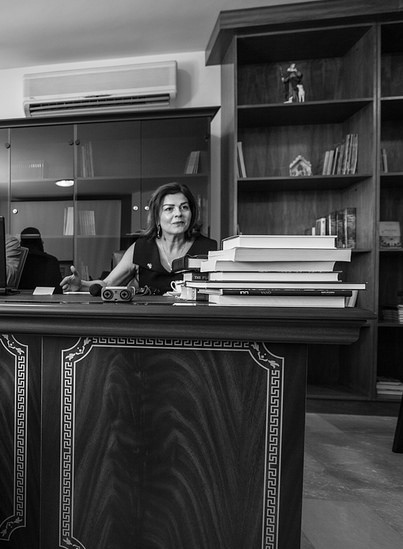
Goussous has been honored for her commitment to dialogue between nationalities and faiths in the Middle East, and was chosen to work as an international peacemaker through a partnership of the United Nations and the Presbyterian Church (U.S.A.).
An ecumenical background has allowed Goussous to work with international churches while remaining loyal to the rich traditions of the Orthodox Church. She is an activist working to support and empower the most vulnerable populations in Jordan while listening for God’s vision in these times of strife.
Outlook: The Presbyterian Church (U.S.A.) has supported the Middle East Council of Churches (MECC) for many years. What would you Presbyterians to know about your work? How can they help?
Goussous: The Middle East Council of Churches has been working with the guests in Jordan (the Syrian and Iraqi refugee communities) for years now. Its mission is to improve the lives of refugees and vulnerable people in Jordan, and to help the hosting communities to cope with this new reality by developing and supporting community-driven initiatives and helping to create a balance. The goal is to change the stagnant situation of the refugee population into an active engagement of everyone through experiences that are meaningful, productive and profitable.
The key elements of this initiative are:
- To empower a community collaboration;
- To implement vocational training workshops organized by members of the refugee groups; and
- To employ and support locals and to foster the relationships between the refugee community, the neighborhood and the citizens of Amman, Jordan, regardless of religion, gender, class or any other distinction, by introducing social inclusion and community integration.
Outlook: What are MECC’s chief concerns in Jordan right now?
Goussous: There are 1.5 million Syrian refugees in Jordan now, and in order to be able to assist them, help from other parts of the world is sorely needed. As in the past, donations from your church would be highly appreciated. What would also be of great help is to make people in your country more aware of the current situation in Jordan, perhaps by sending delegations from the United States to get an on-the-ground view of the situation and pass this information on to other church members. We would also like to start an internship program with your denomination.
Our chief concern is the enormous burden Jordan is carrying with regard to the huge number of refugees in our country. We are afraid that the current situation will have a negative impact with regard to economic and social stability. The local churches are doing their utmost to help, but it is a huge strain and outside help is badly needed.
Outlook: Where are you seeing God in action? What gives you hope in the work that you do?
Goussous: We see God in action in our work with the refugees, both Christians and Muslims.
Jesus told us: “Come, you who are blessed by my Father, inherit the kingdom prepared for you from the foundation of the world. For I was hungry and you gave me food, I was thirsty and you gave me drink, I was a stranger and you welcomed me, I was naked and you clothed me, I was sick and you visited me, I was in prison and you came to me.’ Then the righteous will answer him, saying, ‘Lord, when did we see you hungry and feed you, or thirsty and give you drink? And when did we see you a stranger and welcome you, or naked and clothe you?”
And: “It is more blessed to give than to receive” and “Whoever is generous to the poor lends to the Lord, and the Lord will fully repay them.”
By our work for the most vulnerable, we will be a witness and a sign of the Christian presence.
What gives us hope is that by being actively involved in the community and giving help where we can, we are building the Christian presence.
In the past, Christian universities – such as the University of Beirut – were established. Especially in the present situation in the Middle East, the creation of Christian educational facilities would be helpful.
Outlook: What do you wish American Presbyterians knew about Jordan?
Goussous: Jordan is a country that has welcomed refugees for a long time. After 1948, it received many Palestinians; during the Iraqi crisis, Iraqis fled to our country. In recent times, more than a million Syrians entered our country. Jordan has always been very generous in helping these vulnerable people and this is a special quality of our country.
Our country does not have many natural resources, but we are a country that is heavenly blessed. There are many holy Christian sites, such as the Jesus’ baptism site and Mount Nebo.
Moreover there is the lowest point on earth at the Dead Sea and a wealth of archeological sites such as Petra and Jerash. These all testify to our rich and varied past.
Our country also plays a role in trying to bring peace to the region. In 2010, His Majesty King Abullah took the initiative to introduce the World Interfaith Harmony Week. It was unanimously adopted by the UN (United Nations), and the first week of February has been observed as a World Interfaith Harmony week since then.