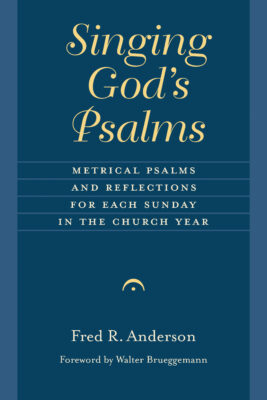
 Fred R. Anderson
Eerdmans, Grand Rapids, Mich. 259 pages
Reviewed by Emily Chudy
The psalter has long been recognized as the songbook of the Israelite people and a steady heartbeat at the emotional center of Christian life. Generations have turned to the words of the Psalms to express joy, sadness, anger, thankfulness and hope. Tradition finds these psalms often expressed in song, sung by congregations in collective voice as part of worship together. Recently, a resurgence of interest exploring the psalter’s place in our corporate worship has worship teams seeking new ways to hear and sing these words in the church today.
Fred R. Anderson’s work compiled in “Singing God’s Psalms” is a gift to churches and their leaders engaged in the adventure to reclaim the psalms for the 21st century church. An ordained PC(USA) pastor with experience leading congregations, Anderson is also trained as both singer and choral conductor. He offers settings of psalms accessible for worshipping communities to sing and adaptable for diverse services – all in conversation with the pericopes and selections determined by the Revised Common Lectionary. The project originally grew out of Anderson’s personal search for the holy during a period in his ministry he describes as “on the verse of burnout.” That search becomes a rich, Spirit-filled, living psalter in modern language, metered and placed in verse for singing and memory, set to common tunes. Many of the settings are already part of the heart-songs of those in the pews each week.
“Singing God’s Psalms” is easy to follow. A brief introduction to the art of singing the psalms in metered and versed text is followed by a chart identifying the psalms for each week of the liturgical year in the lectionary cycle. The rest of the book is dedicated to Anderson’s interpretation and settings for each psalm in chronological order. For many psalms he offers more than one tune to which the words can be set. This provides pastors and musicians an opportunity to choose the best fit for worship on a given day or season. Read this book with a hymnal in hand unless you are knowledgeable about church music, as the tunes are identified only by name. I found it helpful to have the music available so I could sing along as I read.
The psalms themselves are skillfully interpreted and Anderson somehow finds a way to maintain the integrity of the original text while still fitting the form and rhyming patterns required by metrical and metered hymnody. His commitment to the use of inclusive language is worth celebrating. Each psalm is followed by a brief, but rich, explanation of the context and meaning of the psalm. More than simply educational, these reflections help foster ideas for how the psalm can be used in worship. Pastors, church musicians and worship leaders will benefit from this book for worship preparation. At the same time, it is accessible enough that individuals can read it to encounter the psalms in a new way.
Emily Chudy serves as co-pastor of Central Presbyterian Church in Downingtown, Pennsylvania.