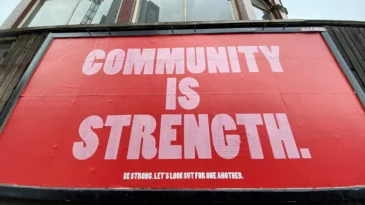
“Help us, O Lord, to remember our kindred beyond the sea. … We are one world, O God, and one great human problem and what we do here goes to solve not only our petty troubles alone but the difficulties and desires of millions unborn and unknown. Let us then realize our responsibilities and gain strength to bear them worthily.” – W.E.B. Du Bois, “Prayers for Dark People”
In 1979, historian Herbert Aptheker published a volume of prayers found in an envelope entrusted to him by Du Bois. The prayer is footnoted with Psalm 46, also known as “Luther’s Psalm.” According to legend, whenever Luther was disheartened or sad, he would respond, “Come, let us sing the forty-sixth Psalm.”
It has been ascertained that Du Bois’ prayers were composed between 1909 and 1910. At that time, he was facing a whirlwind of issues. His Niagara Movement was in demise due to heavy opposition by Booker T. Washington and his supporters. Du Bois’ efforts to get former supporters of the Niagara Movement to join the new biracially established National Association for the Advancement of Colored People (NAACP) was widely scrutinized.
Under such circumstances, Martin Luther sung Psalm 46 four centuries earlier. Du Bois prayed according to its message.
Du Bois makes reference to “our petty troubles.” I would argue that it was not his intent to minimize the profound gravity of the problems of the organizations under his leadership. Nor was he minimizing the issue of racism; it was, in fact, Du Bois who in “The Souls of Black Folk” stated, “the problem of the 20th century is the problem of the color line.” Racism remains America’s biggest problem and the ugliest scar on the face of her history.
What Du Bois did in his prayer was compare the quibbling of individuals in his organizations to the much more intricate issues of the larger society. He also held America responsible to do a self-examination – to explicate her inability to solve her race matters in the context of much more complicated matters on the global stage.
If a nation is unable to solve internal issues, how can they be taken seriously when address a crisis of national or international magnitude? Or, as God responded to the complaining Jeremiah, “If you have raced with foot-runners and they have wearied you, how will you compete with horses?”
With the phrase, “We are one world … one great human problem,” Du Bois invokes his understanding of the African Zulu proverb umuntu ngumuntu ngabantu. In modern times, the proverb has been shortened as ubuntu. The proverb suggests that a person is a person because of people. “I am because you are and you are because I am.”
Ubuntu was summed up by Martin Luther King Jr. like this: “We are caught in an inescapable network of mutuality, tied in a single garment of destiny. Whatever affects one directly affects all indirectly. I can never be what I ought to be until you are what you ought to be, and you can never be what you ought to be until I am what I ought to be. This is the inter-related structure of reality.”
The church will never be all that it can be until the communities it serves are all that they can be. Our country will never be all that it can be until her citizens, all of them, are all that they can be.
We are not greater than our neighbors around the globe. We do not have the deepest understanding of the universe. We do not have a trademark on the gospel. We do not hold all truths! How do we engage in authentic dialogue with other people of other faiths?
We can never be all that we ought to be until our global neighbors are all that they ought to be.
 CARLTON JOHNSON is the operations officer for Johnson C. Smith Theological Seminary in Atlanta. He also serves as president of the Atlanta chapter of the Association for the Study of African American Life and History.