Editor’s note: This week we’re sharing stories of Presbyterian congregations who have answered the invitation from co-moderators Denise Anderson and Jan Edmiston to read and discuss “Waking Up White” as a church. Read the series here. Resources, including video clips and a guide for a four-session group study of the book, are available at the GA co-moderators’ website.
Every morning in the shadowy darkness, I turn on the light. I hold my daughter as she whimpers and shields her eyes from the bright light and whisper to her, “I know sweetheart. It’s hard to wake up.” It is hard to wake up. It’s hard to wake up from a deep sleep when it feels too early in the day. It’s also hard to wake up to new realities and startling self-revelations.
 This spring, my church and I responded to the invitation from PC(USA) co-moderators Denise Anderson and Jan Edmiston to read the book “Waking Up White, and Finding Myself in the Story of Race” by Debby Irving. The whole denomination was invited to invest time and energy into discussions and reflections on this book that explores what it means to be white while examining racism, white privilege and the culture of white supremacy.
I am thankful for the willingness of the church to take up this study, which is both a needed one and a challenging one for many predominantly white congregations. In our discussions, we wrestled with many aspects of Irving’s book, particularly the ways that class and race intersect. We wondered about microaggressions, both how to avoid them and how to really understand them. We listened to one another and continued to be surprised by what we heard.
Throughout the study, I had several “wake-up call” moments. Just like the author, my family has benefitted from the GI bill for several generations. Educational benefits and access to housing have been great blessings. The wealth stored in those benefits has, in part, allowed me to live the comfortable life I do today. I was stunned to learn about the many reasons black service members were unable to access these benefits and thereby also unable to pass them on to their children. I was stunned to see redlining maps of neighborhoods a stone’s throw from mine. Even though I have always known that history and culture have a huge impact on our outcomes in life, I did not fully appreciate the (many) extra legs up that my family received, just because we are white. It’s hard to wake up and realize my own privilege.
As part of our discussion, we all tried to put together a few pieces of our own racial autobiography, which is, in a sense, the contents of Irving’s book. Like many white people asked to engage in this task, I didn’t initially think I had much to include – not many stories or experiences related to race jumped out at me. But the deeper we dug, the more I realized that sentiment was completely untrue. There was the time as a small child I dressed up for Halloween in an ethnic costume that would never be deemed acceptable to wear today. There was my time spent in mission service in Malawi where every time I left the house, children pointed at me and called out “mzungu” – white person. There was even a recent book I checked out from the library to read to my daughter about the singer Bessie Smith. The picture book turned out to be about Bessie’s encounter with members of the Ku Klux Klan. When I finally realized the contents, I squashed my urge to close the book and protect my child from knowledge of such evil. We kept reading, knowing that families of color have no such luxury of “protecting” children from understanding race and the scourge of racism.
From the class members, I was grateful to hear stories about how race has shaped the city surrounding our church, where our denominational headquarters is also situated. I learned about bussing from people who experienced desegregation firsthand. I learned about schools that automatically held black children back a grade when they entered a newly integrated school. I learned about people who have strong cross-racial friendships and why they believe that has been possible for them. These stories are powerful in helping me understand the place of race in our society and in my own life. Some are painful to hear and were obviously painful to have lived through. These stories are also rarely told, at least in the mostly white churches I have served. I needed this wake-up call – in the form of the book and in the voices of my congregants. I am grateful to have had this entry point, which was shared across our denomination. But I also know that turning on the light is only the very first thing we do. Then, the rest of the day follows and the real work begins. May we rub the sleep from our eyes and get moving.
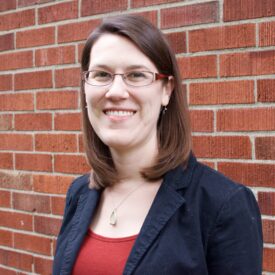
 EMMA NICKEL serves as interim pastor at Beulah Presbyterian Church in Louisville, Kentucky. She is passionate about congregational ministry, trying new recipes and keeping her baby’s naps on schedule. She lives in Louisville with her husband, Matt, and their young daughter.