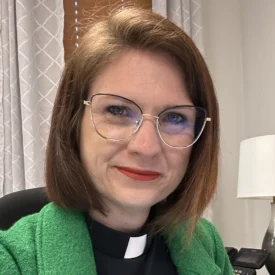
As a minister in my 40s, with decades of ministry still ahead of me, I find myself constantly wondering: Does ministry really have to be this exhausting? Isn’t there another way forward?
And before you assume this is simply another article about church decline, stay with me, because I actually believe there is hope.
That hope is what ultimately led the Presbytery of Eastern Virginia to submit ORD-03 to the 226th General Assembly (2026), calling for a denominational study of a collaborative approach to ordained ministry. At its core, the overture asks if a more sustainable and connectional way of organizing ministry would better support PC(USA) congregations and ministers.
At its core, ORD-03 asks if a more sustainable and connectional way of organizing ministry would better support PC(USA) congregations and ministers.
Because many of us know the current system is under strain.
Across the church, we are witnessing prolonged pastoral vacancies, clergy burnout, declining participation, and a growing wave of pastoral retirements that increasingly outpace the number of students enrolling in seminaries to pursue ministry careers. In many ways, all churches are navigating a significant transition as we move into a new era of ministry — not simply post-COVID, but through a broader reformation that was already underway long before the pandemic accelerated it. Congregations of every size are increasingly in need of more support to discern and implement new, faithful ways of doing ministry.
Related reading: “The future of the Presbyterian Church (U.S.A.): Decline, renewal and shifting trends” by Gregg Brekke, Presbyterian Outlook reporting
In the Presbytery of Eastern Virginia alone, 16 out of 44 congregations are currently without full-time ordained leadership, and eight rely primarily on supply pastors. While our churches are navigating difficult seasons, they often need more intentional support and guidance, not less. And honestly, it is too painful to keep watching congregations decline this way.
I have witnessed how the closure of churches within our presbytery has heightened anxiety in other congregations, leading some to fear they’re next and that presbytery involvement signals not support but the beginning of a shutdown. That culture of fear has therefore shaped many churches to operate from a place of survival rather than following the Spirit’s lead into new ways of being the church. Is this truly the trajectory we want?
To be clear, transformative ministry is happening throughout our denomination. But by and large, the current system has become increasingly unsustainable. In his article “Departure: Why I Left the Church,” Alexander Lang describes the immense pressure ministers face. He said, pastors are expected to be professional speakers, CEOs, counselors, fundraisers, human resource directors, masters of ceremonies, and pillars of virtue. Few people naturally possess all these gifts, or time, leaving ministers with unrealistic responsibilities and congregations disappointed when expectations are not met.
That is where cooperative ministry begins to feel worth exploring.
While collaborative practices already exist in various forms across the denomination, ORD-03 asks the church to study more intentional partnership — not merely as a temporary solution for struggling congregations, but as a fuller expression of Presbyterian connectionalism.
ORD-03 asks the church to study more intentional partnership — not merely as a temporary solution for struggling congregations, but as a fuller expression of Presbyterian connectionalism.
Importantly, the overture begins with a study rather than a blueprint. The realities facing congregations and ministers are complex, and any meaningful reimagining of ministry deserves careful theological, pastoral and structural discernment. Questions surrounding calls, accountability, pastoral identity, compensation and the role of presbyteries are significant and nuanced. The goal is not to rush toward simplistic answers, but to create space for the church to faithfully explore healthier and more collaborative forms of ministry for the future.
Still, I believe it is important to begin imagining possibilities.
Related reading: “Lessons from a worker-pastor” by N. Barry Dancy, Presbyterian Outlook reporting
Imagine stronger support for congregations
Imagine congregations of every size having access to teams of pastors with complementary gifts rather than relying on a single person to meet every need. Churches could share expertise in preaching, education, mission, administration, and discipleship while receiving support long before challenges become crises. Presbytery leaders could become trusted partners in cultivating healthy ministry, not simply responders when congregations face decline or conflict.
Imagine deeper collaboration among churches
Imagine churches no longer reinventing ministry in isolation while neighboring congregations wrestle with the same challenges. Congregations could more intentionally share worship resources, educational opportunities, mission initiatives, administrative systems and creative partnerships. Technology could further strengthen connectionalism through shared calendars, communication platforms, and collaborative tools that keep churches connected across communities.
Imagine healthier lives for pastors
Imagine pastors no longer carrying the weight of ministry, change, conflict and discernment largely on their own. Collaborative teams could provide space for colleagues to dream together, exchange ideas, support one another, and navigate the realities of ministry side by side. Ministers could receive more intentional opportunities for spiritual care, reflection and renewal rather than relying on a single continuing education event to sustain them.
Imagine a renewed future for ministry
Imagine pastoral transitions that no longer stretch on for years and drain congregational momentum. Imagine if younger generations, who often value collaborative leadership over hierarchical structures, renewed their interest in serving in parish ministry because they find it both meaningful and manageable. Perhaps this season would be remembered not primarily as a time of decline, but as the moment we found the courage to reimagine what connectional ministry could become.
Related reading: “Gen Z’s complicated return to faith — and what Presbyterians are seeing” by Gregg Brekke, Presbyterian Outlook reporting
At its core, this vision feels deeply Presbyterian. We have always understood ourselves to be a connectional church. Perhaps this is one of those moments that call us not simply to preserve inherited systems, but to faithfully reimagine how we live out our connectional identity in a new era of ministry.
Because if we truly invest in healthier systems, deeper collaboration, and the well-being of ministers and congregations alike, perhaps what waits on the other side is not merely survival, but revival.
Editor’s note
GA227 approved ORD-03, “On Studying A Collaborative Approach to Ordained Ministry for the Faithful Support of Congregations and Ministers,” 417-38. Learn more.