LOUISVILLE – Disaster relief. Systemic racism. Finding money for translation services. Theology and governance.
The Presbyterian Mission Agency Board considered a lot – from the practical to the prophetic – during the last day of its Sept. 21-23 meeting. Here are some kernels from the pile of business.
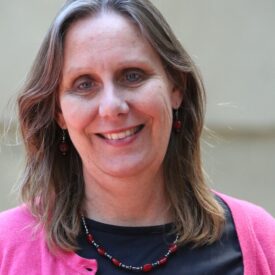
Disaster relief. Presbyterians have generously given more than $3 million for disaster relief since Hurricane Harvey hit Texas and Louisiana, said Laurie Kraus, director of Presbyterian Disaster Assistance (PDA). That money is much needed, she said, to respond to a stunning series of hurricanes (Harvey, Irma and Maria), fires in the Pacific Northwest and earthquakes in Mexico, plus humanitarian needs in places around the world, from South Sudan to Sierra Leone.
The hurricanes in recent weeks have affected 12 presbyteries, Kraus said. PDA has sent trained national response team members to work with mid councils in those areas to assess damage and organize a response, and has provided $142,000 in initial grants to affected presbyteries in Texas and Florida.
“The Presbyterian Church has been extraordinarily generous,” Kraus said.
She expects PDA to be involved with long-term recovery related to the hurricanes for the next three to five years, at least. Kraus said PDA has already fielded inquiries from more than 400 work teams wanting to help out, and is working to link those volunteers with denominational partners that focus on the initial cleanup and mucking out. If Presbyterians have work teams wanting to help, “our call center is ready to receive them,” Kraus said.
Puerto Rico. Before leading closing worship Sept. 23, Sara Lisherness, director of Compassion, Peace and Justice Ministries for the Presbyterian Mission Agency, said Presbyterian leaders had just heard from Edwin González-Castillo, stated clerk of the Presbytery of San Juan in Puerto Rico.
He reported that electricity was out; clean water was scarce; people were missing. Worried Presbyterians with family and loved ones in Puerto Rico have been unable to make contact. The breaching of the Guajataca Dam in northwest Puerto Rico is endangering 70,000 people, Lisherness said, calling on Presbyterians to pray for those suffering in Puerto Rico and their worried families, and to send support for the relief effort to PDA.
Structural racism. With the board holding cultural humility training at this meeting regarding the Doctrine of Discovery and its legacy of oppression, killing and dispossession of Native Americans, and with the board hearing an interim report from its Power and Privilege ministerial team, discussion of structural racism and its implications for the Presbyterian Church (U.S.A) has been woven through this meeting.
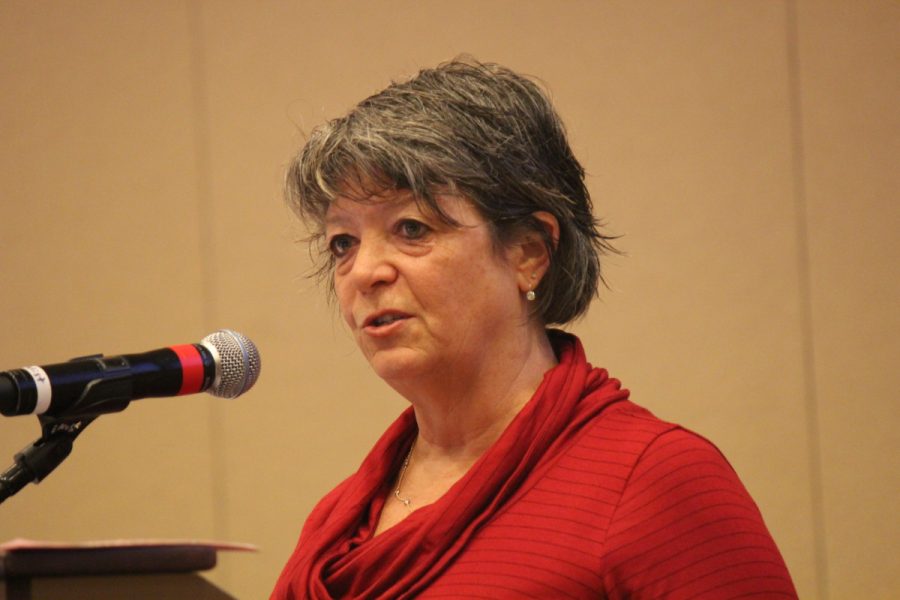
During opening worship Sept. 23, Valerie Small, manager for General Assembly Nominations, continued that challenge – saying that worthy programs and initiatives aren’t enough, and the structures that support and sustain injustice also need to be dismantled. Christians are called to live moral lives, to say to one another, “Here I am, after you,” Small said. “You have to come first.”
One example: the need for translation services, an issue that’s surfaced several times during this meeting. Small said she grew up with a Japanese mother who spoke little English, living in New York – hearing all the world’s languages on the streets.
What if everyone who worked for the PC(USA)’s national staff was multilingual, she suggested, and the denomination lived into its spoken commitment to multicultural ministry and hired the translators it really needs? “We cannot say that we want to grow the church and have one Spanish and one Korean translator on staff. That does not work,” Small said.
And “this is not an issue of competing priorities,” she said. “This is the priority of the Presbyterian church. The PC(USA) cannot exist as a 91 percent white denomination,” in a nation that’s demographically shifting, increasingly becoming a nation of people of color and of immigrants. “If it’s a matter of budgets then we need to rethink how we do our budgets,” she said.
All PC(USA) materials should be available in multiple languages, she said. And Racial Ethnic and Women’s Ministries has one of the smallest budgets of any ministry division in the Presbyterian Mission Agency – “how does that work?”
As the PC(USA) looks ahead, “we’d better pray in color, and we’d better be prepared to knock down the structures that prevent our faithful response to God’s call,” Small said.
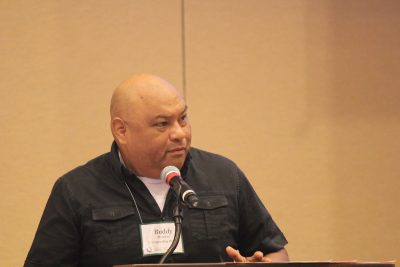
Advocacy committees. “What Valerie said.” That’s how Buddy Monahan, from the Advocacy Committee for Racial Ethnic Concerns, began his report to the board later that morning.
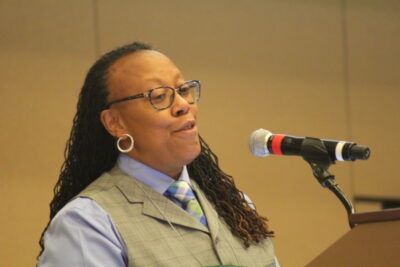
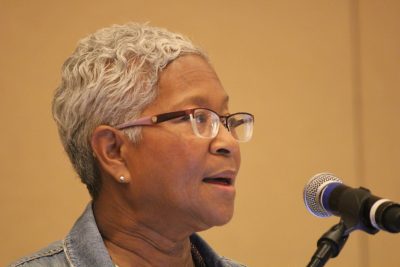
“Take this on,” Flo Watkins, from the Advocacy Committee for Women’s Concerns, urged the board. “Get in the game. Don’t take a knee. Let’s partner together for a just society and a just world by starting by being a just church.”
Budget. The board approved a revised mission budget for 2018 of just over $65 million, including the use of more than $345,000 from unrestricted reserves. And the Presbyterian Foundation has notified the Presbyterian Mission Agency of a new $1.25 million gift received from an estate in July. Denise Hampton, the agency’s controller, told the board’s Finance Committee that gift was designated for international education and medicine.
Executive director search. Nancy Ramsay, a board member from Texas, leads the committee that’s searching for a new executive director for the Presbyterian Mission Agency. Ramsay said the search committee has identified a “talented, diverse pool” of candidates and plans to identify finalists by mid-October. The committee hopes to recommend a new executive director by the middle of November, so that person could begin work by the first quarter of 2018, Ramsay said.
On Sept. 13, the board announced that it had hired Dave Crittenden as acting executive director of the agency, replacing Tony De La Rosa, the interim executive director, who resigned following a closed-door meeting of the board.
Governance Task Force. The board extended the term of is Governance Task Force through the end of the 2018 General Assembly. And it approved a new recommendation proposed by Joseph Morrow, a minister from Chicago.
That new recommendation states that the Governance Task Force will bring to the board for consideration at its meeting in Louisville Feb. 7-9 a draft document outlining “the purpose, role and relationship” of the board’s work to the General Assembly, including in that document “theological foundations and a mechanism for revision.”
Earlier in the meeting, the board voted to reduce its size from 40 voting members to 20, and to reconfigure its committee structure and make other changes. An understanding of matters of purpose, role, relationships and theological foundations was inherent in that action, Morrow said. But having that stated explicitly “makes it public,” he said, and emphasizes that the move to make specific changes “is also driven by a vision theologically that we believe is faithful.”
It’s also important that those who will serve on the board in the future understand the conversations the current board is having about inclusivity and dismantling racism, Morrow said –for them “to be reminded of the reasons for the changes we have made.”