“You are not going to pass that test by osmosis!”
I have rarely used the term “osmosis” in its proper scientific form, but have usually equated it with the all-nighter “hail Mary” that if I slept on top of my book or with my book under my pillow, the movement of solvent molecules from the information inside might migrate into my semi-permeable brain.
But recently I have come to believe that osmosis works not just scientifically, as the permeable cells in our bodies rehydrate or as a less concentrated substance moves to a more concentrated substance, but that osmosis also works theologically.
We tend to view reading theology as an unnecessary practice after leaving the seminary classroom, or as an eccentric field reserved for a few academic specialists. Ministry is practical and pragmatic and sitting around reading Calvin or Augustine or Kathryn Tanner clothes us in doctrinal straightjackets and causes us to get hung up on minutiae like infra- and supralapsarianism or the hypostatic union, not to mention losing sight of the church budget or strategic plan or the person needing a visit. Yet in spite of these occupational hazards about the regular practice of theological reading and reflection, we might also find that it is important to think about whether Jesus Christ was God’s intention for humanity and creation from the very beginning, or whether Jesus Christ was God’s answer to humanity’s sin and brokenness only after the fall and Israel’s struggles, and that such ongoing theological reflection might have implications for the practice of ministry, for preaching and for our pastoral care. Or that affirming our faith in the Nicene Creed means we are also affirming that the Son is of the same substance with the Father (homoouisa) and that affirming anything less calls into question the redemption of the world and the fullness of the incarnation. If Jesus Christ is not fully divine and fully human, then are we fully reconciled in his life, death and resurrection?
Perhaps one of the most significant and powerful pastoral theological themes that has significant potential for theological osmosis is the phrase in the Apostles’ Creed that “he descended into hell.” Far from being a throw-away line or just a statement about how bad it got for Jesus, such a phrase is unpacked in interesting ways throughout the theological tradition by Luther, Calvin and Barth, only to name a few. To confess that Jesus Christ descended into hell is a statement of faith that God has gone the infinite distance away from God. That by descending into hell, God endured and did away once and for all with the state of godforsakenness, emptiness and nonbeing. So then, whatever trial, hell or struggle we may be experiencing, God has not only endured and stood in our place with us in such circumstances, but God has gone the infinite distance away from God, so that there is no place in all creation, even hell, that is Godless. As we learn from Barth, “we may choose to live without God, but God never chooses to live without us.” Even in hell.
Taking the time here and there in the course of the day or week or devotion time to read theology helps once again to initiate the process of theological osmosis with us. Where, unbeknownst to ourselves, the whole world around us becomes baptized and sanctified by the Spirit, and we see our work and the people before us, not as problems to be solved or cogs in our pragmatic strategies, but as those who are also touched by the divine life. Theological osmosis does not create sentimental religious opiates that will give us or our people a quick spiritual high. Theological osmosis will not lead us through a step-by-step strategy of ecclesial success. What reading theology does is direct our thoughts to the beautiful intricacies and well-trod paths of God’s identity and movement in our world, so that as we are challenged by the task of reading theology, we discover ever afresh how the divine life permeates our semi-permeable lives and ministries.
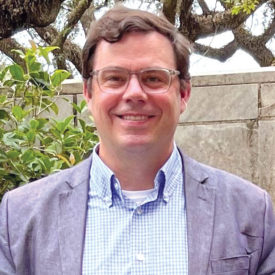
 CHRIS CURRIE is pastor at First Presbyterian Church in Shreveport, Louisiana.