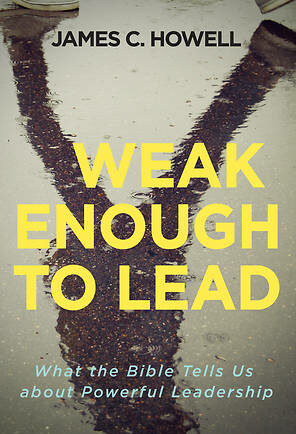
 James C. Howell
Abingdon Press, 164 pages
Reviewed by Jenny Cannon
To write a leadership book based entirely on the concept of weakness is a bit like writing a cookbook for people who don’t spend a lot of time in the kitchen. By design, good leaders aren’t usually known for their weakness. To be tapped as a leader in the first place often means that you have honed your strengths enough to be noticed and managed your weaknesses enough to relegate them to application and interview questions.
But in “Weak Enough to Lead,” James C. Howell asserts that weakness itself is central to our understanding of leadership from a biblical perspective. While many business leadership models and even some current church leadership trends offer clear-cut steps for successful leadership, Howell insists that in plumbing the depths of biblical leaders we don’t find a clear set of principles, but instead the stories of human beings who could be both fallible and faithful leaders. As a counter to the idea that effective leadership depends on having the right answers, Howell begins the book by lifting up a little-known prayer from King Jehoshaphat who prayed, “We do not know what to do, but our eyes are on you” (2 Chronicles 20:12).
After the opening chapter, the book turns first to the example of Jesus and suggests that a Messiah born as a flesh-and-blood baby highlights the significance of childlike leadership and a reversal of the typical power structures at work in our world. It then moves on to a brief look at Hannah’s sacrificial faith as an example of leadership based in letting go.
The rest of the book is organized mostly around the stories of male leaders from the Hebrew Bible including hall-of-famers such as David and Moses, general categories (such as priests) and, finally, Peter and Paul from the New Testament. Women are highlighted in conjunction with many of the leaders, though the absence of a deeper look at women such as Ruth or Mary seems a curious omission from a book that aims to lift up unexpected angles of leadership.
The chapters do build on one another, setting the narrative context for each leader’s story and wrapping in the perspectives of other more minor characters. Each chapter also ends with study questions designed to explore the paradoxes of these flawed and faithful characters and provide good fodder for conversation by pastors and congregation alike.
Howell manages to draw out salient points for reflection from each character’s story, without falling into a set of simplistic leadership principles. He highlights the rougher edges of human beings who have a tendency to be softened by their familiarity in our biblical storytelling. And he asks us not to smooth those rough edges but understand how these failings might also be part of our own call to lead out of weakness. That is really the call at the heart of this book: In committing ourselves to be followers of Jesus Christ, we are in fact committing ourselves to weakness. And leaders who are given to sacrificial love more than to esteemed recognition will always by some measure be too weak to lead. Thanks be to God.
Jenny Cannon is pastor of Bethesda United Methodist Church in Maryland.