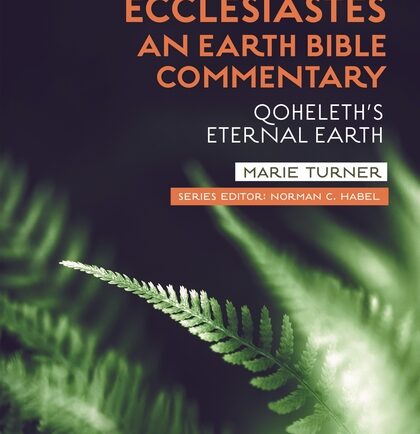
 Marie Turner
Bloomsbury, 144 pages
Reviewed by Susan G. De George
In the last several years, growing numbers of congregations have taken up the biblical imperative to heal the earth and protect all God’s children living on it. Wanting to build such a focus into worship services, pastors find themselves looking for commentaries and hermeneutical material with a creation care bent to help them prepare for sermons. The need for Christian ecological education resources in this area has grown. Early in the 20th century, one of the go-to collections that pastors could reach for was the five-volume “Earth Bible.” Then, in 2011, the first volume of the Earth Bible Commentary series came out. Sporadically since then, excellent commentaries on a wide range of individual biblical books have been published as part of this series. In each of these commentaries, the eco-justice hermeneutic attempts to move beyond merely pointing out ecological themes in Scripture or looking for what supports for creation theology can be found in the Bible to actually identifying with the Earth and its creatures in their struggle for eco-justice as one reads a biblical passage. At the same time, each commentary aims to give a detailed analysis of the literary dimensions of the text being examined.
The newest volume in the series, Marie Turner’s “Ecclesiastes: An Earth Bible Commentary,” gives an ecological reading of Ecclesiastes by focusing on two voices: that of the Earth (the primary preserver of eco-justice) and that of economy (responsible for the instability or security of a person). Through attention to these two voices, she hopes to give the reader insights on how biblical wisdom literature can provide a guide for the current environmental challenges. As she does so, though, I found Turner trying to lead me down unnecessary rabbit holes rather than directly addressing the issues.
For example, in the first chapter Turner explores the meaning of the key Hebrew phrase habel habalim (vanity of vanities). She summarizes scholarly studies of the term and concludes that she will have to make decisions about how to interpret the phrase on a case-by-case basis, depending on a passage’s context. This made perfect sense to me. But the first time she gets to an individual passages using the phrase (Ecclesiastes 1:1-3) and she tries to figure out whether “absurdity” or “breath” makes more sense in the passage, she follows the phrase in the direction of Albert Camus’ “Myth of Sisyphus” and from there to “a poignant newspaper article” she remembered about a artist’s suicide in a Scottish woods. These then lead her to decide that “like Camus after him, Qoheleth faced the desert of life’s frustrations.” From there she ultimately concludes, “The sense of the phrase is probably best understood in relation to hebel as ‘breath,’ with its sense of elusiveness.” While I don’t disagree with the actual translation choice she eventually chooses for the verse, the winding, leaping path from biblical times to 20th-century France to contemporary Scotland back to biblical times seems unnecessary and inappropriate.
These kinds of diversions and leaps happen frequently throughout the commentary, weakening some of the otherwise excellent points that Turner makes. For someone pressed for time and hoping to use “Ecclesiastes: An Earth Bible Commentary” as a preparation for sermon material or a Bible study, having to sort through the chaff to get to the wheat may be asking too much.
Susan G. De George is stated clerk of Hudson River Presbytery and professor of religious studies at Pace University in New York City.