“From dust you were formed and to dust you will return”
It was Ash Wednesday, and the crowd was small since it was also Valentine’s Day. I was also about five months pregnant, and had that in the back of my mind as I reminded everyone of their baptism and their death at the same time. As part of my meditation, I reflected on Nadia Bolz-Weber’s story about Ash Wednesday, “If our lives were a long piece of fabric with our baptism on one end and our funeral on another, and we don’t know the distance between the two, then Ash Wednesday is a time when that fabric is pinched in the middle and the ends are held up so that our baptism in the past and our funeral in the future meet.” It was a reminder that God is with us; nothing can separate us from God. Seventeen people had just died in Parkland, Florida, so that was in the back of my mind too as I placed ashes on everybody’s foreheads. “From dust you were formed and to dust you will return.” Nothing can separate us from God — even death.
The next morning, I got a call first thing from a member of the church: “Richard had a heart attack and is being rushed to the hospital. It was really bad, we don’t think he’s going to make it.”
I had just seen him last night. “From dust you were formed and to dust you will return.” He was the last through the line, the last person I said those words to, he made eye contact and nodded as I spoke those words, and now those were the last words I said to him. Richard was a pillar of our congregation; well respected, well loved, very particular and devoted to the church. I spent the day with his family, wife, children, grandchildren, sister and brother-in-law, sitting around his house. The power had gone out that morning, so we sat in the living room with no noise of televisions, heaters or machines around us. Occasionally the children would cry, but most of his family sat there in shock. As the day went on and they began to be able to process the death a bit more, we started to talk about what the service would look like:
“A lot of people will want to be there.”
“He went to everybody’s funeral or visitation, everyone will want to come to his.”
“Maybe we should have it at the Old Bluff? It fits more people than Bluff.”
I am the pastor of a church called Bluff Presbyterian in Wade, North Carolina, but we also manage the old building about a mile away known as the “Old Bluff.” This church was founded in 1758 and, as the second building on the property, was built in 1858. It has a long history, founded by Scottish Gaelic speakers in the 1700s. They had both patriots and loyalist members during the Revolutionary War, and Sherman’s army camped there before the Battle of Averasboro. In its 260-year history, I am the first female pastor. Even more, I am the youngest pastor they’ve had in a long time.
We decided on the Old Bluff for the service. The night before, the visitation lasted for about four hours (it was supposed to be two) because so many people were there to see Richard’s extended family and express their condolences. He always went to other people’s visitations and funerals. The Old Bluff began to fill up early as well. The only power in the church comes from a couple of plugs in the front where we can plug in speakers and microphones, so I was there early to test it and still wasn’t the first one there. As the service began, with the church full, his extended family filed in behind me as the congregation sang “Blessed Assurance, Jesus is Mine,” and filled much of the center of the church.
I spoke some words of Scripture, prayed and sat down as Richard’s niece, Karen, walked up to the pulpit to sing “In the Garden.” Karen was a bit out of breath, a bit emotional. But not only because she was distraught about the death of her uncle, but because she, like me, was five months pregnant. As I listened to her sing, it dawned on me, that this was probably the first time in the 260-year history of Bluff Presbyterian Church that two pregnant women led worship in the old church. What a statement. What a gift. What a blessing. We were welcoming new life into the world, into the church, while remembering the life of someone who meant so much to his family and the church. Someone whose name will always be remembered in the history of the church. We were in a place with a rich history, honoring someone with a rich history, ready to welcome new life into the world. This was where the fabric was pinched in the middle, a place where God was present and we were reminded that nothing can separate us from the love of God.
Throughout the spring and early summer I did two more funerals for the same extended family. Karen sang for both of those services too. “We need to stop doing this,” Karen and I said to each other. Our team of pregnant women leading worship for funerals was doing it too much. It still seemed special, meaningful that this new life was helping usher out those who were on their way out of the world, but that first service seemed to have a unique presence. This had never been done before.
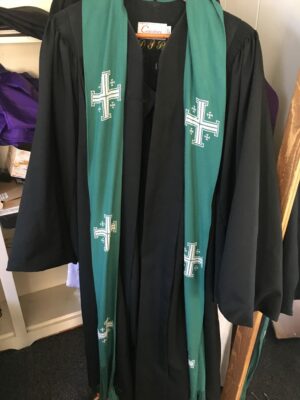
On June 21, I led a funeral at the funeral home for the mother of one of our members. I wore the “traveling robe” shared by my sisters in ministry. It was two weeks before my due date, and someone commented that I looked “big.” It was a well-meaning older lady who was quickly scolded by her entire family. I didn’t know the woman who died, so I did the best I could with my message. I talked about the journey of life, and how the journey is not exactly over but just beginning for her. That night I started to feel contractions, they got closer together throughout the next day, and on June 23, I gave birth to my second daughter.
In the last few months of my pregnancy in the “traveling robe” as I prepared to bring new life into the world, I really started thinking about about Nadia Bolz-Weber’s words that I used months before: “The promises of baptism and funerals, the promises of birth and death are so totally wrapped up together. For we come from God and to God we shall go.” We come from God and to God we shall go. What a blessing, that as a minister I get to be with those who go to God and their families as they grieve. What a blessing, that as a mother I get to be involved in bringing someone into the world. And what a blessing, that we live in a time and place where I can do both.
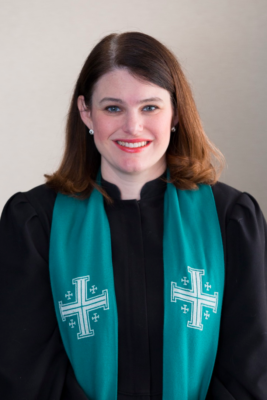 MEG LINDSAY DUDLEY is the pastor of Bluff Presbyterian Church in Wade, North Carolina. She has worn the “traveling robe” twice now, and has two wonderful daughters, Lindsay (3) and Julia (3 months).