Guest commentary by Robert McCutcheon
I was baptized in 1951 into Pittsburgh’s 6th United Presbyterian Church, now Eastminster; my introduction to the city’s Jewish life was aquatic in a different way.
In high school I swam for the old Young Men’s Hebrew Association — the Jewish Y, as it was known. For a year after college I worked as a lifeguard at the Irene Kaufmann Center, the site of the present Jewish Community Center, where I kept my membership on and off to the present day — when it is now free, thanks to Medicare and my advanced age. On Saturday, Oct. 27, had I been in Pittsburgh, as I often am, instead of in Elkins, West Virginia, where I now live, on my way to work out at the JCC I would have driven right by Tree of Life Synagogue.
I was not the only Gentile on the YMHA’s team, but certainly in a religious minority. I was warmly welcomed, though (and not because of my swimming prowess, as if I had any). I learned all about Reformed, Orthodox and Conservative; I figured I belonged to the Chlorinated branch of Judaism. My teammates advised me, if I thought my credentials might be challenged, just to sign in as McCutcheonstein, and no questions would be asked. Far from being an alien, I enjoyed a sort of dual citizenship. I remember driving back and forth from my home in the suburbs to the pool in the fall, when the lawns of Squirrel Hill (which news reports have mentioned) would bloom with succoth, and my youth was full of Jewish lore, largely provided by the elders of the club, who all but bar mitzvahed me in the locker room. The journalist Howard Fineman, a native of Squirrel Hill just about my age, during a TV interview called the neighborhood a paradise, and, goy that I am, I agree.
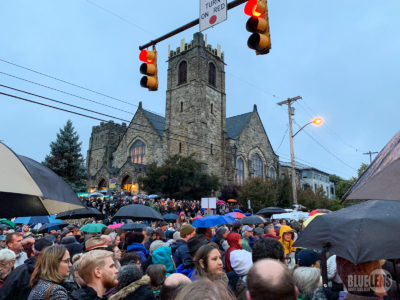
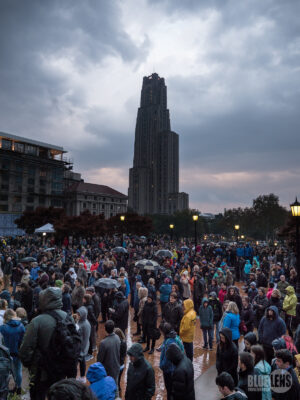
The testimony in the news that Squirrel Hill is organic to the city (and was to my education – my Christian education) is not hype. The district is one of many ethnic communities in Pittsburgh, an especially vital one, and the whole city responded to its tragedy. Television viewers saw mourners gathered in front of Sixth Presbyterian Church, which is right across Forbes Avenue from the JCC and was the home congregation of Fred Rogers. He would have recognized the presence of his neighborhood. A branch of Carnegie Library, another great Pittsburgh institution, is on a third corner of Murray and Forbes. Squirrel Hill abounds in houses of worship and learning — often the same houses. They are a reminder how organic Judaism is to Christianity — as vine to branch, as stem to shoot.
One episode from that golden age distils my intercultural experience. During a workout circa 1980, one of my fellow masters swimmers at the JCC urged me to attend a class he was taking at the nearby Hebrew Institute on the Gospel of Mark — taught by a rabbi. I took him up on his offer and was so impressed to see a roomful of attentive young Jewish adults studying a Christian text from their perspective, which in turn allowed me to see the book in a fuller light. When I went on to teach the Hebrew Bible to college students, I hoped to recreate that respectful atmosphere. That evening I think I made the rabbi, Ron Brauner, a little nervous; he may have been expecting me to brandish some pamphlets and start evangelizing. But I was able to return the favor, or maybe turn the tables, some 25 years later when I invited him to Davis & Elkins College, related to the PC(USA), to deliver a lecture endowed in the name of William Phipps, a past Presbyterian professor of religion and author of “The Wisdom and Wit of Rabbi Jesus” among other works delving into the Jewish background of Jesus. Brauner titled his talk “Judaism is not a religion,” and on that occasion he was just as insightful and stimulating as long before.
For many centuries, Judaism and exile have been near-synonyms. The most profound study of Jewish refugees I know of in literature (outside the Torah) is a 1941 novel by Erich Maria Remarque (best known for “All Quiet on the Western Front”), called “Liebe deinen Nächsten”. It recounts the trials of a half-Jewish boy and his Jewish girlfriend on the eve of World War II as they are turned back at one Grenze(border) after another looking for a haven. Its title, from the New Testament (“Love thy neighbor”) is poignant and ironic at the same time: On the run, they are all the neighbors they have. Near the end of their ordeal, the girl voices the eternal victim’s lament: “Weshalb macht man das alles mit uns? Wir haben doch niemand etwas getan!” (“Why do people treat us like this? We haven’t done anything to anyone.”) According to the boy, that is not the question but the answer: “Ich glaube, das is der ganze Grund.” (“I think that is the whole reason.”)
Two of Brauner’s observations, one in the session on Mark years ago and one when he visited Davis & Elkins, offer wisdom and hope in a present with its own uncertainties. The day I visited his class, he was covering Mark 13, sometimes called “the little apocalypse,” when Jesus predicted difficult times for his disciples, including the fall of the Temple. Brauner suggested that this prospect would sound more alarming to Christians than to Jews. Jews, having survived the fall of one temple (Solomon’s), would see the second fall as “one great catastrophe, but not the end of the world.” Many years later, as one of his duties as Phipps Lecturer, Brauner visited my Bible as literature class and explicated Psalm 23 (which would be familiar to most of us in English, and especially in the King James Version) in Hebrew. The thrust of his discussion was that the poem is much earthier and less abstract in the original than in our versions. The word usually translated “soul” in Hebrew is nephesh (נֶפֶשׁ), which Brauner rendered “breathing mask” — the mouth and nostrils. When in the KJV’s Psalm 69 “the waters come in unto my soul,” the situation is even more serious than it sounds, as any swimmer would sense. So in God’s green pastures, by still waters, God doesn’t restore our soul so much as let us catch our breath.
The shooting targeted the older generations, the Bible’s toledoth. One of the victims was my father’s age, 97, baptized into 6th United Presbyterian Church in 1921; three were about mine. We can be sure though that the attack on the Tree of Life Synagogue, great catastrophe though it is, will not be the end of the world for that resilient faith community, and we can trust that God will let Squirrel Hill, and all of us, breathe again.
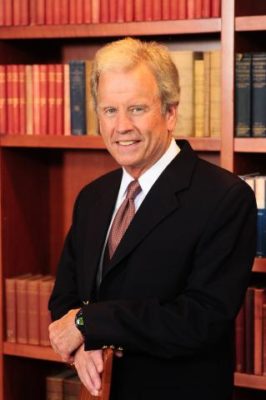 ROBERT McCUTCHEON is assistant professor of English at Davis & Elkins College in Elkins, West Virginia, and served as a ruling elder at Eastminster Presbyterian Church in Pittsburgh.