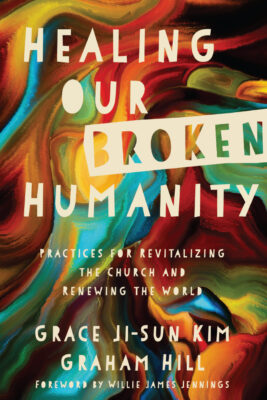
 Grace Ji-Sun Kim and Graham Hill
IVP Books, 208 pages
Reviewed by Rachel Cheney
Starting conversations about change can be uncomfortable in most communities with political and sociological diversity. Even within denominational boundaries, individual churches have unique histories and perspectives. In our cultural context fraught with untrue binaries, divisive polarization and reactionary tribalism, communities of faith are challenged to confront injustice in their midst and in the world. “Healing Our Broken Humanity” offers a roadmap to begin the process of healing through dialogue and action in the church.
With candidness, the authors suggest nine practices congregations and small groups can use to begin conversations about how to identify entrenched oppression in the church, repent for collective wrongdoing and subvert cultural tendencies toward sins of omission and commission. At the end of each chapter, the authors suggest practical tools for readers to apply what they are learning to their lives, along with questions for discussion or individual reflection.
By relying heavily on personal experience and conviction, they approach topics such as systemic racism, class inequality and heteronormativity. A tendency in the church is to erect boundaries that identify those on the inside and those on the outside. Kim and Hill invite the reader to repent of this ongoing practice and actively work against it. They highlight the power of communal practices to bring healthy change within the church. Kim describes how intentionally forming new practices in the church inspires positive change. She says, “Discipleship practices and new ways of conceiving and speaking about God and the world shape our life together.” Both authors suggest that continued learning in a community broadens our understanding of how we view others and becomes a powerful tool for combating prejudice.
The connection between repentance for complicity and lament was one unique suggestion the authors made. Through lament, communities are challenged to grieve for the way the world is, repent of collective complicity and then reimagine the church and world as a place of peace and equality.
This book is an excellent first step for communities and churches. It offers a blend of well-researched studies and personal stories demonstrating how the church has been complicit in promoting injustice. Without sounding melodramatic or alarmist, they paint a picture of a world that desperately needs people of faith to rise up and confront the challenge of systemic problems in church and the world.
This book serves as an introduction to healing and wholeness for communities of faith. However, there is room for expansion and more depth in a number of areas, specifically that of gendered and environmental oppression. And finally, to a reader unfamiliar with the extent of social justice issues, it would be helpful for the authors to point to external resources that support their claims. A facilitator of a small group reading this book would want to encourage supplemental reading — particularly for groups with diverse political and social views.
Overall, the book succeeds as an introduction to practices that revitalize and promote healing in the church. Readers will benefit from the array of stories and practices the authors suggest. I highly recommend this book for individual and small group discussion as a text for open-minded beginners interested in promoting growth in their personal life and church.
Rachel Cheney is the youth director at Brownson Memorial Presbyterian Church in Southern Pines, North Carolina, who is passionate about ministry and exploring avenues of growth for the church.