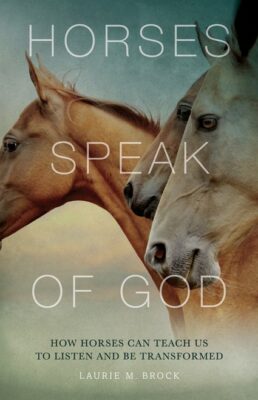
 Laurie M. Brock
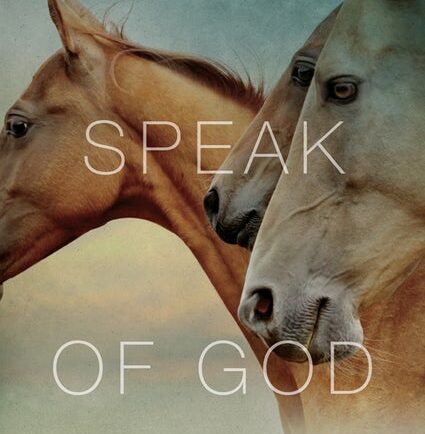
Paraclete Press, 144 pages
Reviewed by Jennifer Meyers
As a teenager I rode my horse on a large network of trails, often alone. In the solitude of the woods, I attempted to imitate the form of professional jumper riders I’d observed at the last horse show. More importantly, my horse and I listened to each other. He is the only one who did not cower as I practiced songs learned in church, and I would pray. I never tried, like Laurie M. Brock, Episcopal priest and former attorney residing in Lexington, Kentucky, to put words to the experience of worshipping God on the back of a horse, but I can attest she gets it right.
In 17 essays succinctly summed up by one-word titles (Still, Collect, Balance), she offers an extended meditation on how the bodily act of riding horses opens her soul to a new experience of divine presence, one that discards words to express a different tongue: “The language of healing that only horses speak.” She explains, ”These creatures teach me to feel life and faith in my body and in my being, not to cover these feelings with words and intellect.” Brock takes us onto the back of the American Saddlebred where, through wisely chosen metaphors, we not only learn how to ride, but she also encourages a renewal of thinking about what it means to be a spiritual person and how to live out a fresh style of faith. She positions us in a saddle that looks like a ”potato chip covered in leather,” and imperceptibly guides us into “the perfect meditation position … that stretches downward to the horse and upward through the crown of our heads. … Dropping the weight of our incarnate selves pushing downward to anchor our souls.” We “direct a ton of an animal” with “tiny human appendages” — our fingers and wrists. And so, we arrive at a new relationship with God in the holiness of everyday life, even “the holy space of the barn.”
In down-to-earth writing (no theological jargon here), she says, “I toss a pile of manure into the bucket as Jesus says, ‘Yes.’” Laced with humor, and surprisingly vulnerable for a pastor, she writes: “I used her mane to wipe away my tears. Friesian manes are slightly less absorbent than Kleenex tissues, but in the middle of a barn and in the midst of life, we use what we have to dry our tears.” Brock connects the life of the church to the ordinariness of the daily, helping us to walk our faith talk, whether that is on a bucking ride or “grounded, however dull it may seem, by routine.”
Brock loves words, and cherishes their form and power. “We are, as we like to say, people of the Word.” At times I grew impatient with the text weighted by words, but as I slowed my reading I appreciated how carefully she crafted complex thoughts. The essays are best read reflectively. Just as learning to ride takes practice, it takes time to assimilate what Brock is saying. Moving (by horseback no less) from centuries of faith-words found in Scripture, prayers and creeds to the silence of “sitting deep” in our authentic self in the presence of the holy takes discipline. The writing is well worth taking time to contemplate because horses do speak of God and Laurie Brock is an excellent translator.
Jennifer Meyers lives in Ocala, Florida, with a small menagerie of animals, three of which are horses.