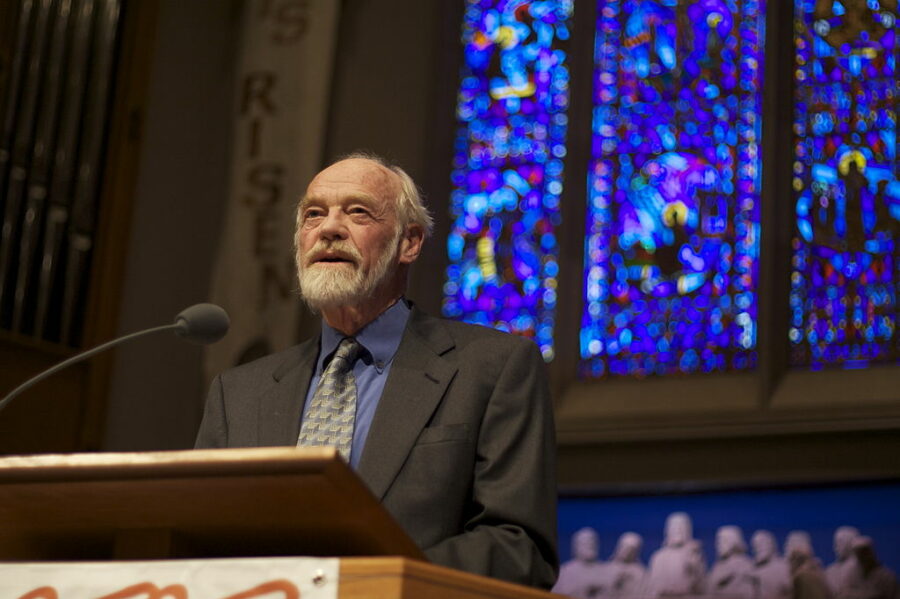
Eugene Peterson was not a personal friend, but he was my companion. And he continues to be.
Sadly, I never had the opportunity to know him personally. In the wake of his death, I have enjoyed reading many personal tributes from friends and family and those close to him. I can’t express such personal intimations here, yet I cannot conceive of the work of ministry or my own ministry apart from Eugene Peterson. Like Zuzu’s teacher in “It’s a Wonderful Life,” every time a bell rings, I feel like Eugene Peterson has saved another person’s ministry from being reduced to managerial technique, consumerist whims or the quixotic quest for cultural relevance.
Several weeks ago, I read a lamentation from a sister church (The Church of England), voiced through the Dean of Southwark, that his church was prioritizing leadership skills over theology. In many circles today such news is not met with alarm, but thanksgiving. “Let’s usher in a new age of leadership, governance, and deft managerial technique, and let’s usher out antiquated theology and doctrinal claims and the need for theological reflection in shaping the church’s life and witness. Theology and theological reflection on the practice of ministry is a thing of the past. Good riddance.” Eugene Peterson faithfully and obediently stood in front of the approaching Goliath, a Goliath armed with powerful entrepreneurial recommendations, sure-fire managerial techniques, positively certain church effectiveness strategies, the latest demographic relevance models, all backed by a powerful Philistine army full of the latest church growth workshops and statistical data about what is most relevant for ministry; and for his entire ministry and prolific publishing career, Peterson pulled from his modest satchel little stones like “prayer,” “Scripture” and “theological reflection.” Stones that could never possibly fell a giant. Stones that could never sustain a ministry. Stones that could never be more relevant than the hard data, the experts or just giving people what they want. In his tribute to Peterson in theChristian Century, David Wood writes, “Peterson never delivered a set of instructions or a formula for success in ministry.’ In contrast, Peterson offered less in terms of the latest and newest and challenged us instead to enter once again the strange new world of the Bible, to enter there more deeply, more regularly, more contemplatively, allowing that world to baptize us and our imaginations and to engage the “real world” shot through with the glory of Christ.
As I move forward with my own dog-eared collection of Peterson’s books, I am struck by how many of them were given to me as I began to contemplate and act on the call to ministry. In the front were inscriptions like this one: “May this saint guide you as he has me.” Or: “I wish I had read Peterson when I was in seminary, so I pass this on to you.” Sadly, even with those kind of admonitions it took me some time to realize the buried treasure that had been given to me and planted in my own fields. And it was a long time before I ever learned that the author of “The Message” was a minister for his entire ministry in the Presbyterian Church (U.S.A.). Who knew that this prolific author, teacher, writer served quietly and faithfully as a church planter and pastor in the PC(USA) for 29 years? I counted over 30 books and publications, and yet not one was published by his own denomination’s publishing house, and apparently it took him 17 tries before getting his first book into print. We don’t know what to do with people who don’t tick all the right boxes do we? In this way, I would call Peterson not just a pastor but a prophet, even prophetic. He was a faithful and thoughtful Presbyterian pastor whose writing was able to shape and influence far beyond any parochial limitations, and yet he did so by largely critiquing much of what passes for Christianity in North America by saying things like this: “There is a great market for religious experience in our world; there is little enthusiasm for the patient acquisition of virtue.” Or this: “The persons whom I lead in worship want shortcuts … they want me to fill out the form that will get them instant credit (in eternity). They are impatient for results. They have adopted the lifestyle of a tourist and only want the high points” (from “A Long Obedience in the Same Direction”).
There is a part of me that is sad that I was never one of Eugene Peterson’s friends or acquaintances; there is part of me that is sad I never got to meet him or hear him speak. But in truth, Eugene Peterson continues to be my companion, his writings continue to surround me, inspire me, prod me and point me to the true source of ministry, reminding me of what truly matters in ministry and helping me to see that the way of discipleship, while it may be a “long obedience,” is also filled with joy and with rich traveling companions all along the way.
Thanks be to God for using Eugene Peterson to get us further down the road.
 CHRIS CURRIE is pastor at First Presbyterian Church in Shreveport, Louisiana.