According to historians, Hadrian, the Roman emperor who ruled Rome from 117 to 138 A.D., ordered his soldiers to build a wall between Britain and Scotland, which was at the time the limits of the Roman Empire in the West.
It allowed Roman soldiers to control the movements of people coming into or leaving Roman Britain. In Hadrian’s words, they wanted to “separate Romans from the barbarians” to the north, as well as to control immigration and smuggling of goods.
Another theory is that Hadrian’s Wall was partly constructed to reflect the power of Rome and was used as a political point by Hadrian.
Hadrian has been described as ‘’enigmatic and contradictory, with a capacity for extreme cruelty and self-conceit.’’
Physical walls have been used throughout history both for protection against invaders and to separate peoples of different cultures and worldviews. The movement toward building walls continues today in the U.S. and other parts of the world, fueled by today’s ‘’emperors’’ and efforts to keep out perceived ‘’strangers’’ who may have a different religion or belong to other ethnicities and cultures.
Unfortunately, even some Christian groups applaud these actions with the pretext of preserving their way of life, racial supremacy and white privilege, as well as their seemingly warped understanding of the Christian faith, which they consider to be the only one that matters. ‘’Winning’’ at all costs, regardless of who might suffer and lose even the basics of life – such as a decent and living wage, health care and the right to seek asylum protection – seems to be their mantra and practice.
On the other hand, Jesus’ words and witness do not support this ‘’zero-sum’’ worldview. Jesus welcomed and affirmed everyone regardless of his or her station in life, ethnicity, religion or gender. He challenged precisely those who wanted to erect walls of separation, whether from a political or religious worldview.
Jesus did this years before Hadrian. As reflected in the Gospels, he resisted the Roman Empire which also wanted to create virtual and real walls of separation between the Roman conquerors and the Palestine people based on cultural and religious oppression — including the Jewish people, the culture and religion where Jesus was born.
For these reasons Jesus was persecuted by the privileged religious leaders in cahoots with the Roman conquerors, and eventually jailed, tortured and left to die on a cross.
Ironically today, the modern political state of Israel in that same part of the world – claiming to be fulfilling biblical prophecy – subjugates the Palestinian people who have lived in the area for centuries. Actual walls of concrete and social ostracism separate these communities. These oppressed Palestinians, struggling to preserve their ancestral land and liberty, happen to be both Muslim and Christian.
According to Joshua 6:1-27, the walls of Jericho fell after the Israelites marched around the city blowing their trumpets. Whether we take it as symbolism or fact, it reflects how God’s people can tear down barriers and build community.
When Jesus died on the cross, the writer of Matthew’s Gospel tells us that “at that moment the curtain in the sanctuary of the Temple was torn in two, from top to bottom,’’ permitting humanity and God to be reconciled so that also any enmity between communities could disappeared (Matthew 27:51).
Let us continue to blow our trumpets of compassion and justice and seek to tear down any wall or curtain that separates God’s creatures as followers of the One who came to bring about the kin-dom of God, where we are family regardless of our differences because we all have the same spark and spirit from the creator God.
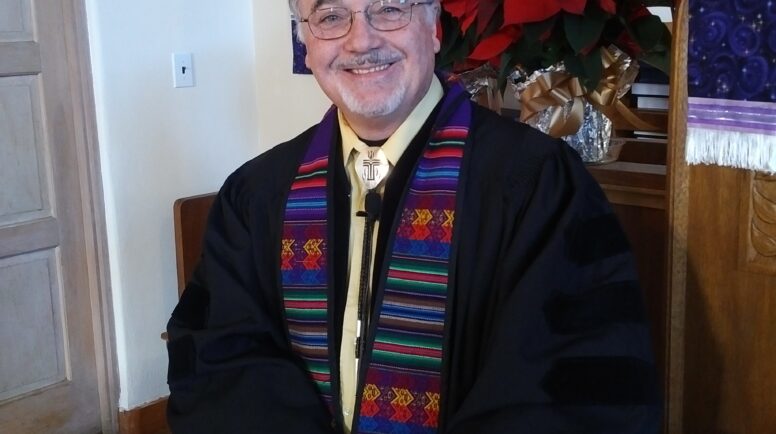
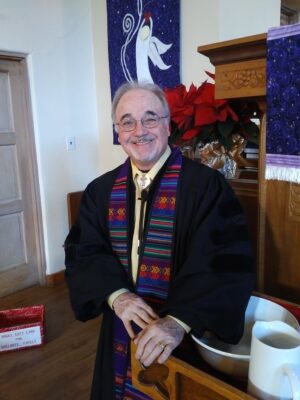 Tony Aja is the pastor of Westminster Presbyterian Church in Santa Fe, New Mexico, and moderator of the Hispanic/Latinx National Presbyterian Caucus.