In 1974, a group of farmers were digging a well in China when they found some unusual pottery. Further excavation discovered over 8,000 life-size figures of soldiers along with chariots, weapons and horses from the third century B.C. The discovery became known as the Terracotta Army. It was a significant finding because the artifacts allowed researchers to understand the culture and political systems of an era that no longer exists. It was an archaeologist’s dream to gain such detailed insight into an entire civilization through the objects they left behind. Who were they? Why did they make this? What need did it satisfy for its creators? The things we produce and consume say something about us. Archeologists of the future will someday study the material things we leave behind as relics and draw conclusions about our society. What will they infer about us?
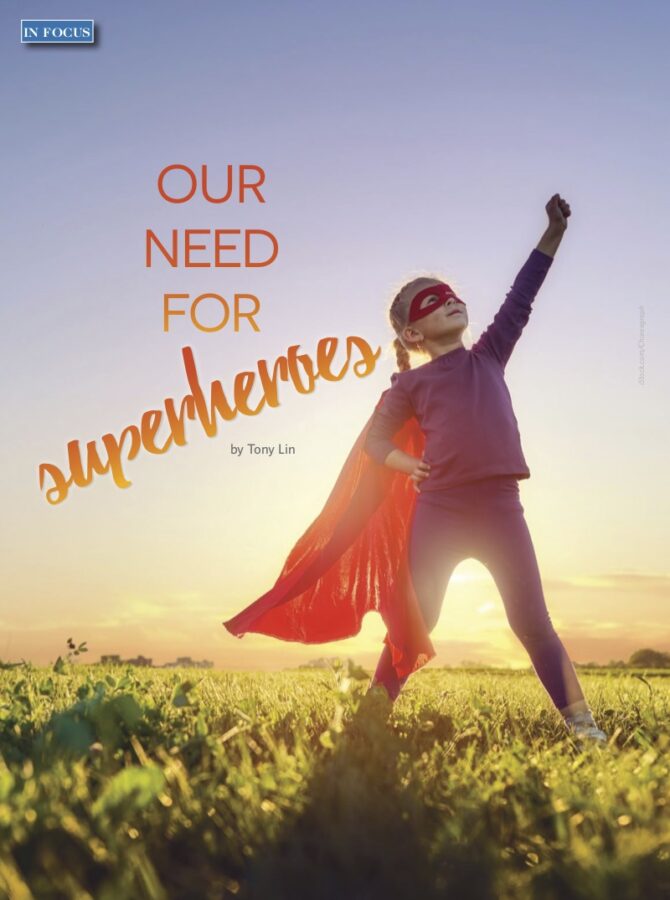
 Like all artifacts, comic book superheroes are cultural products that satisfy a cultural need. They reveal something about the culture that creates them and consumes them. Every civilization creates legends with mythical power and unshakable convictions, superior beings who do the right thing for the community. American superheroes are an inherent part of the American experience. They feed our cultural hunger for power, victory and valor. And as a society our hunger for superheroes is insatiable. The highest grossing movie franchise of all time is the Marvel Cinematic Universe — movies which altogether (including “Black Panther,” “Avengers” and “Ironman”) have brought in over $22 billion dollars in just 11 years. That figure is still growing. It has earned more than all the “Star Wars” and “Harry Potter” movies combined. These movies are popular not just because of their entertainment value, but because they quench a thirst that cannot be satisfied.
The fight against our finitude
From birth until death, humans are in a constant battle against our physical limitations. As newborns our instincts lead us to crawl, then walk and eventually run. It is an inner human desire to be more than we are, to transcend the physical limitations of our bodies and our world. We carry these desires into adulthood using machines to help us achieve what our bodies cannot. From cars to planes, we’ve invented things to go beyond our natural bodies. This same desire leads some to the destructive uses of performance enhancement drugs. But the desires for greater power are not always selfish.
 As finite beings living in a world full of dangers, we face constant reminders of our mortality. Our desire for greater power is often fueled by our desire to avoid suffering and death, not just for ourselves but for others. The sense of helplessness is never greater than when we watch powerlessly as others, especially loved ones, suffer. Our desire to surpass our physical limitations might be motivated by personal ambitions, but can also stem from a genuine desire for the good of others.
This is the role that superheroes play in our society. Superheroes satisfy our dreams to be more than mere humans and they affirm our deepest commitments and desires for a better world and our better selves.
Hope and disillusionment
Looking at superheroes through an archeological lens helps us see these characters as cultural artifacts that tell our story. Modern American superheroes were born out of a time of national need. They were created as a response to a cultural disillusionment.
 Friedrich Nietzsche declared the sentiments of an era when in 1882 he proclaimed that God was dead. God was dead because humanity had finally overcome the need for the divine. A generation raised in the dreams of modernity wagered on human advancement to fill the needs that God would not. We would heal the diseases that God did not. We would grow crops and build cities bigger than anything God had ever done in nature. The advancement of technology, science and human knowledge had made God irrelevant. Hence, God was dead.
Americans were living in an era of great progress and growth. Life was supposed to be better and easier for everyone. There would be no need for the barbaric practices of old. Like the inhabitants of Shinar, we began to build and create things that would make a name for us. But the tower of modern marvels began to crack as American reality was far from the modern dream. The United States fell into the Great Depression. The technology that was supposed to improve the human condition ended life for millions in two World Wars. America was rife with racism as the Ku Klux Klan enjoyed a golden era of renewal in the 1920s. Rather than ushering in the dreams of a better future, modernity gave us chaos, the extent to which we had never seen.
Modernity gave us urbanization and industrialization. The romanticized agrarian frontier life faded away and was rapidly being replaced by loud machines and cities filled with all kinds of people who looked very different than those who were here before. How were Americans to make sense of these changes?
The birth of superheroes
It was during this time of cultural confusion that many of today’s superheroes were born. They were created because of our need for cultural heroes that would affirm our deepest commitments. Perhaps what best encapsulates our need of superheroes is the introduction to “The Adventures of Superman,” a 1950s TV show: “Faster than a speeding bullet! More powerful than a locomotive! Able to leap tall buildings in a single bound!” Superman was the answer to the modern man’s fear (I use “man” intentionally as it was largely a white man’s fear) that technology and the promises of modernity would yield terror rather than glory. Superman was the embodiment of our hope that someone was still more powerful than our most powerful creations — more powerful than our weapons, our machines and our big cities. Powerful enough to save us from ourselves and all that threatened to destroy us.
 Superheroes are a projection of our best selves in a vulnerable world. They encapsulate our ideals. Superman, for example, is the ideal American. Like most Americans, Superman was an immigrant. An alien ended up on earth as a refugee after his own planet was destroyed. He was raised in the heartland, adopted by a traditional farming family. He learns good old-fashioned American values from them. But when he grows up, he takes his powers to the big city to save people and make the world a better place. He is the perfect embodiment of the American dream. He reaffirms the fantasy of the model immigrant for many. The lone foreigner who fully assimilates into white middle class America and lives out its purest aspirations while still retaining the best of his own world, using it all in the service of this great nation.
The late modern resurgence of superheroes
The cultural anxieties that gave rise to comic book superheroes generations ago have only intensified. In many ways, the disillusionment with modernity is greater now than before. Technology has given us the knowledge of the world in the palm of our hands and seemingly made facts irrelevant. Devices that were supposed to connect us often make us more isolated and divided. The rise of automation threatens the economic lives of many Americans. Every day we live with the threats of violence: locally through mass shootings and globally through nuclear war. The same modernity that gave us prosperity is also responsible for the global warming crisis. We are still living through the age of disillusionment.
While technology has alleviated much suffering and improved the quality of many lives, its potential for causing agony has also magnified. We need cultural reminders of our ideals, even if only in fantasy and embodied in superheroes. We need an imaginary representative who has dominion over technological power and will use it for the good of humanity. We yearn for good to defeat evil once and for all. In other words, we want to be saved.

Ordinary superheroes?
In an ironic twist, the most popular comic book superheroes today are not the ones endowed with superpowers but the normal people who aim their resources for the good of others. Batman and Ironman, for example, are regular guys. They are not from another planet, nor been enhanced by gamma rays. What they do have are the resources necessary to do good. They have abundant wealth, intelligence and the commitment to fight evil. Bruce Wayne and Tony Stark are the ideal we hope every wealthy individual in America shall aspire to emulate: people who are aware of their great privilege and choose to serve the good of others at great personal cost, even as they struggle with their personal demons. They are not perfect. They are not invincible. They just rose to the occasion. They recognize that they are in the positions they are in for the sake of justice for others. They are ideal, if flawed, people who use the promises of modernity for their ideal purpose: to defeat evil and make the world a better place.
The good news of the gospel in a world hungry for superheroes
This is the very good news that the church is called to preach to a superhero-deprived world: While there were some superhero-like biblical characters, such as super-strong Samson and super-soldier David, the great majority of biblical heroes and heroines were normal people, like Esther, who made themselves available “for such a time as this.” The biblical examples of God using ordinary people during extraordinary seasons for divine purposes are myriad: a couple of midwives who saved countless babies from death in Egypt, a young man with a fancy coat who ends up saving nations from starvation, a child’s lunch feeds 5,000 hungry people, 12 average fishermen and tax collectors who went on to change the world. Like Bruce Wayne or Tony Stark, none of them were born with supernatural powers. They were not perfect. They were not invincible. They just chose to rise to the occasion, to answer the call to stand on the side of good and in opposition to evil, no matter the cost to themselves.
We, the church, can speak a word of hope into a disillusioned world. We can fill the need that superheroes satisfy in the real world. We can sacrificially give of ourselves showing the world that human vulnerability is not to be feared if we have eternal life. The limitations of the physical world do not restrict us because we worship a God whose strength is made perfect in our weakness. We are not called to save the world. Jesus has done this. We are only to use our God-given gifts for “such a time as this.”
Presbyterians as a whole are the second richest Christians in America. We have the power to alleviate much suffering. Together, we have the opportunity to make ourselves and our resources available for such a time as this. We can join the many faithful Christians who have turned their churches into sanctuaries. We can turn our unused properties into affordable housing in the cities where homelessness is epidemic. We can use our positions of power to fight injustice and inequality. We can get very personal and be the ones to drive someone without a car, help a child with their homework, be a friend to the lonely. We can live with the singular aim to channel all our energies and resources to make the world more just and peaceful, trusting that the world, that we, are already saved. Good not only will triumph, through Jesus Christ evil has been defeated.
Perhaps when future archeologists discover our artifacts, they will conclude that this was a society that did not hoard power but sought to share it. A world that did not seek to destroy enemies but to love them. A culture where the weakest and most vulnerable were protected by all people, not just the rare individual superhero. Archeologists of the future could draw these findings if we begin to work toward those ends and make them visible right now.
 TONY LIN is a Presbyterian minister who was born in Taiwan and grew up in Argentina. He lives in Charlottesville, Virginia.