 Guest commentary by Joshua Musser Gritter
Silent night, holy night
Mary screams, Joseph paces back and forth.
“Will the baby survive?”
All is calm, all is bright
Barren cave, lonely and dark.
He’s never delivered a baby before.
Round yon virgin, mother and child
She doesn’t know if she’s ready to be a mother,
Savior or not.
Holy infant, so tender and mild
Now a crib, soon a cross.
“I thirst,” he cries forth.
Sleep in heavenly peace, sleep in heavenly peace
So ignoble this birth, so ugly this child.
God covered in stable stench and earthen muck.
Terrifying night, lonely night.
In the dirty nativity,
Divine lungs breathe human dust.
I’ll never forget my first Advent as a pastoral intern. I was serving in Durham, North Carolina, at Trinity Avenue Presbyterian Church — a church, by the way, with a bucketful of saints for congregants. On one glorious Advent Sunday it was my turn to offer the children’s message. There’s a lot of varying opinions on what makes a good children’s message, but most pastors who’ve been in the game long enough admit to winging it half the time. But on that Sunday, I was more than prepared. I even had a place or two where I thought I’d get the congregation to cackle and hum over the cute answers the children would give to my silly questions.
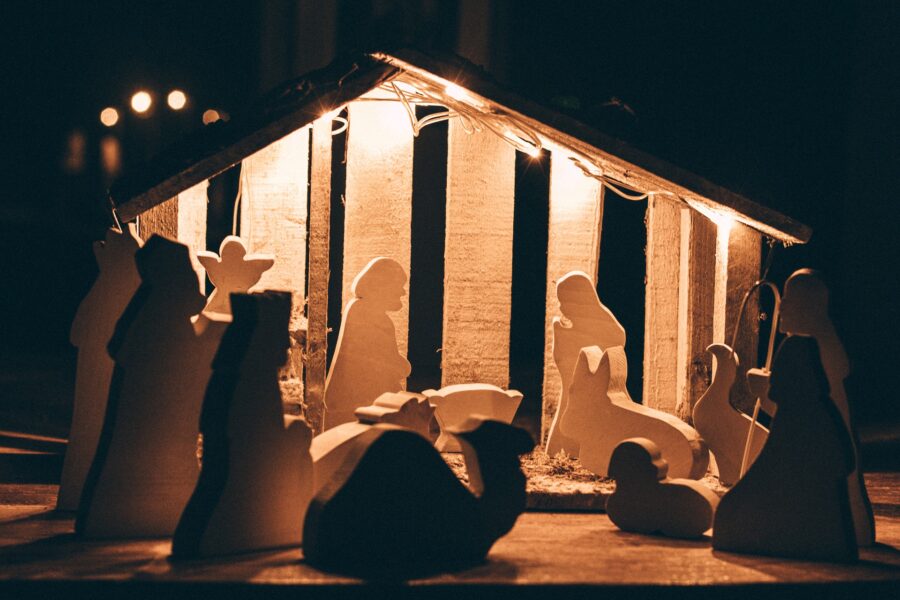
I brought a prop with me, too. Good children’s messages always have a good prop. I held in my hands what I would consider a standard procedure Nativity scene. You know, the Nativity where Joseph and Mary look like white Midwestern farmers on vacation in the Middle East, where the perfectly manicured camels and donkeys stand majestically admiring the baby, where the beautifully crafted wooden crib (do I detect a maple finish?) tenderly holds blonde-haired, blue-eyed baby Jesus.
As I showed the children around the barn of Jesus’ birth, I asked them, “What do you like most about this Nativity?” They answered exactly as I had hoped: “I like baby Jesus. He looks happy.” A lovely awe hovered across the congregation.
“What else do you like, children?” Two brothers a year apart wrestled and bit at one another behind me. The congregation giggled while I shot Mom and Dad a glance that says, “Let’s clean this up, folks!”
Another child answered, “I like that the animals were nice to Jesus.” Hearts were full, a communal smile swept through the room.
And then would come the finale. The cutest child of all of them said, “I like how the family is all together for Christmas.” And there it was. Husbands and wives joined hands, grinch-like hearts grew several sizes. Even the cranky choir member couldn’t help but grin. Joy to the world might as well have been playing in the background.
Just as I was about to close the deal with the typical, “And isn’t that what Christmas is about?” line, a quiet child we’ll call Timmy blurted out, “I don’t like it at all!” His parents gave him that don’t you dare look while the congregation snapped out of their sentimentality and began to laugh hysterically. I turned red in the face, thinking to myself, “Hey kid, don’t mess this up for me.” All my self-preservation alarm bells were ringing inside me: “Change the subject, crack a joke, dodge the moment” they told me. But I was curious. So I answered the young intern-wrecker, “What don’t you like, Timmy?”
“I don’t like how clean it is. I grew up on a farm. Animals are stinky. Farms are dirty. Shouldn’t Jesus’ nativity be smelly and dirty, too?”
The congregation grew silent — the kind of silence that happens when a group of people simultaneously detect a space’s sacred temperature. I didn’t know what to say. I wish I could say I segued into something beautiful, but there could be no wrapping to cover over this idea that Timmy brought out of the box. A theological bomb exploded all over my perfectly manicured pastoral moment. No matter what prayers I prayed or liturgy I lead for the rest of that service, I couldn’t get Timmy’s comment out of my head. I suppose they call it a children’s message because sometimes the children deliver the message.
Timmy was right, and that evening he was the best theologian in the room. My Nativity was a sanitized Nativity, a westernized Nativity, a white-washed Nativity. It was too put together, too clean. On that first Christmas morning there was not silence, and there certainly wasn’t holiness — at least not as the purity laws of Leviticus would define it. There was no epidural, no measuring of dilation, no nurses checking in. Mom and Dad weren’t in the waiting room listening for the baby’s first cry and friends weren’t bringing balloons and Starbucks lattes the next day. The first Nativity was smelly, it was dirty.
What is it about us that makes us shirk from the unholiness, the unkemptness, the undignified nature of our Lord’s birth? And what will happen to us if we stare into the crib and come to the irrational and irreconcilable conclusion that this is what God is like: a weak, spitting-up-on-himself, utterly dependent, infant? Is it possible that Advent destabilizes and shocks us to our core even more than holy Lent? History will speak of the Jewish Rabbi on the Roman cross, but none would dare suggest that the clue, climax and culmination of human history is lying in that crib. How could God stoop so low? How could divinity dirty itself so irreverently?
Timmy’s comment gives us the true shape of our Advent longing. Beyond the Advent wreaths and Christmas trees, beyond our attempts to clean up Jesus’ birth with our bows and wrapping paper, is the God who will only clean up our mess by being born in the mess. Terrifying night, lonely night. In the dirty nativity, divine lungs breathe human dust.
 JOSHUA MUSSER GRITTER co-pastors First Presbyterian Church in Salisbury, North Carolina, with his wife Lara. They watch movies together with their dog Red.