No one suffers the same way during any particular point in human history, including a global pandemic. People of color continue to experience hardships due to systemic injustices. Economic inequity has been exacerbated by rampant unemployment. Healthcare employees make huge sacrifices, along with other essential workers from grocery store clerks to factory workers. And, of course, so many people have lost loved ones to COVID-19.
In the congregation I pastor, I have noticed a stark difference in the suffering of parents and retirees. On a Zoom call, one person will have uploaded a background of a scenic view of the calm ocean, another will be muted because a child is yelling in the background. One person will complain of loneliness, another of never having a moment alone.
We face different challenges and struggle with different kinds of stress.
But let’s not compare suffering.
Brené Brown names the problem of “comparative suffering,” but I’d heard it for years — every time a well-meaning parishioner would dismiss her suffering (it is usually a woman) because “other people have it so much worse.”
The other side of comparative suffering is when someone else would vent his frustration (it is usually a man) and dismiss another person’s pain: “What is he complaining about? Gimme a break!”
Experiences vary during this pandemic, but everyone deserves to feel their feelings. By refusing to acknowledge either someone else’s or our own suffering, we actually diminish our ability to empathize and give compassion, to others and ourselves.
And everyone needs compassion.
If we have compassion for others and ourselves, we can appreciate such moments of cheerful humility, moments the writer Brian Doyle called “gobsmacked by wonder and grace, especially grace under duress.”
This brings me to singer-songwriter Alanis Morrissette.
Morrisette’s 1995 album, “Jagged Little Pill,” has sold 33 million copies worldwide. Her distinctive vocals about angst and rebellion were the background music to my high school days. But I hadn’t thought about her in years.
Until she performed this summer on “The Tonight Show.”
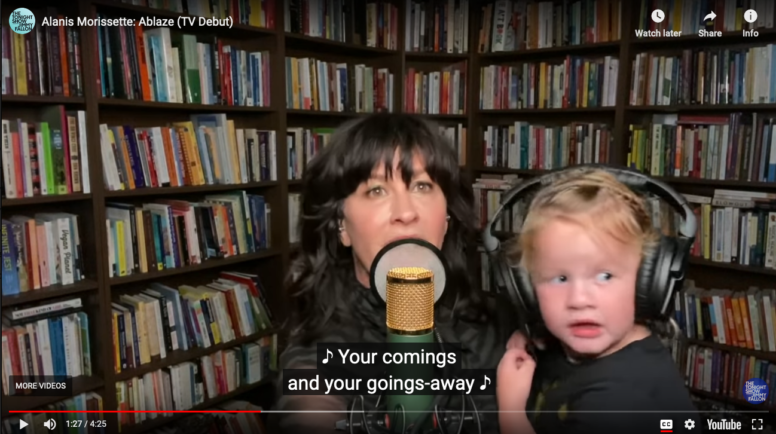
COVID-19 doesn’t care if you are a world-famous rock star debuting your critically-acclaimed album. For this television performance, Morrisette and her bandmates recorded separately in their own homes — just like the choir at my church. (I assume they used more advanced technology than the Acapella app our choir director uses.)
Like so many parents I’ve seen on video conference calls, Morrisette held a young child in her arms.
At least one news headline characterized this performance as “sabotaged” by the toddler who, it must be admitted, did cover her mommy’s mouth at one point while she was trying to sing!
I remembered how, before the quarantine, my 4-year-old son would saunter to the Communion table when I was offering the Prayer of Great Thanksgiving and tug on my robe. He wanted to show me the picture he had just crayoned.
When we are young, none of us really understand what our parents do. We don’t care about their titles or accomplishments, their public duties or performances.
But even as babies, we are intimately, exquisitely aware of how caregivers make us feel in the moment.
While the lyrics to the song “Ablaze” are beautiful, Morrisette embodied poetry in her wordless response to her daughter — her kind, patient smile. I was gobsmacked by her grace under duress, which brought tears to my eyes. I thought that’s how I want to be with my kids.
That’s how I want to treat everyone.
Our experiences are different, our lives are unique. No one is ever able to step fully into the shoes of someone else. But we all know what it is like to suffer. And we all know the difference between being dismissed, diminished and shamed versus embraced, included and loved.